

tarboat's photos
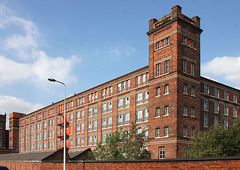
Bee Hive No.2 Mill
| |
|
|
Owned by the Bee Hive Spinning Co Ltd of Great Lever, Bolton, the No.2 Mill was built as an expansion of the business in 1902. The mills closed for cotton spinning in 1967 and subsequently became used for mail order warehousing and distribution. The adjacent No.1 mill was burned down in an arson atack in August 2019 and although both mills were listed Grade II they were rapidly demolished to make way for a housing development.
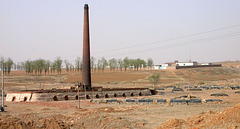
Hoffmann
| |
|
|
|
A typical brickworks of the type seen in northern China with a large Hoffmann type kiln and stacks of green bricks covered against frost. A view from the train not too far from Jinzhou.

Four in a row
| |
|
|
Four blast furnaces (named after English Queens) at the Scunthorpe steelworks. The largest and most recent one on the right is Queen Victoria.
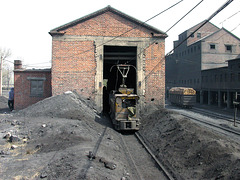
At the tippler house
| |
|
|
Electric locomotive hauling tubs from the tippler house at Zaojiatun, Nanpiao. This narrow gauge system serves a mine some distance to the west of the standard gauge line.

Pacer on the loose
| |
|
|
The Pacers soldier on to provide more socially distanced space for passengers. This pairing with a 150 at the Goyt viaduct, Marple, was on a service from Rose Hill. The driver gave us a nice fanfare on the horn as they passed.
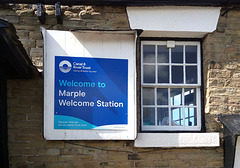
Welcome welcome
| |
|
I visited the locks at Marple on the Peak Forest Canal today. The sheer number of large blue signs erected by the Canal and River Trust was astonishing, I have never been welcomed to so many things in one morning and this included a picnic table! The whole lot jarred very badly with the historic structures and added little or no value to the experience.
I already know that this is the Peak Forest Canal, Marple Locks and a picnic table so don't need loads of money wasting on signs to welcome me to them. On the other hand I have no idea what a Welcome Station might be, but it clearly needs a big sign on a historic building to ensure that we know where it is so that we can be welcomed to it. Presumably some manager has been tasked with ensuring full and effective corporate branding in all directions.
Union Bank
| |
|
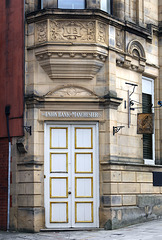
Former Union Bank Of Manchester premises on Bridge Street in Stockport.
The Union Bank was an early joint stock bank in the industrial heartland of Lancashire, established in 1836 with a capital of £6 million divided into 24,000 shares of £25 each. Although the original intention of the Union Bank was to confine itself to Manchester, after twenty years this policy was changed, and its first branch opened at Knutsford in 1856. The bank flourished with the growth of industry and acquired several smaller banks in Lancashire, Cheshire and Yorkshire. It became an affiliated bank within the Barclays Group in 1919, when 99% of its capital was acquired under an arrangement whereby Union Bank shareholders were given shares in Barclays to replace their Union Bank shares. This was Barclays' last major acquisition before the Treasury put a block on major banking mergers in 1920. The Union Bank continued to be managed and marketed separately until 1940 when it was fully absorbed into Barclays.
No empties
| |
|
|
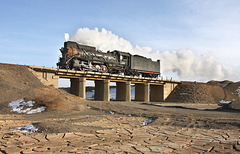
A JS class locomotive heads back light engine from the exchange sidings on the Sandaoling Coal Railway after dropping off a load of full wagons.
Market Buildings
| |
|
|
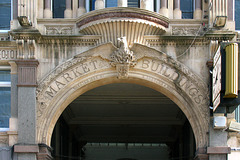
Solomon Andrews (5 April 1835 - 9 November 1908) was an entrepreneur and head of the Solomon Andrews and Son bus and tram-operating company, based in Cardiff. In addition to his transport interests he also developed a number of properties in Cardiff.
In 1884 he constructed the Market Buildings in St Mary Street, Cardiff at a cost of some £12,000. Sadly this building was destroyed by fire in June 1885, and it had been replaced with this structure by September 1886, the new building being constructed with eight-inch-thick concrete flooring to prevent further fires. It was also decorated and inscribed to ensure that the developer would be remembered.
Bryn-yr-ardd kiln
| |
|
|
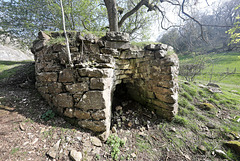
There are many old disused limekilns around North Wales but their condition is rapidly deteriorating. This Denbighshire example is suffering from the tree growing out of the pot which will eventually break it down completely.
Under the wires
| |
|
|
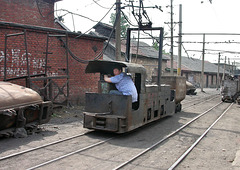
Surface transport at Mine No.2 in Pingdingshan uses an overhead wire electric system with this locomotive. At least the live wire was a bit higher than on many of these systems.
Ropeway remains
| |
|
|
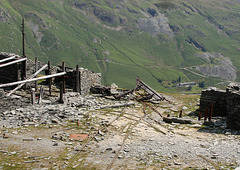
Mandalls Slate Co Ltd worked a number of quarries on the slopes of Coniston Old Man. The main processing area was the mill at Saddlestone to where the slate 'clogs' were brought down by an aerial ropeway.
Remains of the ropeway are still evident right up the hill with both fixed and moving ropes lying on the ground. The collapsed wooden framework was the start of the next flight of the ropeway.
Flash!
| |
|
|
|
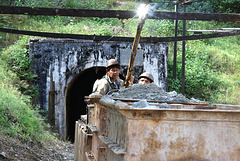
Sparks fly as an overhead wire electric locomotive brings tubs of ore out of the tunnel at Wallah Gorge leading from the Burma Mines Tiger Tunnel workings to the tippler and loading bunkers.
Blizzard conditions
| |
|
|
|
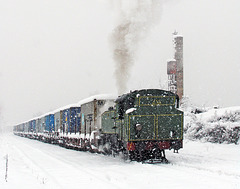
62-638 goes about its duties at the Lukavac soda ash factory in Bosnia-herzegovina. We only had permission for the one visit into the works and the weather conditions proved to be extremely challenging.
Back to Bewdley
| |
|
|
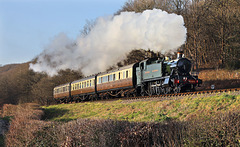
The large prairie tank is seen with its train at Northwood as it heads back to Bewdley on The Severn Valley Railway.

Kostolac power station
| |
|
|
|
Kostolac 'A' power station is operated by Elektroprivreda Srbije (EPS) and comprises two units built in 1967 and 1980 with a capacity of 100 Mw and 125 MW respectively. The locomotives were originally supplied by the United Nations Relief and Rehabilitation Administration to Yugoslavia after WW2. They are working on the line from the Klenovic opencast mine to the power station.
Ready to go
| |
|
|
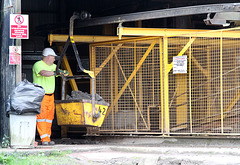
Bucket 42 is on the rail and ready for launch at the top of the Claughton Brickworks aerial ropeway. The launcher is waiting for an empty bucket to reach a certain point on its way up before sending this full bucket of shale along the rail and onto the rope. This ensures that the load on the rope is kept evenly spaced and the speed correct as it operates entirely by gravity.
The bin is a bonus.
Accrington Station
| |
|
|
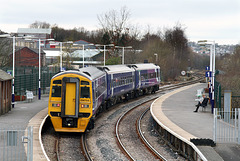
A three coach class 158 unit departs the rather basic station at Accrington on its way to Blackpool. I don't think that much remains of the original East Lancashire Railway structure constructed in 1848.
