

RHH's photos


05 Jul 2017
11 favorites
4 comments
Heartleaf Buckwheat
Photographed in Grand Teton National Park, this is the common wildflower, Heartleaf Buckwheat, Eriogonum compositum.

Chapel of the Tranfiguration
The Chapel of the Transfiguration is an Episcopal chapel in Grand Teton National Park that is still used for services. It predates the establishment of the national park.

Chapel of the Tranfiguration
This is the view from the window behind the altar in the Chapel of the Transfiguration in Grand Teton National Park. The chapel is still used for services and is often the site of weddings.

Evening Storm Over the Tetons
We parked the car at a viewpoint as a storm (a very windy storm) moved in over the Tetons at sunset. The highest peak in the photo is Grand Teton. This was taken on a 2017 trip to Wyoming and South Dakota.

05 Jul 2017
9 favorites
4 comments
Evening Storm Over the Tetons
Taken on a 2017 trip to Yellowstone, the Tetons and the Black Hills of South Dakota, this was a storm moving in over the mountains at sunset.

Grand Tetons
These peaks, all in the Teton Range, are from left to right Nez Perce, Teewinot, Grand Teton, Mount Owen and Mount St. John. The photo was taken from a viewpoint along the highway through the park and is from a 2017 trip to Yellowstone, Grand Teton and the Black Hills.
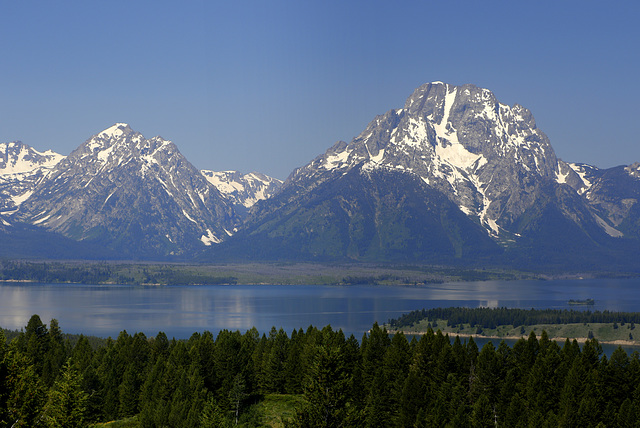
Mount Woodring and Mount Moran, Tetons
Taken from the Signal Mountain trail, the peaks are Mount St. John on the left and Mount Moran on the right in Grand Teton National Park.

Mining Equipment
This old mill used for crushing gold ore is located in Warm Spring Canyon in Death Valley National Park near Warm Spring Mining Camp. The camp was built in the early 1900's and was the center of gold and talc mining in the area. The old buildings from the camp still remain and the spring for which the area is named is in the hills behind the camp.

Warm Spring
Warm Spring is an important and historical spring in Death Valley National Park. It was originally the site of a winter camp of the Shoshone Indians. In the 1880's a ranch was established there which was later destroyed by flash floods. In the early 1900's a gold and talc mining camp was located there, of which the buildings still remain. The site is now the property of the National Park Service.
For a Guest account such as this, the number of content displayed is limited to a maximum of 100.
