

RHH's photos


Voringfossen
This is Voringossen (Voring Waterfall), the best-known waterfall in Norway, though only 83rd in height among Norway's many waterfalls. We stayed in a guest house that was just above the falls and walked to the falls that morning, though it was rainy and wet, spending most of the morning visiting the various viewpoints. Voringfossen drops 182 meters from the Hardangervidda Plateau into the Mabodalen Valley, a valley into which we would hike later in the day to see the falls from a different perspective. There is a hotel above the falls and a bridge from which the falls can be viewed, visible in the upiper left of the photo.
Our impressions of Norway were that it was (1) very beautiful especially the fjords and mountains, (2) very expensive, (3) full of waterfalls, and (4) full of tourists. We were at Voringossen early but by the time we left the parking lot on the other side of the falls was filled with vehicles and we found on our hikes that the best-known trails were also jammed with tourists. The weather was generally decent, though we had a lot of cloudy weather and little sunshine, but the day we visited Voringfossen was the only day we had a lot of rain and came back to our guest house wet.

Hardangervidda Guest House
This was the guest house we stayed in the first two nights in Norway. Conveniently it was just around the corner from Voringfossen (Voring Waterfall), the first of the places we wanted to visit in Norway. As with almost all the houses int he area, it had a sod roof.

Colorado River
This was the Colorado River at the end of the Bright Angel trail. We hiked from Indian Gardens to the River one of the days we spent backpacking in Grand Canyon. This is a relatively open and quiet part of the river and a place where rafting groups usually stop, often letting passengers off and picking up new passengers. The photo was taken by our daughter.

The Trail
After backpacking into Grand Canyon and setting up camp at Indian Gardens we spent a day hiking down to the Colorado River along the lower part of the Bright Angel trail. This was part of the trail and shows how steep it was in places. Part of the trail shown, the part with the switchbacks, is called the Devil's Corkscrew.
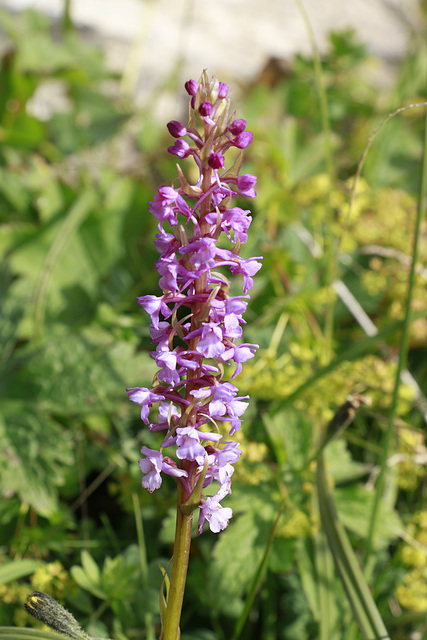
Chalk Fragrant Orchid
Part of our recent trip to Norway was a hike to Trolltunga (Troll's Tongue). This popular hiking destination is east of Bergen and we spent a day hiking there. This native orchid was one of the wildflowers we saw along the way and I've identified it as Gymnadenia conopsea, the Chalk Fragrant Orchid.

Purple Gentian
This Purple Gentian, Gentiana purpurea, was photographed along the Trolltunga trail in Norway. Trolltunga is a popular hiking destination near Bergen.

Og Lake and Mount Assiniboine
This photo was taken on a recent backpacking trip in the Canadian Rockies, in Mount Assiniboine Provincial Park in British Columbia. We were coming to the end of our second day, and our destination, Lake Og, was visible as we hiking out of the Valley of Rocks, crossed the last ridge and descended to the lake. The trail is visible in the lower right and we would camp on that side of the lake for a night before continuing to Mount Assiniboine and Magog Lake, our final destination.

Mount Assiniboine
After two tough days of backpacking in Mount Assiniboine Provincial Park we camped at Og Lake with Mount Assiniboine, the Matterhorn of the Rockies, looming over the other peaks. The person is my grandson, Cole, and when the photo was taken we were crossing the last ridge before Og Lake and our campground.

Giant's Causeway
These are some of the 40,000 basalt columns that make up the main formations at Giant's Causeway. The Causeway is on the north coast of County Antrim in Northern Ireland and is a popular tourist destination. Interestingly, when we lived in Northern Ireland in the 90's there were many fewer visitors, no visitors' center and no fees. Now there is huge visitors' center, busses to the Causeway, and parking fees to accommodate the thousands of visitors. The name refers to an Irish legend about the formation of the Causeway by a giant named Finn McCool - according to the legend he tore up and threw into the sea massive chunks of the coast in order to make a causeway to Scotland (which has similar coastal formations) so that he could fight the Scottish giant Benandonner. We were at the Causeway twice during our recent trip, once by way of a Sunday walk and a second time to accommodate a visitor.
