

.:madworm:.'s photos
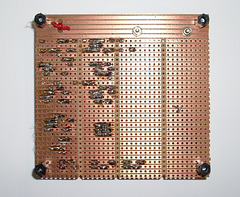
Water level sensor
| |
|
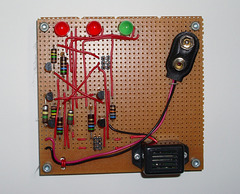
Water level sensor
| |
|
Quick hack. Detects low/high/normal water level and indicates it using 3 LEDs. I didn't calculate any resistor values, pure trial and error. Some of these just work as inverters, so the LEDs light up in the right way.
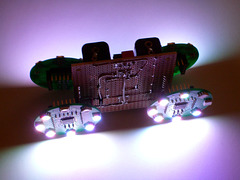
Almost looks like a little car
| |
|
4 times the fun. I need a cheep source of these SMD RGB LEDs. I don't feel like buying a full reel yet.

Tektronix 314 - back cover removed
| |
|
I heard a strange noise when I used it the last time. Something was sliding back and forth in there. Still I used it last time. After removing the back cover it turned out that 2 metal screws were completely loose.
As you can see in the photo, they could have shorted out quite a lot of things in there. Call me stupid.
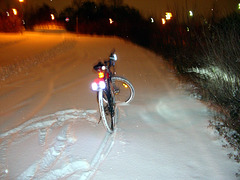
Test ride under harsh conditions
| |
|
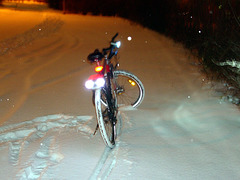
Test ride under harsh conditions
| |
|
Now this bike should be clearly visible at night. The next step will be a bigger headlight with more "bang".
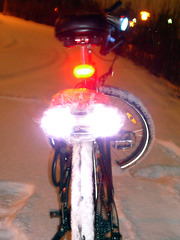
Test ride under harsh conditions
| |
|
"Can you see me now ?"
And before you post a comment regarding the illegal-ness of white taillights, read this .
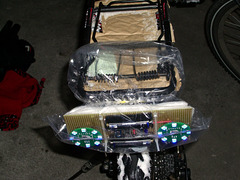
Improvised mudguard
| |
|
Plastic bags have many applications, just like rubber bands.
After taking off the bag again, the rubber bands holding it in place just vanished! I've searched every pocket in my jacket, the floor, you name it. A rubber band eating 'thing' is down there.
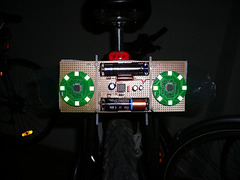
Pimped tail lights
| |
|
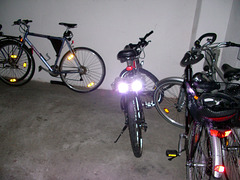
2x RGB LED Ring , 2x AA, 1x MAX756, 1x 1N5817, 1x 22µH 3A, 1x 220µF, 2x 47µF, 1x 100nF and lots of patience.
No test drive yet. It has snowed a lot and it feels like -20°C outside. My fingers almost fell off.
And the best thing, as usual, it works with the Arduino IDE. Just pull off the cpu modules and reprogram them as you like. A 6pin FTDI compatible header is on their backsides. There's also an ICSP header, but that can only be used once to program a bootloader. After that MOSI/MISO/SCK are used for the LEDs (whole PORTB of the chip). The backplane provides power (5V) and a common bus consisting of 2 GPIO pins and of course the I2C lines. In this case I use one line for a trivial syncing routine. The boards run with the internal oscillator and that seems to vary quite a low between these two chips. Without syncing after each run, there would be significant dephasing.
Now I should really get some mudguards. Getting a wet but is one thing, but deliberately exposing hand-made electronics to a mixture of salty, dirty and half molten snow is unheard of.
Pimped tail lights
| |
|
No test drive yet. It has snowed a lot and it feels like -20°C outside. My fingers almost fell off.

Step-up converter with LT1618
| |
|
The current sensing resistor is still missing as I couldn't find 0.22Ω anywhere, but the chip also has adjustable output voltage support. I just measured the LED current and adjusted the voltage. That's not the right way, but this was an "emergency build" ;-)
Edit: The [expletive deleted] chip is dead !
XMAS time
MSOP10/TSSOP8 - DIP adapters
| |
|
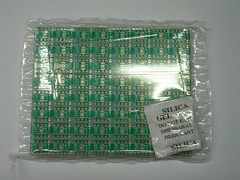
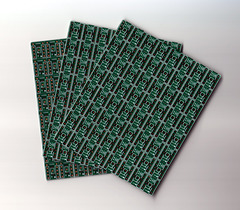
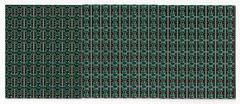
The boards are scored. I didn't explicitly order it that way, but they snap off very easily. At first glance I didn't see the grooves, so that was a positive surprise! I had already thought about using the mini mill to cut these out. Pure horror. I probably would have had to use a 0.5 or even 0.3mm tungsten carbide mill, and these break very easily.
MSOP10/TSSOP8 - DIP adapters
| |
|
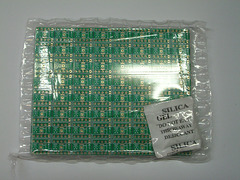
The boards are scored. I didn't explicitly order it that way, but they snap off very easily. At first glance I didn't see the grooves, so that was a positive surprise! I had already thought about using the mini mill to cut these out. Pure horror. I probably would have had to use a 0.5 or even 0.3mm tungsten carbide mill, and these break very easily.
MSOP10/TSSOP8 - DIP adapters
| |
|
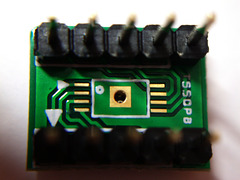
MakePCB have taken their time - as usual. Excellent quality though and affordable.
Luckily the panels are scored. Otherwise I'd have payed for quite expensive coasters.
MSOP10/TSSOP8 - DIP adapter
MSOP10/TSSOP8 - DIP adapters
| |
|
