


University of Pennsylvania Museum

The University of Pennsylvania Museum of Archeology and Anthropology, commonly called The University Museum, is an archaeology and anthropology museum that is part of the University of Pennsylvania in University City, Philadelphia, Pennsylvania. Text excerpted from: en.wikipedia.org/wiki/University_of_Pennsylvania_Museum_o...
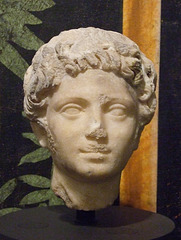
Marble Portrait of a Youth in the University of Pe…
| |
|
Marble Portrait of a Youth
Probably from Cyprus
2nd- 3rd century AD
# MS 5702
This portrait of a teenage boy has soft fuzzy sideburns, as if to suggest the beginnings of a beard. He represents an unknown Cypriot youth of the period of Roman domination of the island of Cyprus.
Text from the U. Penn. Museum label
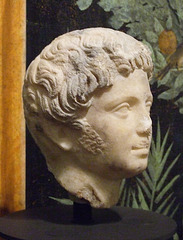
Marble Portrait of a Youth in the University of Pe…
| |
|
Marble Portrait of a Youth
Probably from Cyprus
2nd- 3rd century AD
# MS 5702
This portrait of a teenage boy has soft fuzzy sideburns, as if to suggest the beginnings of a beard. He represents an unknown Cypriot youth of the period of Roman domination of the island of Cyprus.
Text from the U. Penn. Museum label
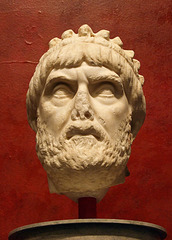
Marble Head of a Priest of the Imperial Cult in th…
| |
|
Marble Head of a Priest of the Imperial Cult
Possibly from Caesarea (Kayseri), Turkey
# MS 215
Tiny busts of 11 divinities decorate the figured crown. This type of crown seems to be most at home in Asia Minor where it is frequently but not exclusively associated with the imperial cult.
Text from the University of Pennsylvania Museum label.
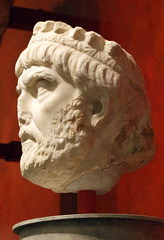
Marble Head of a Priest of the Imperial Cult in th…
| |
|
Marble Head of a Priest of the Imperial Cult
Possibly from Caesarea (Kayseri), Turkey
# MS 215
Tiny busts of 11 divinities decorate the figured crown. This type of crown seems to be most at home in Asia Minor where it is frequently but not exclusively associated with the imperial cult.
Text from the University of Pennsylvania Museum label.
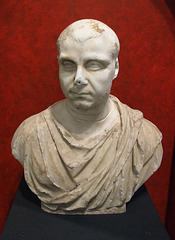
Marble Funeral Portrait of a Middle-Aged Man in th…
| |
|
Marble Funeral Portrait of a Middle-Aged Man
AD 240
# MS-250
The back of the head is summarily carved and the scale of this portrait is less than life-size. This suggests that the piece was displayed in a shallow niche inside a communal tomb known as a columbarium (dovecote), used for housing the cremated remains of the dead.
Text from the U. Penn. Museum label.
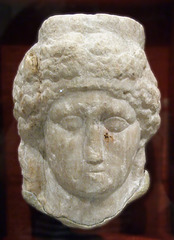
Marble Head of Cybele(?) in the University of Penn…
| |
|
Marble Head of Cybele (?)
Roman Imperial period
# L-123-24
This head is a poorly modeled provincial work with flattened features and staring eyes. The abundant hair flowing to either side of the forehead and face are characteristic of Magna Mater's Asia Minor images. While the crown has been deliberately trimmed down, the back appears to have been attached once to a votive relief.
Text from the U. Penn. Museum label.
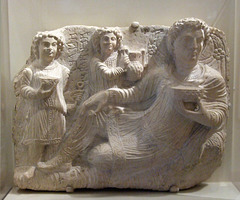
Palmyrene Limestone Loculus Cover in the Universit…
| |
|
Limestone Loculus Cover
Palmyra
2nd century AD
# CBS 8902
This cover depicts a youth reclining with a vase in his left hand. Two males in smaller scale, perhaps slaves, stand by holding an amphora and a cup. Their rigidly frontal poses and stiff figural style are hallmarks of the provincial Roman style in Syria.
Text from the U. Penn. Museum label.
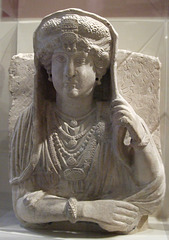
Palmyrene Limestone Loculus Cover in the Universit…
| |
|
Limestone Loculus Cover
Palmyra
2nd century AD
# CBS 8904
This bust of a woman of high status, perhaps a priestess, is adorned with an elaborate headdress and jewelry. Palmyra's inhabitants spoke Aramaic and Greek in the 2nd century AD, when this cover was carved. The "Aramaic" epitaph here is false, however. It was added in modern times to increase its market value.
Text from the U. Penn. Museum label.
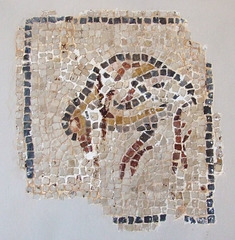
Bird Mosaic Floor Fragment in the University of Pe…
| |
|
Fragment of a Mosaic Floor
Bird
Syria
4th-5th century AD
# 68-39-1
Text from the U. Penn. Museum label.
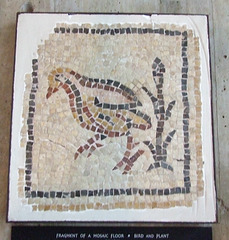
Bird and Plant Mosaic Floor Fragment in the Univer…
| |
|
Fragment of a Mosaic Floor
Bird and Plant
Syria or Turkey
4th-5th century AD
#69-27-2 (?)
Text from the U. Penn. Museum label.
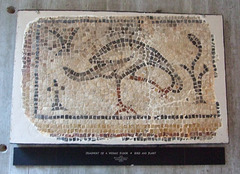
Bird and Plant Mosaic Fragment of a Floor in the U…
| |
|
Fragment of a Mosaic Floor
Bird and Plant
Syria
4th-5th century AD
Anonymous Donor
#68-39-3
Text from the U. Penn. Museum label.
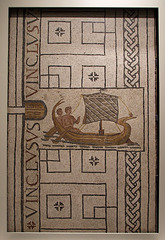
Roman Figural Mosaic in the University of Pennsylv…
| |
|
Figural Mosaic
Perhaps from Utica, Tunisia
First half of the 3rd century AD
# MS 4012
An intriguing puzzle, this mosaic appears to be an adaptation of a now lost mosaic from Hadrumentum (Sousse). It probably came from the Roman Tunisian town of Utica and represents Theseus sailing away from the Cretan labyrinth, here mostly missing. Its inscription, VINCLVSVS, repeated twice, remains controversial.
Text from the U. Penn. Museum label.
and
Mosaic Flooring
Mosaic flooring, the decorative equivalent of carpeting, was in near universal use throughout the Roman Empire. The Romans took the concept from the Greeks who made mosaics of carefully selected natural pebbles. In the 3rd- 2nd centuries BC this art form was modified through the use of tesserae- stones, glass, or glazed terracotta cubes cut to uniform sizes. Tessellated mosaics became the norm in the Roman period.
The fragments shown here illustrate several techniques of Roman mosaic.
Text from the U. Penn. Museum wall plaque.
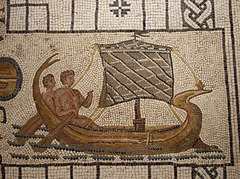
Detail of a Roman Figural Mosaic in the University…
| |
|
Figural Mosaic
Perhaps from Utica, Tunisia
First half of the 3rd century AD
# MS 4012
An intriguing puzzle, this mosaic appears to be an adaptation of a now lost mosaic from Hadrumentum (Sousse). It probably came from the Roman Tunisian town of Utica and represents Theseus sailing away from the Cretan labyrinth, here mostly missing. Its inscription, VINCLVSVS, repeated twice, remains controversial.
Text from the U. Penn. Museum label.
and
Mosaic Flooring
Mosaic flooring, the decorative equivalent of carpeting, was in near universal use throughout the Roman Empire. The Romans took the concept from the Greeks who made mosaics of carefully selected natural pebbles. In the 3rd- 2nd centuries BC this art form was modified through the use of tesserae- stones, glass, or glazed terracotta cubes cut to uniform sizes. Tessellated mosaics became the norm in the Roman period.
The fragments shown here illustrate several techniques of Roman mosaic.
Text from the U. Penn. Museum wall plaque.

Opus Alexandrinum Mosaic in the University of Penn…
| |
|
Opus Alexandrinum Mosaic
Rome
4th century AD
# MS 4014
This flooring is made up of thin squares of red and green porphyry and slivers of white marble set to create a roughly checkerboard effect. This technique is called Opus Alexandrinum.
Text from the U. Penn. Museum label.
and
Mosaic Flooring
Mosaic flooring, the decorative equivalent of carpeting, was in near universal use throughout the Roman Empire. The Romans took the concept from the Greeks who made mosaics of carefully selected natural pebbles. In the 3rd- 2nd centuries BC this art form was modified through the use of tesserae- stones, glass, or glazed terracotta cubes cut to uniform sizes. Tessellated mosaics became the norm in the Roman period.
The fragments shown here illustrate several techniques of Roman mosaic.
Text from the U. Penn. Museum wall plaque.

Marble God or Divinized Emperor in the University…
| |
|

Bull Head from the Sound Box of a Lyre in the Univ…
| |
|
Jump to top
RSS feed- Latest items - Subscribe to the latest items added to this album
- ipernity © 2007-2025
- Help & Contact
|
Club news
|
About ipernity
|
History |
ipernity Club & Prices |
Guide of good conduct
Donate | Group guidelines | Privacy policy | Terms of use | Statutes | In memoria -
Facebook
X
