The University of Pennsylvania Museum of Archeology and Anthropology, commonly called The University Museum, is an archaeology and anthropology museum that is part of the University of Pennsylvania in University City, Philadelphia, Pennsylvania. Text excerpted from: en.wikipedia.org/wiki/University_of_Pennsylvania_Museum_o...
The University of Pennsylvania Museum of Archeology and Anthropology, commonly called The University Museum, is an archaeology and anthropology museum that is part of the University of Pennsylvania in University City, Philadelphia, Pennsylvania. Text excerpted from: en.wikipedia.org/wiki/University_of_Pennsylvania_Museum_o...
Lion Head Finial for an Arm of a Chair
Silver, shell, and lapis lazuli
2550-2450 BCE
Ur, Iraq (PG800, Pit Floor)
# B17064
Text from the U. Penn Museum label.
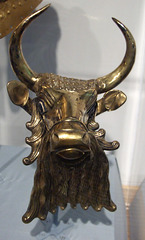
Harp Ornament in the University of Pennsylvania Mu…
Harp Ornament
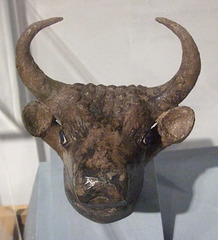
Electrotype
2550-2450 BCE
Ur, Iraq (PG1237)
# 31-18-10
Woolley had a series of electrotype reproductions made of all of the gold objects from the Royal Cemetery. The originals of the pieces seen here are in the Iraq Museum, Baghdad. The bull's head belonged to an elaborately decorated lyre from PG1237. The helmet was discovered in an extremely lavish burial, PG755. Several objects in the tomb mention Meskalamdug. A cylinder seal of Meskalamdug, the king, was found in another royal tomb. There is disagreement over whether or not the burial in PG755 was the king of that name.
Text from two U. Penn. Museum labels.
Bull Head from the Sound Box of a Lyre in the Univ…
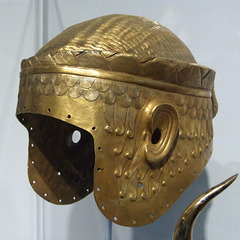
Helmet
Electrotype
2550-2450 BCE
Ur, Iraq (PG755)
# 29-22-2
Woolley had a series of electrotype reproductions made of all of the gold objects from the Royal Cemetery. The originals of the pieces seen here are in the Iraq Museum, Baghdad. The bull's head belonged to an elaborately decorated lyre from PG1237. The helmet was discovered in an extremely lavish burial, PG755. Several objects in the tomb mention Meskalamdug. A cylinder seal of Meskalamdug, the king, was found in another royal tomb. There is disagreement over whether or not the burial in PG755 was the king of that name.
Text from two U. Penn. Museum labels.
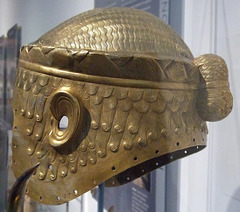
Sumerian Helmet in the University of Pennsylvania…
Helmet
Electrotype
2550-2450 BCE
Ur, Iraq (PG755)
# 29-22-2
Woolley had a series of electrotype reproductions made of all of the gold objects from the Royal Cemetery. The originals of the pieces seen here are in the Iraq Museum, Baghdad. The bull's head belonged to an elaborately decorated lyre from PG1237. The helmet was discovered in an extremely lavish burial, PG755. Several objects in the tomb mention Meskalamdug. A cylinder seal of Meskalamdug, the king, was found in another royal tomb. There is disagreement over whether or not the burial in PG755 was the king of that name.
Text from two U. Penn. Museum labels.
Plaque with Winged Sphinx in the University of Pen…
Plaque- Winged Sphinx
Ivory
Nimrud, Iraq
8th century BC
# 65-3-2
Phoenician ivory carving was widely exported. This piece of Phoenician-style ivory furniture inlay was found at the Assyrian capital of Nimrud in northern Iraq.
Text from the U. Penn. Museum label.
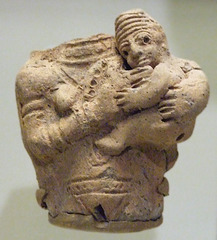
Figurine Fragment of a Mother and Child in the Uni…
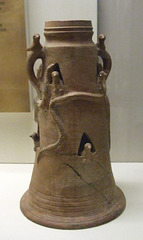
Offering Stand
Ceramic
Beth Shean, stratum V, south temple
Iron IB, 1150-1000 BCE
# 29-103-830
This offering stand is decorated with birds and snakes. These animals commonly appear on ritual objects throughout the eastern Mediterranean, though their symbolic significance remains unknown.
Text from the U. Penn. Museum label.
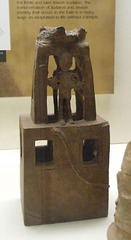
Offering Stand in the Form of a Building in the Un…
Offering Stand in the Form of a Building
Ceramic
Beth Shean, stratum V, south temple
Iron IB, 1150-1000 BCE
# 29-103-807
Offering stands were used to hold bowls in which food, oils or incense were placed as offerings, and sometimes burned, during temple rituals.
Text from the U. Penn. Museum label.
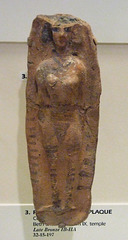
Female Figurine Plaque in the University of Pennsy…
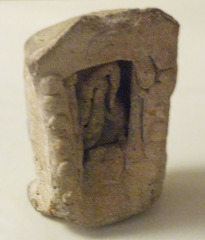
Model Shrine
Ceramic
Amathus, Cyprus
ca. 600 BC
# MS 156
Model shrines such as this one are associated with the Phoenicians and their expansion westward into the Mediterranean. Note the typical Phoenician stylistic features like the crescent moon and sun-disk above the doorway and the proto-Aeolic column capitals.
Text from the U. Penn Museum label.
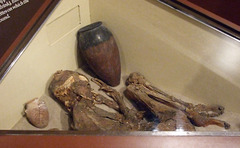
Egyptian Predynastic Burial Reconstruction in the…
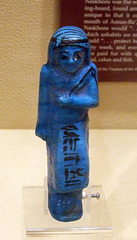
Ushabti for the Army Commander and High Priest of Amun, Pinudjem II
Faience
height, 0.18 meter
Thebes (in Upper Egypt)
21st Dynasty, circa 969 BC
# E595
Pinudjem II was one of the last of the lineage descended from Herihor. When Pinudjem II died, his mummy was placed in the old tomb of queen Inhapi, in the cliffs of Deir-el-Bahri. King Amunhotep I had already been moved to shelter in that tomb, and now the officials of the Theban cemetery became sufficiently confident about the tomb's security that they added the mummies of Seti I and Ramesses II. Within a few years, some forty other royal and priestly mummies were added to the cache.
Text from the U. Penn. Museum label.
Ushabti for the Steward Mah in the University of P…
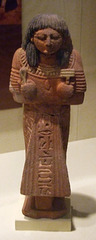
Ushabti for the Steward, Mah
Sandstone
height, 0.35 meter
Anibeh (in Nubia); excavated from tomb SA 14
19th Dynasty, circa 1275 BC
# E11092
The artistic quality of this ushabti is extremely high: despite the granular nature of sandstone, a great deal of minute detail was maintained in the carving. The inscription on the figure reads, "May Osirus, the deputy of Mah, be illuminated: he says, may your sight be opened, may you see the sun disc; may you worship Re' in life; may you be summoned in the cemetery; may you wander the hills of Tjaumut; may you transverse the mountain of the upper cemetery; may you behold the hidden cavern; may you sit on the throne in the sacred land, like the great crews (of the solar barque of Re'); the steward Mah."
Text from the U. Penn. Museum label.
Faience Canopic Jar in the University of Pennsylva…
Canopic Jar
Faience
height, .30 meter
Sediment (in lower Egypt)
19th Dynasty, circa 1250 BC
# E14227a,b
The jackal-headed Duamutef was the guardian of the stomach, after it had been eviscerated and mummified by the embalmers.
Text from the U. Penn Museum label
Help & Contact|Club news|About ipernity|History|ipernity Club & Prices|Guide of good conduct Donate|Group guidelines|Privacy policy|Terms of use|Statutes|In memoria