


University of Pennsylvania Museum

The University of Pennsylvania Museum of Archeology and Anthropology, commonly called The University Museum, is an archaeology and anthropology museum that is part of the University of Pennsylvania in University City, Philadelphia, Pennsylvania. Text excerpted from: en.wikipedia.org/wiki/University_of_Pennsylvania_Museum_o...
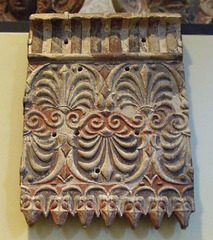
Etruscan Terracotta Revetment Plaque in the Univer…
| |
|
Terracotta Revetment Plaque
Caere (Cerveteri)
4th century BC
# MS1806
This large plaque was made to cover and hang below a horizontal beam. It probably comes from the same temple with the satyr and maenad antefixes mounted above. Its painted surface shows a repeated floral pattern. Several holes, for use in attaching the plaque to the beam, are preserved.
Text from the U. Penn. Museum label

Etruscan Terracotta Antefix in the University of P…
| |
|
Terracotta antefixes
Corneto (Tarquinia)
Late 6th- early 5th century BC
# MS 1821, MS 1828
These two antefixes are from a deposit at Corneto, the countryside of ancient Tarquinii. One, with finely painted surface, shows the popular satyr head. The other shows the bearded, bullish river god Acheloos.
Text from the U. Penn. Museum label.
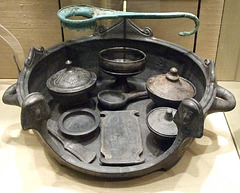
Etruscan Model Brazier Set in the University of Pe…
| |
|
Etruscan Brazier Set
Chiusi
6th century BC
# MS 1355-63
Sixth century tombs at Chiusi often held imitation sets of banquet utensils, made in bucchero pottery instead of bronze or silver. This one holds a ladle, a spatula, a palette or meat tray, a footed bowl, three covered bowls, and a shallow dish.
Text from the U. Penn. Museum label.
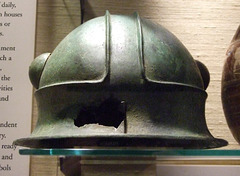
Etruscan Bronze Bell Helmet in the University of P…
| |
|
Bronze Bell Helmet
6th century BC
# MS 1607
Etruscan men had to defend their cities from invading Gauls, Italic tribes, and Romans. The design of armor changed constantly in response to new weapons and enemies' fighting styles: this bell helmet was developed by the famous Picene tribesmen of the Adriatic coast, who were later recruited by the Roman army.
Text from the U. Penn. Museum label.

Etruscan Negau Helmet in the University of Pennsyl…
| |
|
Bronze “Negau” Helmet
5th century BC
# MS 1609
Arms and armor were exported from Vulci and Arezzo to Europe. Etruscan-made “Negau” (named for the find spot in modern Slovenia) helmets were inspired by the armor of marauding Gauls. The helmets were eventually shipped north from Etruria by early “arms dealers” to the barbaric tribes of Gaul, Germany, and Scandinavia. This helmet has fine horse and lion protomes which probably helped anchor leather straps.
Text from the U. Penn. Museum label
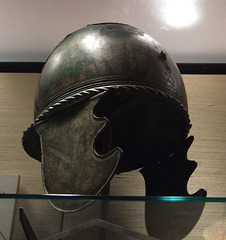
Etruscan Jockey Cap Helmet in the University of Pe…
| |
|
Bronze Jockey-type Helmet
4th century BC
# MS 1606
The design of this Etruscan helmet with cheek protectors was taken over from the Gauls during the 4th century BC. It was later adopted by the Romans as well.
Text from the U. Penn. Museum label.
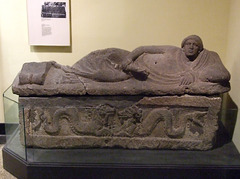
Etruscan Sarcophagus with a Reclining Man in the U…
| |
|
Sarcophagus with Reclining Man
Civita Musarna
3rd-2nd century BC
# MS 3488a,b
The lid shows a man reclining as if at a banquet, still the favorite symbol for an important, socially connected personage. He holds an unidentified object. Other urns and sarcophagi of this period show men with writing tablets, linen books, or cult objects. The sea-monsters that decorate the chest were chosen as supernatural guardians. They symbolize the growing trend in Etruscan art toward simple, repeated images and away from complicated narrative with human figures. (The lid and the chest probably do not belong together.)
Text from the U. Penn. Museum label.
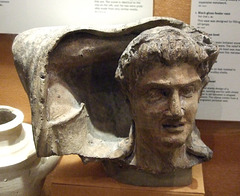
Head from a Terracotta Sarcophagus in the Universi…
| |
|
Head from a Terracotta Sarcophagus
Corneto (Tarquinia)
3rd century BC
# MS 1817
This fragmentary head of a youth is all that remains of a terracotta sarcophagus and its lid. Originally, the lid showed him as if sleeping, with his right arm behind his head in a swathe of bedcovers. The open mouth and deep-set eyes are typical of the Hellenistic style in Etruria.
Text from the U. Penn. Museum label.
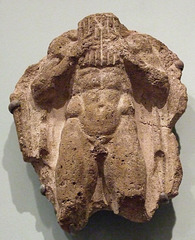
Terracotta Satyr Antefix from Minturnae in the Uni…
| |
|
Terracotta Satyr Antefix from Minturnae
The Forum Portico
2nd century BC
# 32-36-2
Attached to the end of a curved cover tile, this satyr playing his pan pipes was once part of a series of free-standing molded figures that ornamented the edge of the roof of the Republican forum's colonnaded portico.
Text from the U. Penn. Museum label.
and
Minturnae Excavations
The Museum excavated at Minturnae between 1931 and 1933, under the field direction of Jotham Johnson. Johnson cleared parts of Minturnae's walls and a significant part of its center, including the Republican forum with its three-sided portico and Capitolium, the Imperial forum, the Augustan theater, and five temples. As part of a division of finds the Museum received an important selection of marble sculptures, terracotta architectural decoration, pottery, and lamps.
The Museum was not the first to excavate at Colonia Minturnae. The site was initially explored by Domenico Venuri in 1787 and again by a Napoleonic-era Austrian general named Laval Nugent von Westmeath, who removed his finds to Zagreb. The Italian authorities carried out excavations in 1940 and from 1955 to the present. They have also undertaken the restoration of a number of monuments. Minturnae's finds are today found not only here in Philadelphia, but in Zagreb, the Naples Museum, and in the museum at the site.
Text from the U. Penn. Museum plaque.
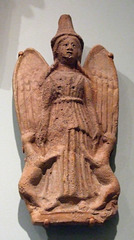
Mistress of Wild Animals Antefix from Minturnae in…
| |
|
Mistress of Wild Animals Antefix from Minturnae
Temple B
Late 1st century BC
# 32-36-14
Attached to a curved cover tile, this crudely provincial figure of a winged Mistress of Animals would have originally been painted. Attended by a conventionalized pair of rearing lionesses, she wears an outlandish pointed Anatolian hat.
Text from the U. Penn. Museum label.
and
Minturnae Excavations
The Museum excavated at Minturnae between 1931 and 1933, under the field direction of Jotham Johnson. Johnson cleared parts of Minturnae's walls and a significant part of its center, including the Republican forum with its three-sided portico and Capitolium, the Imperial forum, the Augustan theater, and five temples. As part of a division of finds the Museum received an important selection of marble sculptures, terracotta architectural decoration, pottery, and lamps.
The Museum was not the first to excavate at Colonia Minturnae. The site was initially explored by Domenico Venuri in 1787 and again by a Napoleonic-era Austrian general named Laval Nugent von Westmeath, who removed his finds to Zagreb. The Italian authorities carried out excavations in 1940 and from 1955 to the present. They have also undertaken the restoration of a number of monuments. Minturnae's finds are today found not only here in Philadelphia, but in Zagreb, the Naples Museum, and in the museum at the site.
Text from the U. Penn. Museum plaque.
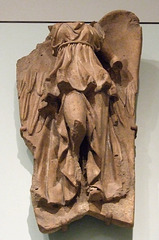
Terracotta Victoria Acroterion from Minturnae in t…
| |
|
Terracotta Victoria Acroterion from Minturnae
From a sacred well beside the Capitolium
2nd century BC
# 32-36-1
The plaque of this beautifully modeled figure of a winged victory is notched to sit on the apex of a pedimented roof. Its originally brightly painted surface has largely faded away.
Text from the U. Penn. Museum label.
and
Minturnae Excavations
The Museum excavated at Minturnae between 1931 and 1933, under the field direction of Jotham Johnson. Johnson cleared parts of Minturnae's walls and a significant part of its center, including the Republican forum with its three-sided portico and Capitolium, the Imperial forum, the Augustan theater, and five temples. As part of a division of finds the Museum received an important selection of marble sculptures, terracotta architectural decoration, pottery, and lamps.
The Museum was not the first to excavate at Colonia Minturnae. The site was initially explored by Domenico Venuri in 1787 and again by a Napoleonic-era Austrian general named Laval Nugent von Westmeath, who removed his finds to Zagreb. The Italian authorities carried out excavations in 1940 and from 1955 to the present. They have also undertaken the restoration of a number of monuments. Minturnae's finds are today found not only here in Philadelphia, but in Zagreb, the Naples Museum, and in the museum at the site.
Text from the U. Penn. Museum plaque.
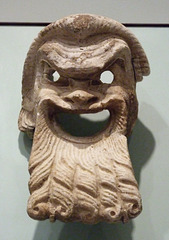
Comic Theatrical Mask from Minturnae in the Univer…
| |
|
Comic Theatrical Mask from Minturnae
From vaults under Temple L
Late 1st century BC- early 1st century AD
# 32-36-62
This marble mask is modelled after the stage masks made of lighter material worn by actual actors. Marble or bronze masks like this one often decorated the entrances of theaters. They also graced the interiors and formal gardens of Roman houses.
Text from the U. Penn. Museum label.
and
Minturnae Excavations
The Museum excavated at Minturnae between 1931 and 1933, under the field direction of Jotham Johnson. Johnson cleared parts of Minturnae's walls and a significant part of its center, including the Republican forum with its three-sided portico and Capitolium, the Imperial forum, the Augustan theater, and five temples. As part of a division of finds the Museum received an important selection of marble sculptures, terracotta architectural decoration, pottery, and lamps.
The Museum was not the first to excavate at Colonia Minturnae. The site was initially explored by Domenico Venuri in 1787 and again by a Napoleonic-era Austrian general named Laval Nugent von Westmeath, who removed his finds to Zagreb. The Italian authorities carried out excavations in 1940 and from 1955 to the present. They have also undertaken the restoration of a number of monuments. Minturnae's finds are today found not only here in Philadelphia, but in Zagreb, the Naples Museum, and in the museum at the site.
Text from the U. Penn. Museum plaque.
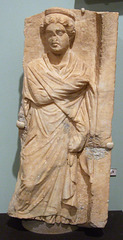
Marble Grave Relief in the University of Pennsylva…
| |
|
Marble Grave Relief
Athens
ca. AD 150
# 63-6-1
The deceased lady is shown in full frontal view. She wears a low polos headdress. It is likely that she has been intiated into the rites of Demeter / Ceres whose cult promised its followers a life after death. Her pose and dress are based on a familiar Greek prototype known as the the "small Herculaneum woman." The originally inscribed pediment and much of the frame are now missing.
Text from the U. Penn. Museum label.
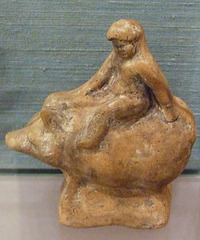
Terracotta Rattle with a Child Riding a Boar in th…
| |
|
Terracotta Rattle with a Child Riding a Boar
Possibly from Pompeii, Italy
1st century BC- 1st century AD
# 51-46-186
A small terracotta pellet inside the body of the boar makes the rattling noise.
Text from the U. Penn. Museum label.
Modern Copy of a Bronze Statue of a Woman from Her…
| |
|
Bronze Statue of a Woman
Modern copy of a Roman original of the 2nd-1st centuries BC
# MS3520
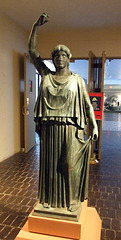
Like the two bronze figures in the outer lobby, this sculpture is a modern copy of one of the so-called dancers that flanked a long narrow pool in the center of a square courtyard in the Villa of the Papyri at Herculaneum, on the Bay of Naples, in Southern Italy. The villa, which gets its modern nickname from the hundreds of papyrus book rolls found there, belonged to a wealthy and cultured Roman, and the villa's courtyards are decorated with an elaborate sculptural program that expresses the sophisticated taste and interests of its owner.
Text from the U. Penn. Museum label.
Seated God with Lion in the University of Pennsylv…
| |
|
Seated God with a Lion
Roman Imperial period with restorations in Italy in the early 17th century or before
# MS 5483
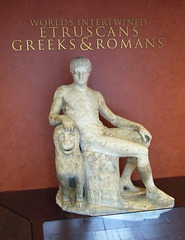
To judge by his youthful and idealized appearance and the panther skin draped over the rocky seat, and the lion, the seated figure is probably Dionysos. The statue was originally meant to be seen in the round and was probably a decorative piece for a Roman garden or villa. Sometime later, holes were cut through the neck of the lion and the back of Dionysos to create a fountain sculpture. The head of Dionysos, the muzzle of the lion, and fragments of the toes and fingers are restorations probably added in the 15th to early 17th centuries in Italy. The statue was purchased by the University of Pennsylvania Museum from a dealer in 1911 and has a pedigree that goes back until 1622. It illustrates how over the centuries interest in the classical world has waxed and waned, but continues to endure.
Text from the U. Penn. Museum label
Seated God with Lion in the University of Pennsylv…
| |
|
Seated God with a Lion
Roman Imperial period with restorations in Italy in the early 17th century or before
# MS 5483
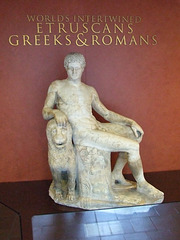
To judge by his youthful and idealized appearance and the panther skin draped over the rocky seat, and the lion, the seated figure is probably Dionysos. The statue was originally meant to be seen in the round and was probably a decorative piece for a Roman garden or villa. Sometime later, holes were cut through the neck of the lion and the back of Dionysos to create a fountain sculpture. The head of Dionysos, the muzzle of the lion, and fragments of the toes and fingers are restorations probably added in the 15th to early 17th centuries in Italy. The statue was purchased by the University of Pennsylvania Museum from a dealer in 1911 and has a pedigree that goes back until 1622. It illustrates how over the centuries interest in the classical world has waxed and waned, but continues to endure.
Text from the U. Penn. Museum label
Detail of the Seated God with Lion in the Universi…
| |
|
Seated God with a Lion
Roman Imperial period with restorations in Italy in the early 17th century or before
# MS 5483
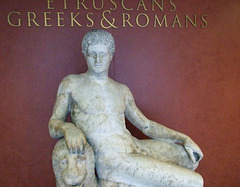
To judge by his youthful and idealized appearance and the panther skin draped over the rocky seat, and the lion, the seated figure is probably Dionysos. The statue was originally meant to be seen in the round and was probably a decorative piece for a Roman garden or villa. Sometime later, holes were cut through the neck of the lion and the back of Dionysos to create a fountain sculpture. The head of Dionysos, the muzzle of the lion, and fragments of the toes and fingers are restorations probably added in the 15th to early 17th centuries in Italy. The statue was purchased by the University of Pennsylvania Museum from a dealer in 1911 and has a pedigree that goes back until 1622. It illustrates how over the centuries interest in the classical world has waxed and waned, but continues to endure.
Text from the U. Penn. Museum label
Jump to top
RSS feed- Latest items - Subscribe to the latest items added to this album
- ipernity © 2007-2025
- Help & Contact
|
Club news
|
About ipernity
|
History |
ipernity Club & Prices |
Guide of good conduct
Donate | Group guidelines | Privacy policy | Terms of use | Statutes | In memoria -
Facebook
X
