

Indycaver (Norm)'s photos

Grandparent's Day
| |
|
|
|

Shredder Rides
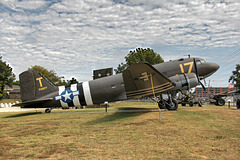
The Douglas C-47 Skytrain or Dakota
| |
|
|
|
The Douglas C-47 Skytrain or Dakota (RAF designation) is a military transport aircraft developed from the civilian Douglas DC-3 airliner. It was used extensively by the Allies during World War II and remains in front line service with various military operators to the present day.[2]
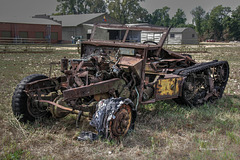
White Half-track
| |
|
|
|
The Carrier, Personnel Half-track M3, also known as the M3 Half-track, was an American armored personnel carrier widely used by the Allies during World War II and in the Cold War. Derived from the M2 Half Track Car, the slightly longer M3 was extensively produced, with about 15,000 units and more than 50,000 derivative variants manufactured (most of which were interim designs).
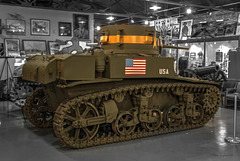
M3A1 Stuart
| |
|
|
|
The M3 Stuart, formally Light Tank M3, is an American light tank of World War II. It was supplied to British and Commonwealth forces under lend-lease prior to the entry of the U.S. into the war. Thereafter, it was used by U.S. and Allied forces until the end of the war.
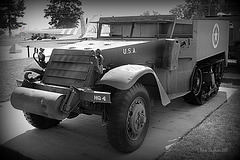
White M3 Half-track
| |
|
|
|
The Carrier, Personnel Half-track M3, also known as the M3 Half-track, was an American armored personnel carrier widely used by the Allies during World War II and in the Cold War. Derived from the M2 Half Track Car, the slightly longer M3 was extensively produced, with about 15,000 units and more than 50,000 derivative variants manufactured (most of which were interim designs).
The design based on the Citroen-Kegresse half-track. The developers attempted to use as many commercial parts as possible. There were also several dozen variants for different purposes. The M3 and its variants were supplied to the U.S. Army and Marines, as well as British Commonwealth and Soviet Red Army forces, serving on all major fronts throughout the war. Although at first unpopular, it was used by most of the Allies at some point in the war.
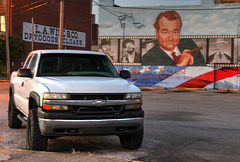
Hometown Boy
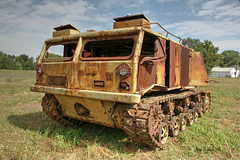
M4 Tractor
| |
|
|
|
The M4 was intended to tow three different artillery pieces: the 155mm gun, the 8in (203mm) howitzer and the 90mm anti-aircraft gun. The M4 HST also was designed to carry ammunition for these weapons in a box at the rear of the chassis. The ammunition box for the 155mm gun and 8in howitzer were the same externally, but had slightly different internal arrangements due to the size of the ammunition. The type for the 90mm anti-aircraft gun was slightly different due to the stowage method and had side-opening doors for access to the ammunition. Production of the M4 began in 1943 and a total of 5,552 were built through 1945 when the slightly improved M4A1 appeared. Towards the end of production, it was decided to use the M4 to support the new M40 155mm GMC and M43 8in HMC as an ammunition carrier in lieu of the M30 previously used with the M12 155mm GMC. These carried additional ammunition in the rear of the crew compartment in lieu of the crew seats and were designated as M4C. There were a number of production changes on the M4 from 1943 to 1945 including a revision of the openings on the rear of the hull for the winch, deletion of ammunition box vents, and the addition of a front mounted emplacement pintle on later production tractors.
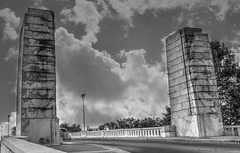
Gateway to the West
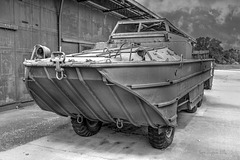
The DUKW
| |
|
|
|
The DUKW (colloquially known as Duck) is a six-wheel-drive amphibious modification of the 2-ton capacity CCKW trucks used by the U.S. military in World War II. Designed by a partnership under military auspices of Sparkman & Stephens and General Motors Corporation (GMC), the DUKW was used for the transportation of goods and troops over land and water. Excelling at approaching and crossing beaches in amphibious warfare attacks, it was intended only to last long enough to meet the demands of combat. Surviving DUKWs have since found popularity as tourist craft in marine environments.
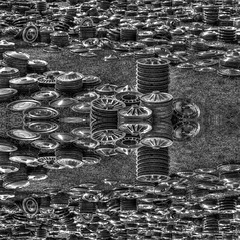
Mirror Challenge

Train at Dusk
| |
|
|
|
Freight train crossing the Wabash River from Vincennes, Indiana to Illinois. Picmonkey collage exercise for the Sunday Challenge.
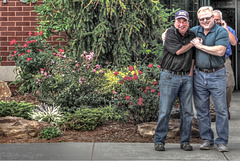
Scot and Bob
| |
|
|
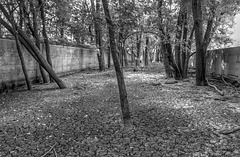
Abandoned Locks

Cannonball Bridge
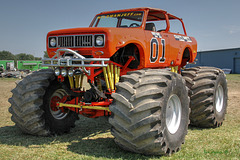
Honda Eater
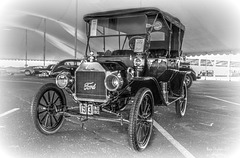
1913 Model T Ford Touring Car
| |
|
|
|
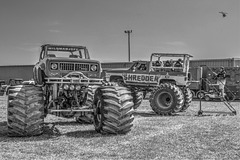
End of the Ride
| |
|
|
|
