

m̌ ḫ's photos


Conquering the Universe
The “Conquering the Universe” mosaic on the Faculty of Mechanical Engineering at the Slovak University of Technology in Bratislava stands as a visionary piece of public art. Created by academic painter Dezider Castiglione in 1962, this bold work forms the front of one of four projecting lecture halls on the main facade facing Freedom Square. Each of these protruding volumes features its own monumental mosaic, highlighting a different theme from the technical and scientific ideals of the time.
This mosaic dedicated to space exploration presents a stylised satellite, reminiscent of Sputnik, moving along its distinctive orbit. The composition places the sun in the centre, with a blue segment indicating the Earth on one side. These elements capture the era's excitement about cosmic discovery and reflect the immense pride in scientific achievement prevalent in 1960s Central Europe.
Thousands of coloured stone tesserae were meticulously set into the concrete surface to compose the mosaic, blending artistic innovation with the era’s engineering ambitions.
The building itself is a hallmark of 1960s Slovak modernism, designed under the direction of architect Martin Kusý . It stands out for its clear, rational layout and its crisp, balanced forms — qualities emblematic of the modernist drive for efficiency and harmony. The rhythmic projection of four lecture halls breaks up the facade’s geometry, providing a dramatic architectural setting for the mosaics and reinforcing the building’s civic and educational significance within Bratislava’s urban landscape.
#HWW
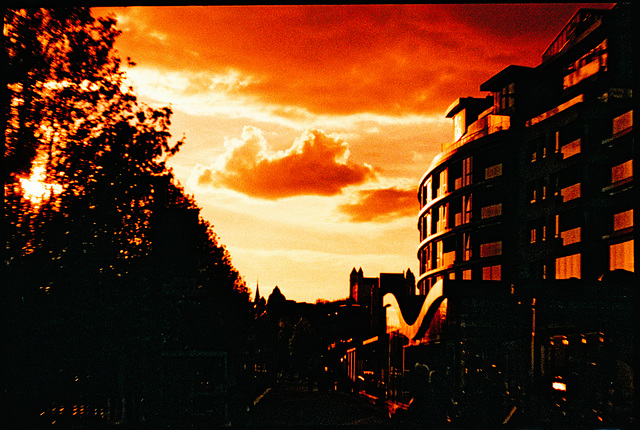
Under a Blood Red Sky
This is an interesting view of Bratislava Castle taken from the Danube riverbank, near a shopping centre. I’m not sure why the photo turned out so high in contrast — it wasn’t intentional, and there was no expired film involved. It’s probably just caused by the sunset light.
The name is dedicated to the "old" album by the Irish band U2 www.youtube.com/watch?v=Rnug2Qd_Ijs

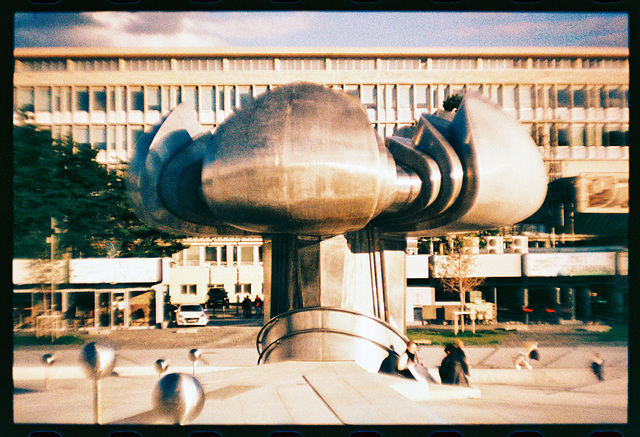
Monuments and Memory
Námestie slobody — Freedom Square — is where layers of history and memory meet in the heart of Bratislava. Back in the seventeenth century, this area was covered by vineyards, then later became home to the Summer Archbishop’s Palace, which now serves as a government building. Over time, bold landmarks like the vast Post Office Palace and the Slovak Technical University were built, turning the greenery into a dramatic urban stage.
The centerpiece of the square is the Fountain of Union ( fontána Družba ), completed in 1980 and renowned as the largest fountain in Bratislava and Slovakia. Its dramatic 9-meter-tall stainless steel linden flower sculpture, a symbol of Slavic heritage, was fully restored in 2023 after years of disrepair. Today, water flows again and the revitalized fountain stands as both a historical marker and a vibrant gathering point for the city.
This square has seen more than its share of drama. In 1948, after orchestrating a Communist coup that swept away Czechoslovakia’s democracy, Klement Gottwald had the square named after him, sealed with a towering statue — a very public sign of the Communist regime’s grip on the country for decades. Through years of shifting politics, the square was a stage for all manner of mass events, from grim fascist rallies to Commie-era parades, its modernist architecture reflecting each twist in the nation’s fate.
All of this changed with the Velvet Revolution ("Tender Revolution" in original) in 1989, when the square regained both its original name and its spirit. Today, the square hums with life once again. It plays host to democracy rallies and pride celebrations, surrounded by modernist shapes and open green spaces that invite both reflection and lively gatherings. It is much more than a relic of dictatorship; it stands as living proof of Bratislava’s commitment to memory, dialogue, and moving forward.


Among Tea Fields and Simple Homes
Mae Salong, a village where mist-shrouded hills are etched with neat rows of oolong tea. Here in the highlands of northern Thailand, the air carries whispers of its Yunnanese origins. This land, once a remote outpost for Kuomintang soldiers, has traded a turbulent past of opium cultivation for the tranquility of these verdant plantations. Now known as Santikhiri, or 'Hill of Peace', the village is a testament to transformation. The legacy of its pioneering Chinese founders is steeped into every cup of local tea and reflected in the serene, rolling landscapes that stretch towards the Myanmar border.
Simple wooden or bamboo houses line the hillsides of Mae Salong. Many villagers keep pigs in small pens near their homes, just as their families have done for generations. These houses are basic but practical, built to keep cool in the heat and shelter from mountain rain. Pigs roam around the yards or sleep in the shade, often watched over by children or elders. This everyday scene shows how the people of Mae Salong live close to the land, blending old traditions with new ways of life.

pigs
Mae Salong, now called Santikhiri, is a small mountain village in northern Thailand close to the Myanmar border. The area is home to Chinese families whose ancestors came from Yunnan after the Chinese Civil War in 1949. At first, they helped the Thai government fight communist forces, and in return they were allowed to stay and later received Thai citizenship. For many years, Mae Salong was known for growing opium, but this changed when the Thai government encouraged people to plant tea instead. Today, the village is famous for its green hills covered with tea fields and cherry blossoms. The main language is still Yunnanese Chinese, and visitors can enjoy Chinese-style food and tea.
09 Jan 2025
12 favorites
7 comments
Camouflage

Fix that car
What once were plain residential blocks are now an open-air museum bursting with colour — Lodhi Art District is Delhi’s answer to street art at its grandest. Since 2015, artists from both India and around the world have flocked here, using exhaustive imagination to paint over fifty massive murals.
Stroll through leafy avenues and you’ll encounter glowing abstractions, whimsical creatures and portraits with powerful social messages, each so different that every turn feels unexpected. There’s no set trail — exploration is the thrill, and new wall art appears often, changing the landscape each year. With its peaceful neighbourhood vibe and lack of crowds, visitors find not only dazzling visuals but also serene green streets perfect for reflection and photography.
