

m̌ ḫ's photos


17 Feb 2012
4 favorites
The cutest kids, and good looking people
IslBG

17 Feb 2012
3 favorites
Chaos of not very dense traffic
IslBG

17 Feb 2012
2 favorites
1 comment
Happy blur
IslBG
Dιѕαρρ…єαяιɴɢ Ƈɑllι…ɢʁαρhყ
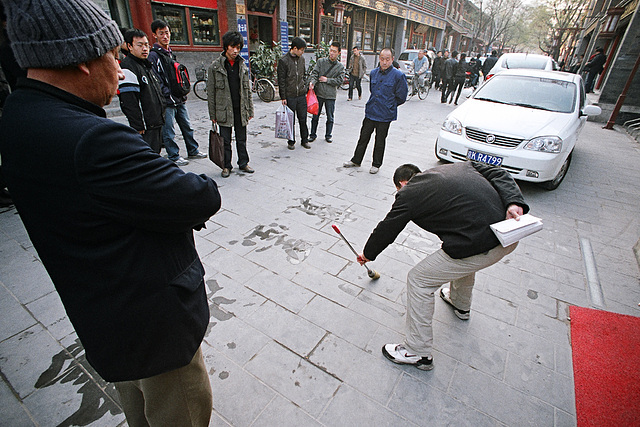
In Beijing’s Liulichang Street, a historic cultural quarter over 300 years old, people often practice 地书 (dishu), or “ground calligraphy.” Using large brushes with sponge tips, they write Chinese characters on the pavement with water. The strokes shimmer for a moment before evaporating in the sun, leaving no trace.
This tradition began in the 1980s and has become a beloved morning ritual, especially among older residents. It’s more than art — it’s gentle exercise, mental focus, and social interaction. Writers often reproduce classical poetry or philosophical sayings from memory, following traditional calligraphy rules. The act is meditative yet communal: people gather, chat, and exchange thoughts on technique and meaning.
Liulichang dates back to the Ming dynasty, named after a famous coloured-glaze factory that once produced tiles for palaces and temples. Later, it became a centre for scholars and imperial exam candidates. Today, the street is lined with antique shops, bookstores, and art studios. Watching dishu here feels natural — a living tradition in a place long devoted to literacy and aesthetics. For Western visitors, it offers a quiet, authentic glimpse into daily Chinese life: no performance, no commerce, just the fleeting grace of expression in water and sunlight.

Everyday Journeys: Motorbike Life
In Mandalay, the motorcycle is not simply a mode of transport—it is central to daily existence, perseverance, and family life.
Each morning, motorcycles surge across the crossroads, essential to the city’s brisk tempo. The sheer number — over 800,000 registered — creates a swirling tapestry of movement throughout the day. For countless families, particularly mothers with children, two wheels represent both autonomy and practicality.
However, there are genuine hazards: motorcycle incidents contribute to the majority of road injuries in the city, and lapses in helmet use markedly increase risk. Despite these dangers, families continue their daily routines by motorbike. Riders adapt to unpredictable traffic, variable weather, and narrow streets, transforming each journey into an exercise in constant attentiveness.

Wat Chedi Luang
Wat Chedi Luang is a historic Buddhist temple located in the heart of Chiang Mai, Thailand. Built in the late 14th century by King Saen Muang Ma as a royal stupa to house his father’s ashes, the temple was finally completed in the mid-15th century under King Tilokaraj. The immense chedi (pagoda) once stood 82m high, making it the tallest structure in the ancient Lanna Kingdom. Although partially ruined by an earthquake in 1545, the chedi remains an iconic landmark and testament to Chiang Mai's rich cultural heritage. The temple also housed the revered Emerald Buddha for nearly a century before it was relocated to Bangkok.
The main hall features a triple-tiered roof and detailed woodwork, highlighted by a gilded, glass-inlaid facade and flanked by Naga serpent statues at the entrance.
Wat Chedi Luang stands out for its powerful Lanna architecture—seen in the towering brick chedi and the ornate wooden halls.
Wat Chedi Luang’s grand stairway, flanked by fierce naga serpents, leading up to a weathered brick chedi and golden Buddha statue—a vivid display of Buddhist architecture and symbolism.

Wat Chedi Luang {3}
The dramatic stairway of Wat Chedi Luang, guarded by powerful naga serpents intricately carved from stone. Rising above, the ancient brick chedi dominates the scene, weathered by centuries but still imposing. At the base, a golden Buddha draped in cloth offers a sense of calm against the monumental scale. The architectural lines and fierce naga figures express the temple’s blend of protective symbolism and historic grandeur, making this a striking example of Lanna Buddhist artistry.

06 Jan 2013
9 favorites
5 comments
A lattice of branches adorned with liquid pearls draws the eye into a miniature cosmos concealed within each droplet

