

m̌ ḫ's photos
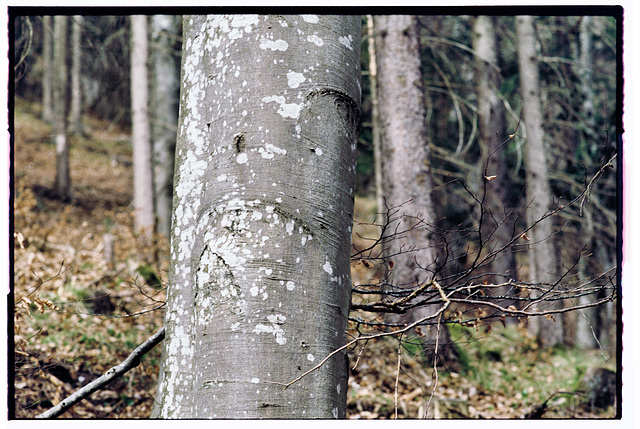

Spotted
Those white spots are tiny scale insects feeding on the smooth bark of European beech, and in the long run they can open the door to beech bark disease that weakens or kills the tree. Beeches themselves are a cornerstone of the Small Carpathians: they shape the cool, shady microclimate of the hills, build deep humus‑rich soils, and feed whole food webs with their leaves and nuts, from soil fungi and spring wildflowers to beetles, birds and large mammals that depend on intact Carpathian beech forests. In this low mountain range above Bratislava and the surrounding wine villages, beech‑dominated woods are the “default” natural forest type, part of the wider Carpathian beech belt recognised as globally important for biodiversity, carbon storage and long‑term forest continuity since the last Ice Age.
11 Jun 2025
13 favorites
4 comments
Enjoying spring
IslBG

an angry fish-resembling rock
Each time the path brings me past this rock, I have to stop for another photo – it looks like a huge, angry fish frozen in stone. Behind it stretches the typical mixed forest of the Little Carpathians near Modra, dominated by beech and oak with patches of conifers and a dense green understorey that stays lush from spring to autumn.

Pop
The slogan in Slovak ‘newspeak’ here means “You can charm people through your style.”
(“Rizznúť” comes from “rizz”, Gen Z slang for charisma or the ability to flirt and attract // “Drip” is Gen Z slang for cool style, especially fashionable clothes and overall look). Actually. apart from the colours and light what really drew my eye here isn’t only the billboard at all. It’s how the late‑summer sunset ties together the old streetfront, with its unmistakably socialist-era street lamps, and the new skyline, with Zaha Hadid’s Sky Park rising behind them. The Sky Park development actually consists of four residential towers in Bratislava, even though many sources long mentioned only three, because the fourth tower was part of the original plan but completed later. This last tower is often barely noted in guides and articles, and from the city centre you usually see only three of them, which probably explains why so many people still think there are just three.

Spa town faux ‘antique’ architecture
Rajecké Teplice spa is what happens when thermal water meets a costume party. It is a modern complex dressed in “ancient Greek” cosplay: fresh concrete hiding under fake marble, brand‑new columns, and armies of statues posing as Antiquity. Think less historic spa town, more Instagram‑ready Olympus built by a luxury hotel chain. It feels like someone asked, “How many pillars, gold details and mosaics can we fit in before the building collapses?” and the architect took it as a personal challenge.
Rajecké Teplice spa is what happens when thermal water meets a costume party. It is a modern complex dressed in “ancient Greek” cosplay: fresh concrete hiding under fake marble, brand‑new columns, and armies of statues posing as Antiquity. Think less historic spa town, more Instagram‑ready Olympus built by a luxury hotel chain. It feels like someone asked, “How many pillars, gold details and mosaics can we fit in before the building collapses?” and the architect took it as a personal challenge.
But beyond the fake Greek and vaguely “exotic” bits, the old part of Turčianske Teplice actually feels like a real historic spa town. You can see layers of different periods: 16th‑century foundations, 18th–19th‑century Rococo‑Classicist spa houses, the domed Late Classicist Blue Bath, and early 20th‑century buildings with a touch of Art Nouveau. Overall, it comes across as calm, balanced and very Central European, rooted in genuinely long spa tradition.
According to a local legend in 15th century, King Sigismund of Luxembourg is said to have camped near Turčianske Teplice and bathed in its hot springs, refusing to remove his golden crown while in the water. This episode became the famous “golden bath” legend, credited with easing his gout or rheumatism and helping him reach old age. Later, the spa’s image as a place for rulers and nobles was reinforced by visits attributed to figures such as Emperor Maximilian I, Ferenc II Wesselényi and Mária Széchy, while in 2007 Archduke Michael von Habsburg‑Lothringen ceremonially opened the new spa complex.

A view on Seoul from Itaewon
This view is special because it links several “Seouls” in one frame, from the everyday streets to the distant skyline. It is taken from a hotel on the hillside above Itaewon in Yongsan‑gu, on the northern side of the Han River, looking down on Seoul’s famous international quarter with its foreign restaurants, bars, clubs and mixed expat–local crowd. We chose this hotel to be just a short walk from Itaewon, known for its energy, yet high enough to see how the city fits together. From the window you look out over central‑north Seoul, with the dense neighbourhoods of Yongsan and nearby districts in the foreground, then, across the Han River, the tall blocks of Gangnam and other southern business areas stretching into the distance. Beyond the city, low mountain ridges close the horizon and show how Seoul sits in a broad basin of hills.

Trees of Gaderska dolina
Not far from the Turčianska village of Blatnica lies Gaderská dolina, one of the most beautiful valleys of the Great Fatra. Known for its dramatic rock formations — overhangs, boulders, caves, and stone windows — it offers scenery that is simply unforgettable. The lively Gaderský potok stream completes the valley’s unique and tranquil atmosphere.
Gaderská dolina is a biodiversity hotspot, often called a living botanical garden. Its varied terrain and microclimate nurture rare plants like alpine fungus, Slovak sedge, and the striking slipper orchid, Slovakia’s largest orchid. Wildlife thrives here too, with bears, lynxes, wolves, and chamois roaming freely among forests and rocky slopes.
The valley also holds cultural significance tied to Juraj Jánošík, Slovakia’s legendary folk hero. His Robin Hood-like story inspired the first Slovak feature film, Jánošík, shot here in 1921 by the Siakeľ brothers. Bielik’s adaptation (1962–1963) returned decades later, cementing Gaderská dolina as a cinematic and historical landmark.
A marked trail begins in Blatnica and runs through the valley, continuing into Dedošová dolina. From there, hikers can branch off toward peaks along the Veľká Fatra ridge. At the valley’s end stands Čertova brána, the Devil’s Gate — a striking rock formation that closes this natural and cultural treasure of Slovakia.

Within Bratislava's woods
Bratislava is one of Europe’s few capitals where natural woodland reaches directly into the urban heart. On the northern slopes above the city centre, the Koliba area forms part of the Little Carpathians and offers an escape into quiet forests only minutes from bustling streets. Trails wind through beech and oak trees, leading to viewpoints over the city and connecting to the Kamzík Hill recreation zone. This unique blend of metropolitan life and wild greenery gives Bratislava a distinctive charm, where residents can enjoy the atmosphere of a capital city while being surrounded by nature.
VIEW IT FULLSCREEN ON BLACK
