

m̌ ḫ's photos
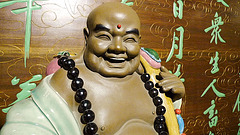
Vegetarian Buddha
| |
|
In Chinese restaurants, the concept of the "Vegetarian Buddha" is most famously embodied in dishes and dining traditions inspired by Buddhist vegetarianism. The most iconic dish is Buddha’s Delight (罗汉斋, luóhàn zhāi), a classic vegetarian medley of assorted vegetables, tofu, mushrooms, and sometimes bean threads, all simmered in a light, savoury sauce. This dish, rooted in Buddhist monastic cuisine, is traditionally enjoyed by monks and laypeople alike, especially during festivals and on the first day of the Lunar New Year, when many Chinese Buddhists and even non-Buddhists choose to eat vegetarian food as a gesture of purification and compassion.
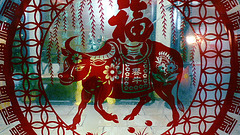
牛
| |
|
The "Year of the Ox"—sometimes referred to as the year of the buffalo, cow, or bull—is the second sign in the Chinese zodiac and symbolises qualities such as diligence, patience, reliability, and strength. Traditionally, the ox is seen as a protector of family happiness and a harbinger of new experiences. Those born under this sign are considered hardworking, persistent, and trustworthy, often achieving success through determination and a practical approach to life. The ox is linked to the Earth element, representing stability and growth, and is associated with the colour yellow, historically reserved for the emperor in China. In the context of the five elements, the Metal Ox is known for originality, independence, honesty, and courage, though can also be stubborn and overly ambitious.
The Chinese word for ox, niú (牛), broadly refers to bovine animals, which is why, outside China, the zodiacal ox is often interpreted as the water buffalo, particularly in Southeast Asian cultures such as Vietnam, where the water buffalo holds great agricultural significance. In some regions, the cow may also represent this sign. However, the yak, while important in Tibetan and Central Asian cultures, is not typically used as the zodiac symbol. Thus, the symbolism of the ox in the Chinese zodiac, whether depicted as an ox, buffalo, or cow, highlights not only physical strength but also moral principles, discipline, and a preference for order and long-term stability.
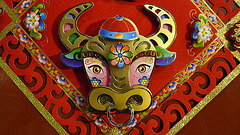
2009
| |
|
|
In 2009, China celebrated the Year of the Ox (often also called the buffalo), and symbols of the ox were truly everywhere—appearing not only in traditional forms like clay or bronze sculptures but also as paper cuttings, plastic decorations, lanterns, and even on envelopes and packaging. The ox, or niú (牛), is a powerful symbol in Chinese culture, representing diligence, patience, reliability, and strength. It is closely associated with agricultural abundance, prosperity, and the values of hard work and stability, which is why it features so prominently during the New Year and throughout the year’s festivities.
Whether made from clay, paper, or plastic, the material of the ox symbol does not diminish its cultural significance. The key is the meaning it carries: a wish for good fortune, stability, and success in the coming year. Traditional clay oxen have deep historical roots and are linked to ancient rituals, such as the spring ploughing ceremonies meant to ensure a good harvest. However, modern versions—be they paper or plastic—allow the symbolism to be accessible, festive, and visible in every home, shop, and public space. These mass-produced representations help keep the tradition alive and relevant, ensuring the ox’s enduring message of perseverance and prosperity reaches all generations.
In essence, it is the symbolism and intent that matter, not the material. Each ox figure, regardless of how it is made, is a bearer of good wishes and a reminder of the values that the Year of the Ox stands for.
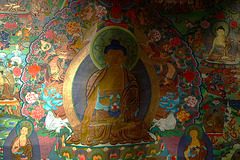
Buddha in shade
| |
|
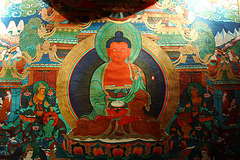
Buddha
| |
|
|
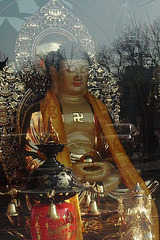
Buddha
| |
|
On Buddhist statues in China, the swastika (卍) on the Buddha’s chest is a mark of auspiciousness and eternity, deeply rooted in Asian religious art. The idea that the direction of the swastika—clockwise or counterclockwise—changes its meaning is a misconception; both forms have been used interchangeably in Buddhist imagery for centuries. The negative association stems solely from its 20th-century misuse in the West. In Chinese Buddhism, the swastika remains a revered symbol of the Buddha’s wisdom, virtue, and the harmonious order of the universe.
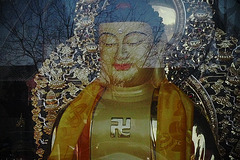
Heil buddha?!
| |
|
Spotting a Buddha statue in China with a swastika (卍) on his chest seems to send some Western tourists into a quiet panic, as if they’ve just uncovered an ancient conspiracy. Let’s clear the air: in Chinese Buddhism, this symbol is about as controversial as a lotus flower. The swastika has been gracing the chests of Buddhas, the doors of temples, and the pages of scriptures for millennia, long before a certain moustachioed dictator hijacked it for his own twisted purposes.
Now, there’s a persistent rumour that the “direction” of the swastika is the secret code—clockwise for good, counterclockwise for evil, as if the universe runs on a sort of cosmic lefty-loosey, righty-tighty rule. In reality, Buddhist art is refreshingly egalitarian about direction; both versions appear in ancient carvings, paintings, and statues, and neither is plotting world domination. The only thing the swastika on a Buddha’s chest is trying to conquer is your ignorance about its true meaning: auspiciousness, the eternal cycle of life, and the Buddha’s infinite wisdom.
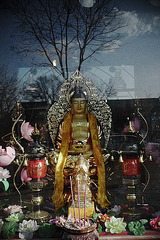
Buddha for sale
| |
|
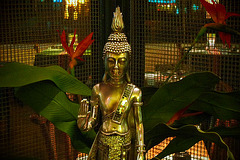
Yunnanese Buddha
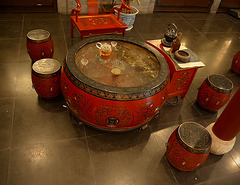
Fancy tea sitting
| |
|
|
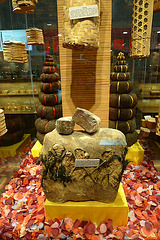
Ripe dark tea
| |
|
|
Ripe dark tea is a broad category of Chinese tea that goes through a fermentation process after the leaves are picked and processed. While most people think of ripe (shou) Pu-erh when they hear "dark tea," there are actually several other types worth knowing about. Ripe Pu-erh comes from Yunnan province and is famous for its earthy, mellow flavor, which develops through a special "wet piling" process that speeds up fermentation.
But ripe dark tea isn't just Pu-erh. For example, Liu Bao tea from Guangxi is another classic dark tea. It’s also fermented in piles and often aged for years, developing a smooth, woody, sometimes nutty taste. Hunan province is known for Fu Zhuan brick tea, which is unique because it grows a special golden fungus during fermentation, giving the tea a slightly sweet and mellow flavor. In Sichuan and Shaanxi, you’ll find other types of dark tea, like Tibetan brick tea and Shaanxi Fu tea, which are compressed into bricks and have their own distinctive earthy and warming qualities.
So, while ripe Pu-erh is the most famous, there’s a whole world of dark teas out there, each with its own flavors and traditions. If you enjoy the smooth, earthy taste of ripe Pu-erh, you might also love exploring Liu Bao, Fu Zhuan, and other regional dark teas—they offer new flavors and a deeper look into Chinese tea culture.
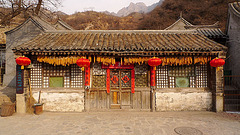
Corn-decorated House
| |
|
|
Cuandixia is a well-preserved Ming dynasty village nestled in the mountains near Beijing, famous for its traditional courtyard homes and ancient stone lanes. One of the most striking sights in Cuandixia, especially during harvest season, is the way villagers decorate their houses with rows of golden corn. This is not just for decoration—it's a practical tradition deeply rooted in rural life. After the corn harvest, families hang corn cobs on the walls, under the eaves, and across wooden racks outside their homes. This method helps the corn dry naturally, keeping it safe from pests and making it easy to store and use throughout the year.
Beyond its practical purpose, hanging corn is also a symbol of abundance and prosperity. It reflects the villagers’ pride in a successful harvest and adds a festive, welcoming atmosphere to the ancient stone houses. The bright yellow corn stands out beautifully against the grey Ming-era architecture, creating a unique blend of history, culture, and everyday life. In Cuandixia, this tradition connects the rhythms of the agricultural calendar with the village’s rich heritage, making it a living example of how practical needs and cultural values come together in rural China.
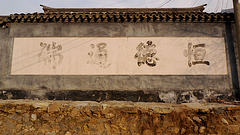
Starý nápis
| |
|
The image shows a wall inscription in Cuandixia Village, a historic Ming-era settlement in Beijing’s Mentougou District.
The four large Chinese characters on the wall are: 佛通德恒
These characters, read from right to left in traditional Chinese calligraphic style, are:
恒 (héng) — constant, enduring
德 (dé) — virtue, moral character
通 (tōng) — to connect, to communicate, to be open
佛 (fó) — Buddha, Buddhism
This phrase can be interpreted as "Buddha's virtue is constant" or "Buddhist virtue endures."
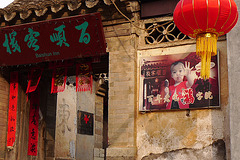
the New and the Old
| |
|
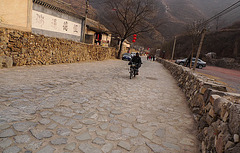
Welcome home
| |
|
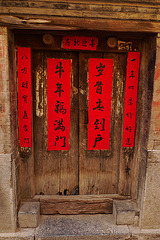
Gate says the new year is coming
| |
|
The image you referenced shows a classic example of the Chinese tradition of pasting Spring Festival Couplets (春联, chūnlián) on gates and doorways during the Lunar New Year. This custom is deeply rooted in Chinese culture and is widely practiced both in homes and on public buildings or gates.
Spring Festival Couplets are red paper strips with black or gold writing, placed on gates and doorways during Chinese New Year. Two long vertical strips go on each side of the gate, and a shorter horizontal strip is placed above. Sometimes, a red diamond with the character “福” (meaning “good luck”) is added. Red symbolizes luck and wards off evil, while the words express wishes for happiness, prosperity, and peace in the new year. This tradition decorates homes and gates to invite good fortune.
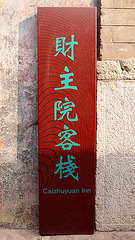
Nápisy IV.
| |
|
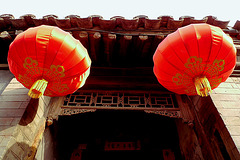
Entrance
| |
|
