

John FitzGerald's photos
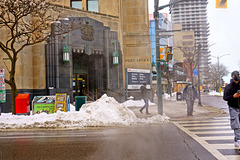
Richmond and Queens, London, Ontario
| |
|
|
|
I prefer the really big view -- type Z then click the representation of a frame at top right), but your preference may vary.
I believe Édifice Dominion Public should should, by Canadian standards, read Édifice Dominion-Public , or, better yet, Édifice fédéral .
The word "Dominion" is pretty much taboo in Canada now (as a vestige of colonial rule) except in the names of the beautiful Dominion Public Buildings that the federal government put up all over the country.
Ridin' with Sig
| |
|
|
|
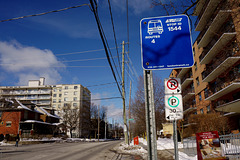
The development of public transit in London, Ontario, has been strongly influenced by the writing of Sigmund Freud. Or so it would seem, anyway -- why else would the London Transit Commission's bus-stop signs be warning you about the id? In accordance with principles of good sign design, of course, "Where is id there shall ego be" has been compressed to "Stop id" (to save space on the sign and allow the use of a larger font).
Fun falsehood: London Adlerians have been boycotting public transit since 1931.
Try it big, as Freud said to Mae West. Just type Z, as he didn't say.
Happy Fence Friday
| |
|
|
|
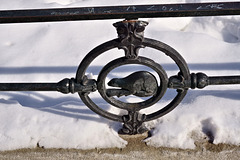
St. Paul's Anglican Cathedral, London, Ontario. That's London, Ontario, not London, England (or, as people say now, London, UK). I believe Canada is the only nation whose national animal is a rodent.
When I posted this I was mystified by why there was a beaver on the fence, since I could find no Canadian Anglican emblems with beavers, except for the coat of arms for the Diocese of Keewatin, which is some distance away. So thanks to Keith Burton who, as he describes in his comment below, discovered that it comes from the coat of arms of the Diocese of Huron, which is the diocese St. Paul's is cathedral of. Here's a link to the diocese's website: diohuron.org
I was unable to find any representations of the coat of arms with bearers (that's bearers , not beavers )) or a motto. I did find one with a mitre appropriately as crest. I couldn't find any explanation of the crossed swords. It seems crossed swords usually symbolize readiness to do battle.

| |
|
|
|
www.google.ca/maps/place/University+Ave+%26+King+St+W,+Toronto,+ON/@43.6480192,-79.3835223,3a,37.5y,29.17h,74.32t/data=!3m6!1e1!3m4!1sjDJ_7G607xoqNcfRDyFQiA!2e0!7i13312!8i6656!4m5!3m4!1s0x882b34d239da86cf:0x6cc9aae21d43fff0!8m2!3d43.6476565!4d-79.3848108
Happy Fence Friday
| |
|
|
|

| |
|
|
|
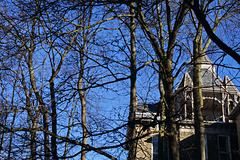
Waverley 2
| |
|
|
|
Another view of Waverley, from the back this time. The other photo I posted is in the PiP at upper left. More information about the house at this link:
www.ipernity.com/doc/fitzgerald/50561638
| |
|
|
|
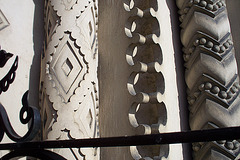
University College, University of Toronto
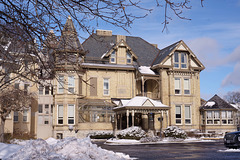
Waverley
| |
|
|
|
Another example of the architectural aesthetic of my new neighbourhood. This is Waverley, built for Charles F. Goodhue in the 1880s. The original architect was Capt. Hamilton Tovey, a Briton who was Goodhue's uncle, but the plans were extensively modified by local architect George F. Durand. It is now a retirement home.
Charles's father George was quite the lad. Here's a link to an article about him from the Dictionary of Canadian Biography:
www.biographi.ca/en/bio/goodhue_george_jervis_9E.html
This is probably best viewed on black. Type Z to see if you agree.
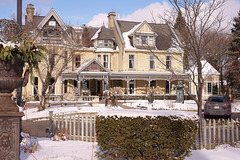
Idlewyld
| |
|
|
|
Another example of the architecture in my new neighbourhood in London, Ontario. Idlewyld was built for C. S. Hyman, who served as mayor of London and as a federal cabinet minister under Wilfrid Laurier.
The house has been expanded a couple of times. The original house is on the left, with the two leftmost gables. It is now a hotel.
Hyman was also a noted sportsman: Canadian men's singles tennis champion seven years in a row, captain of the national cricket team (and the most successful one), and a player for the London Tecumsehs baseball team (although not for the championship team shown in my Ephemera album). He is also believed to have introduced bridge to Canada.
By the way, Canadians chose baseball over cricket because toffs like Hyman played cricket. Before his time cricket was the game of the Family Compact, an anti-democratic Tory clique that ruled Upper Canada until the 1840s. The citizenry chose to play baseball. The schools of the posh still play cricket to this day, though. To give him his due, Chuck, as we have seen, played both games.
This is probably best viewed on black. Type Z to see if you agree.

| |
|
|
|
When I posted this I said that this view had disappeared, since this end of the bridge had been moved. In fact, it was the other end that was moved. I'm pretty sure the mesh is gone, though.


| |
|
|
|
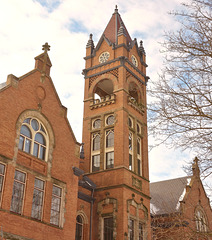
Western Ontario Normal School
| |
|
|
|
The architectural aesthetic of my new neighbourhood is somewhat different from the one of the neighbourhood I just left. The Western Ontario (later London) Normal School opened in 1899, and was the third normal school in Ontario (Toronto and Ottawa having the first two). For some reason it was built facing north, so the front never gets the sun except on summer mornings and evenings. It sits in a large park, so they coulda built it facing south, eh, with a nice park in front of it.
Normal schools are teachers' colleges. They teach the norms of pedagogy. Canadian and American normal schools (and Argentine ones) only prepared teachers for primary school.
Teachers' college seems to be the preferred name in most places these days, but Paris still has the École normale supérieure.
The building is now the headquarters of the YMCA of Southwestern Ontario.
==========
I added some red to bring out the brick. I think that's what's showing up in the clouds. It's not as noticeable in the large version. Especially if you turn your head toward the left and up and look at the photo sideways -- anything for art, right?

| |
|
|
|

| |
|
|
|

| |
|
|
|
