

Esther's favorite photos


Roundabout in Tunnel
This was one of the many tunnels we went through in Norway, the longest of which was 25 kilometers. This one was much shorter but had a roundabout in the tunnel which I managed to photograph as we made our way from Eidfjord to Bergen.

Skjervsfossen
After two nights and day near Voringsfossen we made our way to Bergen. The drive along Eidfjord and on to Bergen was beautiful and we made several stops and detours along the way, this waterfall on one of the detours. The waterfall is named Skjervsfossen. It was raining at the falls and the spray from the falls was blowing our way so we were quite wet when we returned to the car.

25 favorites
Bon dimanche avec un bouquet , créé à partir de la rose du jardin , avec ChatGPT....

48 favorites
The Last Frame is the First
Digital artwork I developed from photos taken at various art galleries and from the High Line in New York City's Chelsea District (New York, New York)— September 12, 2026.
Architecture, memory, and narrative collapse into a single continuous space. A filmstrip featuring Tania Franco Klein's "Game Over" currently exhibited at the Yancey Richardson Gallery declares, "Game Over." Yet, rather than arriving at an ending, the viewer is drawn upward into a soaring current of lines, windows, color, and light.
The work treats memory as something that is constantly edited, reframed, and experienced anew. Stairways suggest passage. People occupy separate moments. Flowing lines escape the boundaries of walls and architecture, connecting otherwise fragmented spaces. The gallery becomes a place in which images are preserved even as their meanings continue to change.
The title proposes its central paradox. Every ending contains the possibility of return. The final frame does not close the narrative. It becomes the point from which the story begins again, or a new story is born.
By Günter Klaus
30 favorites
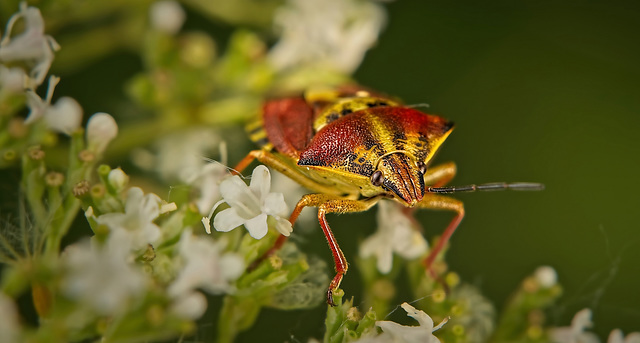
Die Purpur-Fruchtwanze (Carpocoris purpureipennis) ist erwachsen :)) The purple shield bug (Carpocoris purpureipennis) is fully grown :)) La punaise pourpre (Carpocoris purpureipennis) a atteint sa taille adulte :))
Gestern habe ich die Nymphe von dieser Wanze gezeigt,die Färbung variiert von gelblich-orange über rotbraun bis hin zu kräftigem Purpur/Violett. Charakteristisch sind die dunklen Punkte und Streifen auf dem Halsschild sowie das schwarz-gelb gemusterte Hinterleibsrandschild!Erwachsene Tiere erreichen eine Körperlänge von etwa 11 bis 14 mm.Die Wanzen ernähren sich pflanzensaugend. Sie bevorzugen Doldenblütler (wie Möhren oder Bärenklau), Korbblütler und verschiedene Feldfrüchte :))
Pip1-5: Nahaufnahmen der Wanze
Yesterday I showed the nymph of this bug; its coloration ranges from yellowish-orange and reddish-brown to a vibrant purple/violet. Characteristic features include the dark spots and stripes on the pronotum, as well as the black-and-yellow patterned margin of the abdomen! Adults reach a body length of approximately 11 to 14 mm. These bugs feed by sucking plant sap. They prefer umbellifers (such as carrots or hogweed), composites, and various crops :))
Pics 1–5: Close-ups of the bug
Hier, j'ai montré la nymphe de cet insecte ; sa coloration varie du jaune orangé au brun rougeâtre, jusqu'à un violet éclatant. Elle se caractérise par des taches et des rayures sombres sur le pronotum et un écusson abdominal noir et jaune à motifs ! Les adultes mesurent environ 11 à 14 mm de long. Ces insectes se nourrissent de sève. Ils préfèrent les ombellifères (comme les carottes ou la berce du Caucase), les composées et diverses cultures.
Photos 1 à 5 : Gros plans de l'insecte

By Günter Klaus
36 favorites
Der Kleine Kohlweißling (Pieris rapae) am Rotklee :)) The small cabbage white butterfly (Pieris rapae) on the red clover :)) Le petit papillon blanc du chou (Pieris rapae) sur le trèfle rouge :))
Die Flügeloberseite ist weiß mit gräulich-schwarzen Flügelspitzen. Weibchen besitzen zwei dunkle Flecken auf den Vorderflügeln, Männchen nur einen. Auf der Unterseite sind die Flügel blassgelb bis leicht grünlich bestäubt.Mit einer Spannweite von etwa 40 bis 50 mm ist er deutlich kleiner als sein Verwandter, der Große Kohlweißling (Pieris brassicae).Man sieht ihn in Gärten, Wiesen und Feldern bis hin zu Parkanlagen und Siedlungsbereichen von April bis Oktober in zwei bis drei Generationen pro Jahr.Er ernährt sich von Nektar von verschiedenster Blüten :))
Pip1-4: Nahaufnahmen des Schmetterlings
The upper side of the wings is white with greyish-black wingtips. Females have two dark spots on the forewings, while males have only one. On the underside, the wings are pale yellow with a slight greenish dusting. With a wingspan of approximately 40 to 50 mm, it is significantly smaller than its relative, the Large White (*Pieris brassicae*). It can be found in gardens, meadows, and fields, as well as in parks and residential areas, from April to October, with two to three generations per year. It feeds on the nectar of a wide variety of flowers :))
Pics 1–4: Close-ups of the butterfly
Le dessus des ailes est blanc avec des extrémités gris-noir. Les femelles présentent deux taches sombres sur leurs ailes antérieures, les mâles une seule. Le dessous des ailes est jaune pâle à légèrement verdâtre, avec un léger voile. Avec une envergure d'environ 40 à 50 mm, il est nettement plus petit que son cousin, le Piéride du chou (Pieris brassicae). On peut l'observer dans les jardins, les prairies et les champs, ainsi que dans les parcs et les zones résidentielles, d'avril à octobre, avec deux à trois générations par an. Il se nourrit du nectar d'une grande variété de fleurs.
Pip1-4 : Photos rapprochées du papillon

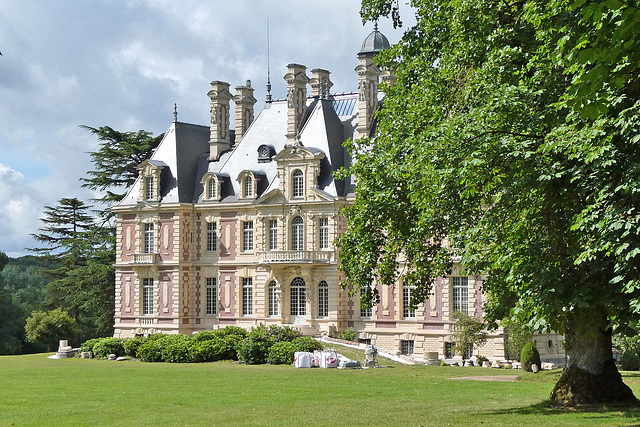
France - Fauguernon, Château de Combray
The original Château de Combray (Combray Castle) was built in the 16th century. The present castle, in the Louis XIII style, dates from the mid-19th century. After 1965, the owner of the castle, who died unmarried, decided to bequeath the estate to the Pasteur Institute.
The castle is now owned by a private individual and not open to the public.

France, Blangy-le-Château
Blangy-le-Château is a picturesque village in the heart of the Pays d’Auge, was awarded in 2024 the official ‘Plus Beaux Villages de France’ label (mid 2026 there were 184 of such villages).
The village is well known for its many colourful half-timbered houses with architectural details, such as the old pharmacy with its carved woodwork, or the 16th century Auberge du Coq Hardi, one of the oldest and most opulent houses in the village (main image).
Jump to top
RSS feed- Latest favorites - Subscribe to the favorite docs of Esther
- ipernity © 2007-2026
- Help & Contact
|
Club news
|
About ipernity
|
History |
ipernity Club & Prices |
Guide of good conduct
Donate | Group guidelines | Privacy policy | Terms of use | Statutes | In memoria -
Facebook
X
