

Esther's favorite photos


By Annemarie
53 favorites
Inside the baobab tree.
I entered in the trunk of this mega-baobab to have a look at the sky.
Wish you a happy Wednesday!

Utah Century Plant
This is the Utah Century Plant photographed along the Tonto Trail in Grand Canyon National Park. After the plant blooms it dies, sending up other plants alongside the original plant.

Utah Century Plant
This is the Utah Century Plant (though photographed in Arizona) growing along the South Kaibab Trail in Grand Canyon National Park. The photo was taken last May when we were in the park hiking and backpacking to Indian Gardens and then down to the Colorado River through Bright Angel Canyon.
The photo seems appropriate since the park has been much in the news recently. There have been flash floods in the canyon which have resulted in closures throughout the park and several deaths. It is difficult to imagine that some of the trails we hiked, at that time so peaceful and quiet, have turned into death traps.

France: Hermival-les-Vaux, Château d'Hermival
Château d'Hermival (Hermival Castle) is dating back to the middle of the 16th-century. The country house was remodeled in the 17th and 18th century under Louis XV. The facades have been listed as a Historic Monument since 1927, featuring distinctive corner pavilions in checkerboard pink brick and cut stone.
Originally owned by the noble Bosch family, it later passed to the Sisters of Bon Sauveur de Caen community, before being renovated in 2019 as a private event venue.


By Günter Klaus
36 favorites
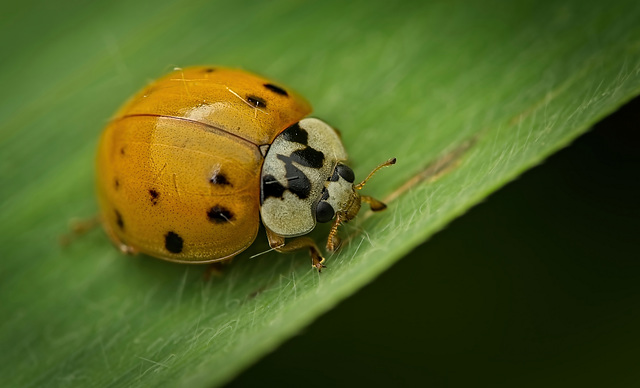
1 (2)Der Asiatische Marienkäfer (Harmonia axyridis) auf seiner Runde :)) The Asian lady beetle (Harmonia axyridis) on its rounds :)) La coccinelle asiatique (Harmonia axyridis) en pleine tournée :))
Sein Aussehen ist variabel in der Farbgebung (gelb, orange, rot oder fast schwarz) mit 0 bis 19 Punkten. Ein typisches Erkennungsmerkmal ist das schwarze „M“ oder „W“ auf dem hellen Halsschild .Mit etwa 6 bis 8 mm ist er etwas größer und robuster als der heimische Zweipunkt- oder Siebenpunkt-Marienkäfer,er frisst enorm viele Blattläuse (bis zu 250 pro Tag), aber bei Nahrungsmangel auch andere Insekten, Eier oder sogar Larven heimischer Marienkäferarten !!
Pip1-4: Nahaufnahmen des Marienkäfers
Its appearance is variable in color (yellow, orange, red, or almost black) with 0 to 19 spots. A typical identifying feature is the black "M" or "W" on the light-colored pronotum. At about 6 to 8 mm, it is somewhat larger and more robust than the native two-spot or seven-spot ladybird. It eats enormous numbers of aphids (up to 250 per day), but in times of food scarcity, it will also eat other insects, eggs, or even larvae of native ladybird species!
Pip1-4: Close-up photos of the ladybird
Son apparence est de couleur variable (jaune, orange, rouge ou presque noir) et elle présente de 0 à 19 points. Un signe distinctif typique est le « M » ou le « W » noir sur son pronotum clair. Mesurant environ 6 à 8 mm, elle est légèrement plus grande et plus robuste que la coccinelle indigène à deux ou sept points. Elle consomme une quantité impressionnante de pucerons (jusqu'à 250 par jour), mais en période de disette, elle se nourrit également d'autres insectes, d'œufs, voire de larves d'espèces de coccinelles indigènes !
Pip1-4 : Gros plans de la coccinelle

By Günter Klaus
31 favorites
Der Gemeine Grashüpfer (Pseudochorthippus parallelus) kam angesprungen :)) The common grasshopper (Pseudochorthippus parallelus) came hopping in :)) La sauterelle commune (Pseudochorthippus parallelus) est arrivée en sautillant :))
Sie sind meist grün gefärbt, es kommen jedoch auch braune oder rötliche Variationen vor. Die Halsschild-Seitenkiele sind fast gerade bis leicht gebogen.Die Flügel sind in der Regel kurz und nicht voll entwickelt. Die Tiere sind daher flugunfähig und fortbewegen sich primär hüpfend.Die Männchen werden etwa 13–16 mm lang, Weibchen sind mit 18–22 mm deutlich größer.Der charakteristische Gesang der Männchen besteht aus kurzen, im Abstand von wenigen Sekunden wiederholten Strophen („srr-srr-srr“), die durch das Reiben der Hinterbeine an den Vorderflügeln entstehen.Man entdeckt sie auf Wiesen, Weiden, Wegrändern und in Gärten, bevorzugt in nicht zu trockenen Graslandschaften :))
Pip1-6: Nahaufnahmen des Grashüpfers
They are mostly green, but brown or reddish variations also occur. The lateral keels of the pronotum are almost straight to slightly curved. The wings are generally short and not fully developed. The insects are therefore flightless and move primarily by hopping. Males grow to about 13–16 mm in length, while females are significantly larger at 18–22 mm. The characteristic song of the males consists of short stanzas ("srr-srr-srr") repeated at intervals of a few seconds, produced by rubbing the hind legs against the forewings. They can be found in meadows, pastures, along roadsides, and in gardens, preferably in grassy areas that are not too dry.
Pip1-6: Close-up photos of the grasshopper
Elles sont généralement vertes, mais on observe aussi des variations brunes ou rougeâtres. Les carènes latérales du pronotum sont presque droites ou légèrement incurvées. Les ailes sont généralement courtes et peu développées. Ces insectes ne peuvent donc pas voler et se déplacent principalement par sauts. Les mâles mesurent environ 13 à 16 mm de long, tandis que les femelles sont nettement plus grandes, mesurant de 18 à 22 mm. Le chant caractéristique des mâles consiste en de courtes strophes (« srr-srr-srr ») répétées à quelques secondes d'intervalle, produites par le frottement des pattes postérieures contre les ailes antérieures. On les trouve dans les prairies, les pâturages, le long des routes et dans les jardins, de préférence dans les zones herbeuses pas trop sèches.
Pip1-6 : Photos en gros plan de la sauterelle

By Günter Klaus
37 favorites
Die Florfliege (Chrysoperla carnea),auch Goldauge genannt :)) The lacewing (Chrysoperla carnea), also called the golden eye :)) La chrysope carnée (Chrysoperla carnea), aussi appelée œil d'or :)
Auffällig sind ihre netzartig, durchscheinende Flügel, die in Ruhe dachartig über dem Hinterleib liegen.Den Spitznamen „Goldauge“ verdankt sie ihren oft metallisch-goldig glänzenden Komplexaugen,ihr Körper ist schlank und meist zartgrün gefärbt, wobei sich manche Arten im Herbst für die Überwinterung leicht bräunlich bis rot-violett verfärben.Die Larven der Florfliege tragen den Spitznamen „Blattlauslöwe“. Eine einzige Larve kann während ihrer Entwicklung bis zu 500 Blattläuse sowie Spinnmilben, Thripse und Wollläuse vertilgen.Die Florfliege ernährt sich im Gegensatz zu ihren räuberischen Larven hauptsächlich von Pollen, Nektar und Honigtau.Sie sind überwiegend dämmerungs- und nachtaktiv und werden oft von Lichtquellen angezogen.
Pip1-5: Nahaufnahmen der Florfliege
Their net-like, translucent wings are striking, lying roof-like over their abdomen when at rest. They owe their nickname "golden eyes" to their often metallic-golden-shining compound eyes. Their bodies are slender and usually pale green, although some species turn slightly brownish to reddish-purple in autumn for overwintering. Lacewing larvae are nicknamed "aphid lions." A single larva can devour up to 500 aphids, as well as spider mites, thrips, and mealybugs, during its development. Unlike their predatory larvae, adult lacewings feed mainly on pollen, nectar, and honeydew. They are predominantly crepuscular and nocturnal and are often attracted to light sources.
Pip1-5: Close-up photos of lacewings
Leurs ailes translucides, semblables à un filet, sont remarquables ; elles se replient en toit sur leur abdomen lorsqu’elles sont au repos. Elles doivent leur surnom d’« yeux d’or » à leurs yeux composés, souvent d’un éclat métallique doré. Leur corps est élancé et généralement vert pâle, bien que certaines espèces prennent une teinte légèrement brunâtre à rouge-violette en automne pour hiverner. Les larves de chrysopes sont surnommées « lions des pucerons ». Une seule larve peut dévorer jusqu’à 500 pucerons, ainsi que des tétranyques, des thrips et des cochenilles, au cours de son développement. Contrairement à leurs larves prédatrices, les chrysopes adultes se nourrissent principalement de pollen, de nectar et de miellat. Elles sont principalement crépusculaires et nocturnes et sont souvent attirées par les sources de lumière.
Pip1-5 : Photos en gros plan de chrysopes
Jump to top
RSS feed- Latest favorites - Subscribe to the favorite docs of Esther
- ipernity © 2007-2026
- Help & Contact
|
Club news
|
About ipernity
|
History |
ipernity Club & Prices |
Guide of good conduct
Donate | Group guidelines | Privacy policy | Terms of use | Statutes | In memoria -
Facebook
X
