

Spicebush swallowtail (F)
papillons
Mei und grade heute muss ich meinen Regenschirm da…
Pardonu min, sed mi hazarde forjxetis el mia galer…
Red-Spotted Purple Butterfly
Die Landung war ganz sanft :)) The landing was qu…
Heliconius cydno (PiP)
Unidentified caterpillar
Caterpillars on oak branch
Anartia amathea
Papilio
Light on.
Pink.
Pearl crescent
Gulf fritillary on milkweed
Viceroy
Papilio
Le procris... petit papillon des foins,
Un volo libero
Question Mark Butterfly
DSN 6895(1)R
Clouded sulfur (F) on zinnia flower
Mud puddling butterflies
Papilio
Variegated fritillary
Gulf fritillary on Lantana
Hummingbird hawk-moth
Ein Russischer Bär - A Jersey tiger - PiPs
Der Klee Gitterspanner ist gleich beim Abheben :))…
Spicebush swallowtail (M)
Aglais io (PiP)
Aglais urticae im Abendlicht
Fressen und gefressen werden - Eating and being ea…
Dem Kohlweißling in die Augen und auf den Rüssel g…
Rusałka admirał
Der zweitkleinste Bläuling Mitteleuropas - The sec…
Szlaczkoń siarecznik
Polyommatus icarus (PiP)
Viceroy - Limenitis archippus
Polowiec szachownica
Der Schmetterling, das Landkärtchen hat seine Flüg…
Zebra swallowtail
Das Große Ochsenauge hat mir einen Besuch abgestat…
Bei der Balz - During mating
Gulf fritillary

1/400 • f/6.3 • 210.0 mm • ISO 1250 •
SONY ILCE-6400
E 55-210mm F4.5-6.3 OSS
EXIF - See more detailsSee also...
Keywords
Authorizations, license
-
Visible by: Everyone -
All rights reserved
-
652 visits
Auch ohne Zipfel kann man leben ... You can live even without a hairstreak ...
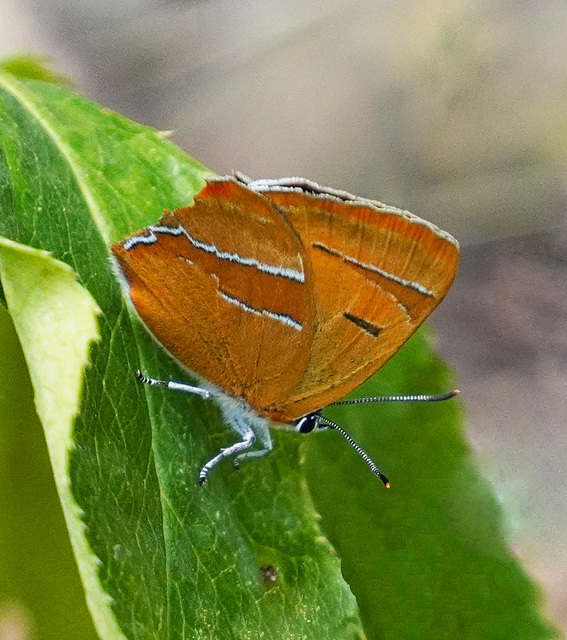

Diesen herrlich gefärbten kleinen Schmetterling, der zur Gruppe der Bläulinge gezählt wird, konnte ich gestern für wenige Sekunden in meinem Garten beobachten. Es war ein weiblicher Nierenfleck-Zipfelfalter (Thecla betulae), dem allerdings wohl durch einen Vogelangriff das "Zipfelchen" verloren ging. Das PiP zeigt die Oberseite des Falters mit den typischen "Nierenflecken", welche dem Männchen fehlen. Ich habe jetzt zum wiederholten Mal Schmetterlinge gefunden (Zipfelfalter, Segelfalter), denen das Schwänzchen wohl durch einen Vogel abgehackt worden ist. Damit kann ich die Theorie von W. Wickler bestätigen, dass mit dem Schwänzchen ein falscher Kopf vorgetäuscht werden soll, der im Fall eines Angriffs zwar verloren geht, den Besitzer desselben aber überleben lässt.
Die Nierenfleck-Falter sieht man deswegen sehr selten, weil sie sich bevorzugt im Kronenbereich von Bäumen aufhalten, und nur die Weibchen zur Eiablage längere Zeit in Bodennähe erscheinen. Er gilt deshalb in Deutschland als ungefährdet.
Nierenfleck-Zipfelfalter_2018.pdf
de.wikipedia.org/wiki/Nierenfleck-Zipfelfalter
butterfly-conservation.org/butterflies/brown-hairstreak
Yesterday I was able to observe this wonderfully colored small butterfly, which belongs to the group of blues, for a few seconds in my garden. It was a female brown hairstreak (Thecla betulae), which probably lost its "little tail" due to a bird attack. The PiP shows the upper side of the butterfly with the typical "kidney spots", which the male lacks. I have now repeatedly found butterflies whose tails (hairstreaks) have probably been chopped off by a bird. With this I can confirm W. Wickler's theory that the tail is intended to fake a false head, which will be lost in the event of an attack, but will allow the owner to survive.
The brown hairstreaks are very rarely seen because they prefer to stay in the crowns of trees and only the females appear near the ground for a long time to lay their eggs. It is therefore not considered endangered in Germany.
Translate into English
Die Nierenfleck-Falter sieht man deswegen sehr selten, weil sie sich bevorzugt im Kronenbereich von Bäumen aufhalten, und nur die Weibchen zur Eiablage längere Zeit in Bodennähe erscheinen. Er gilt deshalb in Deutschland als ungefährdet.
Nierenfleck-Zipfelfalter_2018.pdf
de.wikipedia.org/wiki/Nierenfleck-Zipfelfalter
butterfly-conservation.org/butterflies/brown-hairstreak
Yesterday I was able to observe this wonderfully colored small butterfly, which belongs to the group of blues, for a few seconds in my garden. It was a female brown hairstreak (Thecla betulae), which probably lost its "little tail" due to a bird attack. The PiP shows the upper side of the butterfly with the typical "kidney spots", which the male lacks. I have now repeatedly found butterflies whose tails (hairstreaks) have probably been chopped off by a bird. With this I can confirm W. Wickler's theory that the tail is intended to fake a false head, which will be lost in the event of an attack, but will allow the owner to survive.
The brown hairstreaks are very rarely seen because they prefer to stay in the crowns of trees and only the females appear near the ground for a long time to lay their eggs. It is therefore not considered endangered in Germany.
Vincent Dipietro, Berny, kiiti, Helena Ferreira and 21 other people have particularly liked this photo
- Keyboard shortcuts:
Jump to top
RSS feed- Latest comments - Subscribe to the comment feeds of this photo
- ipernity © 2007-2026
- Help & Contact
|
Club news
|
About ipernity
|
History |
ipernity Club & Prices |
Guide of good conduct
Donate | Group guidelines | Privacy policy | Terms of use | Statutes | In memoria -
Facebook
X

Thank you for the note.
Wünsche noch einen schönen Abend,ganz liebe Grüße Güni :))
photos.app.goo.gl/YQs5kqCdRVMdRWzcA
Sign-in to write a comment.