

Zeit der Sonnenhüte - Time of the coneflowers
Bei der Balz - During mating
Der zweitkleinste Bläuling Mitteleuropas - The sec…
Fressen und gefressen werden - Eating and being ea…
Ein Russischer Bär - A Jersey tiger - PiPs
Auch ohne Zipfel kann man leben ... You can live e…
Der kümmerliche Rest - The meagre remainder
Auch die Unterseite kann entzücken - The underside…
Faulbaum-Bläuling - Celastrina argiolus - Holly Bl…
Kleiner Feuerfalter - Lycaena phlaeas - small copp…
Zahnflügel-Bläuling (Polyommatus daphnis) - Meleag…
Kleiner Schillerfalter - Apatura ilia - Lesser pur…
Kleiner Fuchs - Optimal Sonne tanken - Optimal sun…
Der Admiral - Die Wärme der Sonne genießen - Enjoy…
Tagpfauenauge - Im prächtigen Hochzeitskleid - In…
Die Admirale sind schon da - The admirals are alre…
Segelfalter: einer der schönsten Tagfalter - Scarc…
Aurorafalter: Ich schlafe noch ... Orange tip: I a…
Kleiner Perlmutterfalter - Issoria lathonia - Quee…
Ein Winzling: Das Hornkraut-Tageulchen - A Tiny On…
Aurorafalter: Hilfe, ich stecke fest! - Orange Tip…
Langhornmotte: Länger geht's nicht - Longhorn Moth…
Der Mauerfuchs liebt die Wärme - The wall brown lo…
Ein scheuer Waldbewohner - A shy woodland dweller
Ein ganz seltener Gast - A very rare guest - 2PiP
Insekten-Kamasutra (2)__Insect Camasutra (2) - PiP
Insekten-Kamasutra (1)__Insect Camasutra (1)
Mein Überraschungsfund - My surprise find
Der typische Schmetterling im Hochsommer - The typ…
Ein Liebhaber warmer Standorte ... A lover of warm…
Mit einem ganz langen Saugrüssel ... Equipped with…
Eine haarige Schönheit - A hairy beauty
Seid fruchtbar und mehret euch ... Be fruitful and…
Eine zarte Schmetterlingsfee - A delicate butterfl…
Eine stark gefährdete Art - A highly endangered sp…
Sommerbeginn - Beginning of summer
Der kleine Fuchs - The Small tortoiseshell
Eine stark bedrohte Schönheit - A highly endangere…
Ein sehr seltener Gast (2) - A very rare guest (2)…
Ein sehr seltener Gast (1)- A very rare guest (1)-…
Ein stacheliges Monster - A prickly monster
Er ist wieder da - He is back again
Benannt nach der römischen Göttin der Morgenröte .…
Weibchlicher Aurorafalter - Female Orange Tip - 2…
Jetzt schnell auftanken ... Now quickly fill up. .…

See also...
Keywords
Authorizations, license
-
Visible by: Everyone -
All rights reserved
-
611 visits
Nur für Hummeln und Schmetterlinge geeignet ... Only appropriate for bumblebees and butterflies ...
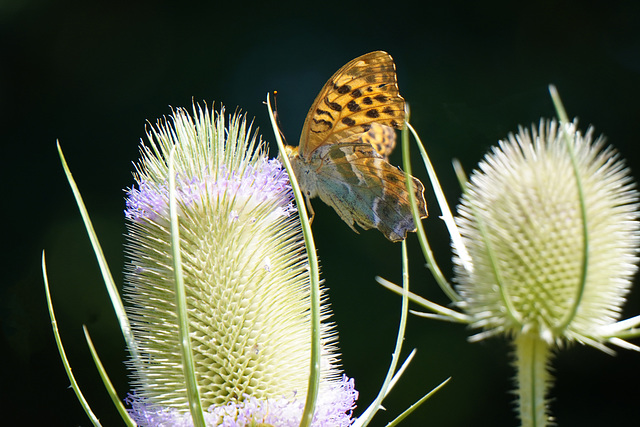

... sind die Blüten der Wilden Karde (Dipsacus fullonum, Syn.: Dipsacus sylvestris), weil die Einzelblüten in diesen Blütenringen ca. 1 cm lang sind, und der Blütengrund mit Nektar nur von langrüsseligen Insekten erreicht wird. Im Bild ein Blick in ein Kardenfeld, wo gerade an einem Kardenblütenstand ein Kaisermantel (Argynnis paphia) Nektar saugt. Dieser Schmetterling ist ziemlich stark beschädigt. Offensichtlich hat er die Attacke eines Vogels überlebt.
de.wikipedia.org/wiki/Wilde_Karde
... are the flowers of the wild teasel (Dipsacus fullonum, Syn.: Dipsacus sylvestris), because the individual flowers in these flower rings are about 1 cm long, and the flower base with nectar can only be reached by long-trunked insects. The photo shows a view into a teasel field, where a silver-washed fritillary (Argynnis paphia) is sucking nectar at a teasel inflorescence. This butterfly is quite badly damaged. Obviously it survived the attack of a bird.
Translate into English
de.wikipedia.org/wiki/Wilde_Karde
... are the flowers of the wild teasel (Dipsacus fullonum, Syn.: Dipsacus sylvestris), because the individual flowers in these flower rings are about 1 cm long, and the flower base with nectar can only be reached by long-trunked insects. The photo shows a view into a teasel field, where a silver-washed fritillary (Argynnis paphia) is sucking nectar at a teasel inflorescence. This butterfly is quite badly damaged. Obviously it survived the attack of a bird.
bonsai59, Ernst Doro, , Eva Lewitus and 31 other people have particularly liked this photo
- Keyboard shortcuts:
Jump to top
RSS feed- Latest comments - Subscribe to the comment feeds of this photo
- ipernity © 2007-2026
- Help & Contact
|
Club news
|
About ipernity
|
History |
ipernity Club & Prices |
Guide of good conduct
Donate | Group guidelines | Privacy policy | Terms of use | Statutes | In memoria -
Facebook
X

Wünsche noch einen schönen Nachmittag,ganz liebe Grüße Güni :))
Schöne Grüße und einen angenehmen Sonntag
Erich
Sign-in to write a comment.