

Die letzten Osterglocken - The last daffodils
Ein Bienenwolf - A very hairy beetle
Ein außergewöhnliches Jagdrevier - An exceptional…
Neulich im Wald ... The other day in the forest ..…
Übersehene Schönheit - Overlooked beauty
Himmelsschlüssel - Heaven's keys
Bunte Eleganz - Colourful elegance
Der Schlagbaum bewegt sich - The Lever is moving.
Gloria dei - Rosa Peace
Nur für Hummeln und Schmetterlinge geeignet ... On…
1) Schachbrettfalter lieben violette Blüten - Marb…
Jetzt leuchten sie wieder - Now they are shining a…
Die Zeit der Frühlingsblumen endet - The time of s…
Pilze soweit man schaut - Mushrooms as far as the…
Ein Spinnennetz in den Regenbogenfarben - A spider…
Die Osterglockenzeit geht zu Ende - The Daffodil S…
Einer der ersten Frühlingsboten - One of the first…
Der kalendarische Frühling 2021 beginnt am 20. Mär…
Silberne Drähte in einem fränkischen Weinberg - Si…
Mein Weihnachtskaktus blüht zu Ostern - My Christm…
Sommer Bokeh - Summer bokeh
Endlich wieder Farbe im Garten - Finally colour in…
Weinbergstulpe - Wild tulip
In Verbindung bleiben - Stay connected
Natural Smiley
Kleine Struwwelpeter | Little tousle-heads
Es wird Nacht im Elbtal - Night is falling in the…
Ein ungewöhnlicher Blütenbesucher - An unusual blo…
Gemeine Hasel (Corylus avellana) - Common Hazel
Im lockigen Haar ... With curly hair ... HFF
Tauperlen - Dew pearls
Pinot noir
Eine raffinierte Insektenfalle - A sophisticated i…
Hochsommer- Midsummer
Ein Tänzchen auf der Mohnkapsel - A dance on the p…
Zitronenfalter (Gonepteryx rhamni) an Kratzdistel…
Nach dem Regen - After the rain
Frühling! - Spring!

See also...
Keywords
Authorizations, license
-
Visible by: Everyone -
All rights reserved
-
530 visits
Frühlingssonne - Spring sun
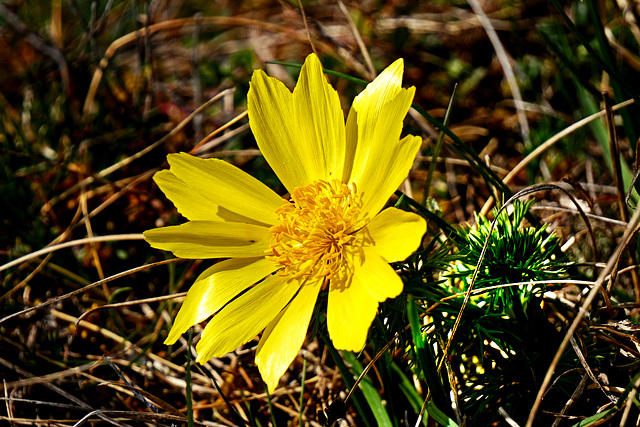

In einem Naturschutzgebiet bei Karlstadt fand ich dieses Exemplar eines Frühlings-Adonisröschens (Adonis vernale). Es war der einzige Vertreter seiner Art weit und breit. Offensichtlich beginnt in diesem Naturschutzgebiet die Ausbreitung dieses schönen Frühblühers.
Das Frühlings-Adonisröschen stammt ursprünglich aus Sibirien und dem Altai. Es ist auch auf Trocken- und Steppenrasen sowie in Kiefernwäldern in Europa und in Westsibirien zu finden.
Noch eine Bemerkung zum Foto. Viele, vor allem gelbe Blüten, weisen im Sonnenschein fotografiert "ausgebleichte" Stellen auf. Der Grund ist sehr wahrscheinlich die Wachsschicht, welche solche Blüten überzieht und das Licht reflektiert, wobei die gelbe Farbe überstrahlt wird. Ohne Sonnenschein fotografiert wäre die Lösung, doch dann ist die gelbe Farbe sehr stumpf.
de.wikipedia.org/wiki/Fr%C3%BChlings-Adonisr%C3%B6schen
In a nature reserve near Karlstadt, I found this specimen of a pheasant's eye (Adonis vernale). It was the only example of its species far and wide. Obviously, the spread of this beautiful early-flowering plant is beginning in this nature reserve.
The pheasant's eye is originally from Siberia and the Altai. It can also be found on dry and steppe grasslands as well as in pine forests in Europe and in Western Siberia.
One more comment on the photo. Many flowers, especially yellow ones, show "bleached" areas when photographed in the sunshine. The reason is most likely the wax layer that covers such flowers and reflects the light, masking the yellow colour. Photographed without sunshine would be the solution, but then the yellow colour is very dull.
Translate into English
Das Frühlings-Adonisröschen stammt ursprünglich aus Sibirien und dem Altai. Es ist auch auf Trocken- und Steppenrasen sowie in Kiefernwäldern in Europa und in Westsibirien zu finden.
Noch eine Bemerkung zum Foto. Viele, vor allem gelbe Blüten, weisen im Sonnenschein fotografiert "ausgebleichte" Stellen auf. Der Grund ist sehr wahrscheinlich die Wachsschicht, welche solche Blüten überzieht und das Licht reflektiert, wobei die gelbe Farbe überstrahlt wird. Ohne Sonnenschein fotografiert wäre die Lösung, doch dann ist die gelbe Farbe sehr stumpf.
de.wikipedia.org/wiki/Fr%C3%BChlings-Adonisr%C3%B6schen
In a nature reserve near Karlstadt, I found this specimen of a pheasant's eye (Adonis vernale). It was the only example of its species far and wide. Obviously, the spread of this beautiful early-flowering plant is beginning in this nature reserve.
The pheasant's eye is originally from Siberia and the Altai. It can also be found on dry and steppe grasslands as well as in pine forests in Europe and in Western Siberia.
One more comment on the photo. Many flowers, especially yellow ones, show "bleached" areas when photographed in the sunshine. The reason is most likely the wax layer that covers such flowers and reflects the light, masking the yellow colour. Photographed without sunshine would be the solution, but then the yellow colour is very dull.
Günter Klaus, kiiti, ColRam, Nora Caracci and 31 other people have particularly liked this photo
- Keyboard shortcuts:
Jump to top
RSS feed- Latest comments - Subscribe to the comment feeds of this photo
- ipernity © 2007-2026
- Help & Contact
|
Club news
|
About ipernity
|
History |
ipernity Club & Prices |
Guide of good conduct
Donate | Group guidelines | Privacy policy | Terms of use | Statutes | In memoria -
Facebook
X

Sonnengelber Schönling...deswegen wohl auch Adonis :)
Ich mag den Glanz auf den Blättern!
Sehr schön Festgehalten.
Bonne soirée
Wünsche noch einen schönen Abend,ganz liebe Grüße Güni :))
Sign-in to write a comment.