


Lot-et-Garonne (47) and Gironde (33)

Fotos taken in the départements Lot-et-Garonne and Gironde, meanwhile parts of "Nouvelle-Aquitaine" region.
Monsempron - Saint-Géraud
| |
|
|
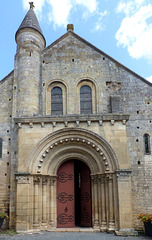
The history of Monsempron (Mons-Sempronius) started, when in the 11th century Benedictine monks from Aurillac arrived and a priory, dependent from the abbey Saint-Géraud in Aurillac. The priory dominating the confluence of Lémance and Lot developed into a kind of fortified monastic town, that later got surrounded by a village. The first church here may have been small and simple. The church seen today got erected in the second half of the 12th century.It got enlarged and modified later, the Romanesque choir got replaced by a larger Gothic one (right).
The secularisation of the Aurillac abbey ended the Benedictine life here, is in 1561 the priory was taken over by a chapter of canons. In 1632 the Lord of Fumel bought the office of prior of Monsempron for his underaged son. Léon de Saulx de Tavannes, prior from 1710 on, resided in Paris. All these priors were just interested in the revenue of the priory.
The chapter got dissolved in 1790. Parts of the buildings were used by the municipality, but in 1793 they were put on sale. Today the whole structure is in the possession of the municipality.
The church has two portals, this one at the western facade is the larger ones. The carvings look so unweathered, that they may well be the result of a renovation.
Monsempron - Saint-Géraud
| |
|
|
The history of Monsempron (Mons-Sempronius) started, when in the 11th century Benedictine monks from Aurillac arrived and a priory, dependent from the abbey Saint-Géraud in Aurillac. The priory dominating the confluence of Lémance and Lot developed into a kind of fortified monastic town, that later got surrounded by a village. The first church here may have been small and simple. The church seen today got erected in the second half of the 12th century.It got enlarged and modified later, the Romanesque choir got replaced by a larger Gothic one (right).
The secularisation of the Aurillac abbey ended the Benedictine life here, is in 1561 the priory was taken over by a chapter of canons. In 1632 the Lord of Fumel bought the office of prior of Monsempron for his underaged son. Léon de Saulx de Tavannes, prior from 1710 on, resided in Paris. All these priors were just interested in the revenue of the priory.
The chapter got dissolved in 1790. Parts of the buildings were used by the municipality, but in 1793 they were put on sale. Today the whole structure is in the possession of the municipality.
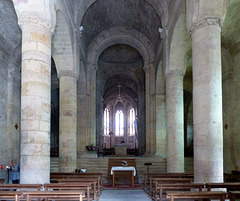
The choir of the church was built over a crypt and so stairs lead up to it. The apse is Gothic. The capitals are extraordinary.
Monsempron - Saint-Géraud
| |
|
The history of Monsempron (Mons-Sempronius) started, when in the 11th century Benedictine monks from Aurillac arrived and a priory, dependent from the abbey Saint-Géraud in Aurillac. The priory dominating the confluence of Lémance and Lot developed into a kind of fortified monastic town, that later got surrounded by a village. The first church here may have been small and simple. The church seen today got erected in the second half of the 12th century.It got enlarged and modified later, the Romanesque choir got replaced by a larger Gothic one (right).
The secularisation of the Aurillac abbey ended the Benedictine life here, is in 1561 the priory was taken over by a chapter of canons. In 1632 the Lord of Fumel bought the office of prior of Monsempron for his underaged son. Léon de Saulx de Tavannes, prior from 1710 on, resided in Paris. All these priors were just interested in the revenue of the priory.
The chapter got dissolved in 1790. Parts of the buildings were used by the municipality, but in 1793 they were put on sale. Today the whole structure is in the possession of the municipality.
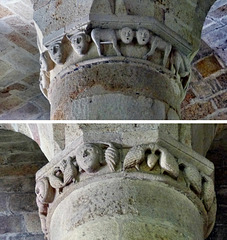
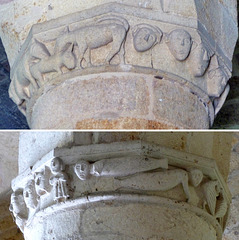
There are some nice, but "normal" capitals around the crossing, but the carvings along the nave are extraordenary. Strange creatures!
Monsempron - Saint-Géraud
| |
|
|
The history of Monsempron (Mons-Sempronius) started, when in the 11th century Benedictine monks from Aurillac arrived and a priory, dependent from the abbey Saint-Géraud in Aurillac. The priory dominating the confluence of Lémance and Lot developed into a kind of fortified monastic town, that later got surrounded by a village. The first church here may have been small and simple. The church seen today got erected in the second half of the 12th century.It got enlarged and modified later, the Romanesque choir got replaced by a larger Gothic one (right).
The secularisation of the Aurillac abbey ended the Benedictine life here, is in 1561 the priory was taken over by a chapter of canons. In 1632 the Lord of Fumel bought the office of prior of Monsempron for his underaged son. Léon de Saulx de Tavannes, prior from 1710 on, resided in Paris. All these priors were just interested in the revenue of the priory.
The chapter got dissolved in 1790. Parts of the buildings were used by the municipality, but in 1793 they were put on sale. Today the whole structure is in the possession of the municipality.
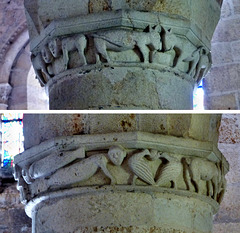
There are some nice, but "normal" capitals around the crossing, but the carvings along the nave are extraordenary. Strange creatures!
Monsempron - Saint-Géraud
| |
|
The history of Monsempron (Mons-Sempronius) started, when in the 11th century Benedictine monks from Aurillac arrived and a priory, dependent from the abbey Saint-Géraud in Aurillac. The priory dominating the confluence of Lémance and Lot developed into a kind of fortified monastic town, that later got surrounded by a village. The first church here may have been small and simple. The church seen today got erected in the second half of the 12th century.It got enlarged and modified later, the Romanesque choir got replaced by a larger Gothic one (right).
The secularisation of the Aurillac abbey ended the Benedictine life here, is in 1561 the priory was taken over by a chapter of canons. In 1632 the Lord of Fumel bought the office of prior of Monsempron for his underaged son. Léon de Saulx de Tavannes, prior from 1710 on, resided in Paris. All these priors were just interested in the revenue of the priory.
The chapter got dissolved in 1790. Parts of the buildings were used by the municipality, but in 1793 they were put on sale. Today the whole structure is in the possession of the municipality.
There are some nice, but "normal" capitals around the crossing, but the carvings along the nave are extraordenary. Strange creatures!

Moirax - Notre-Dame
| |
|
|
In 1049, Guillaume Arnaud, lord of Moirax, donated land to Cluny Abbey to found a Benedictine priory here, where a 9th-century church existed. Pierre de Moirax, the founder's son, was the first prior. The construction of the current church was started around 1060 and spanned for about a century. The priory is located on the heights of the Garonne Valley, not far from Agen, on the way to Santiago de Compostela.

Moirax - Notre-Dame
| |
|
|
In 1049, Guillaume Arnaud, lord of Moirax, donated land to Cluny Abbey to found a Benedictine priory here, where a 9th-century church existed. Pierre de Moirax, the founder's son, was the first prior. The construction of the current church was started around 1060 and spanned for about a century. The priory is located on the heights of the Garonne Valley, not far from Agen, on the way to Santiago de Compostela.

Moirax - Notre-Dame
| |
|
|
In 1049, Guillaume Arnaud, lord of Moirax, donated land to Cluny Abbey to found a Benedictine priory here, where a 9th-century church existed. Pierre de Moirax, the founder's son, was the first prior. The construction of the current church was started around 1060 and spanned for about a century. The priory is located on the heights of the Garonne Valley, not far from Agen, on the way to Santiago de Compostela.
The church is about 50m long.

Moirax - Notre-Dame
| |
|
|
In 1049, Guillaume Arnaud, lord of Moirax, donated land to Cluny Abbey to found a Benedictine priory here, where a 9th-century church existed. Pierre de Moirax, the founder's son, was the first prior. The construction of the current church was started around 1060 and spanned for about a century. The priory is located on the heights of the Garonne Valley, not far from Agen, on the way to Santiago de Compostela.
Below the dome. What an architectural achievement!

Moirax - Notre-Dame
| |
|
In 1049, Guillaume Arnaud, lord of Moirax, donated land to Cluny Abbey to found a Benedictine priory here, where a 9th-century church existed. Pierre de Moirax, the founder's son, was the first prior. The construction of the current church was started around 1060 and spanned for about a century. The priory is located on the heights of the Garonne Valley, not far from Agen, on the way to Santiago de Compostela.
A large pride of lions cavorts on the capitals. Daniel sits in between.

Moirax - Notre-Dame
| |
|
|
In 1049, Guillaume Arnaud, lord of Moirax, donated land to Cluny Abbey to found a Benedictine priory here, where a 9th-century church existed. Pierre de Moirax, the founder's son, was the first prior. The construction of the current church was started around 1060 and spanned for about a century. The priory is located on the heights of the Garonne Valley, not far from Agen, on the way to Santiago de Compostela.
Adam and Eve
Agen - Marche couvert
| |
|
|
The Gallo-Roman city of Aginnum, which existed here, was very populated and had an amphitheater that could accommodate more than 10,000 people. From the end of the 3rd century , the chronicles relate the martyrdoms of Saint Caprais and Saint Foy, who are said to be buried in Aginnum. The first known bishop, named Phébade, is documented a century later.
Over the following centuries, Agen was invaded by the Vandals, the Visigoths, and the Franks before being attacked by the Vikings in the 9th century. Historians have noted three invasions: in 843, 853, and the last in 922. A great loss for Agen was when at the end of the 9th century monks from Conques could steal the relics of St. Foy and transfer them to Conques (where they still are).
In the 13th and 14th centuries, the city was contested between the English and the French. In the early stages of the Hundred Years' War, it came to the English but was conquered and recaptured twice. In 1372, the Duke of Anjou established his headquarters here. Although he lost the city the next year, he was able to retake it by 1374. While thereafter part of the towns and castles of Agenais were temporarily under English rule, Agen remained almost permanently in French hands until the end of the war.
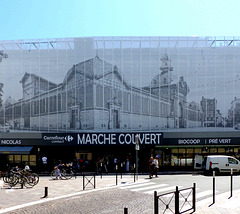
The covered market, built in 1882, and rebuilt in the 1970s, was unfortunately under reconstruction
Agen - Cathédrale Saint-Caprais d'Agen
| |
|
|
The Gallo-Roman city of Aginnum, which existed here, was very populated and had an amphitheater that could accommodate more than 10,000 people. From the end of the 3rd century , the chronicles relate the martyrdoms of Saint Caprais and Saint Foy, who are said to be buried in Aginnum. The first known bishop, named Phébade, is documented a century later.
Over the following centuries, Agen was invaded by the Vandals, the Visigoths, and the Franks before being attacked by the Vikings in the 9th century. Historians have noted three invasions: in 843, 853, and the last in 922. A great loss for Agen was when at the end of the 9th century monks from Conques could steal the relics of St. Foy and transfer them to Conques (where they still are).
In the 13th and 14th centuries, the city was contested between the English and the French. In the early stages of the Hundred Years' War, it came to the English but was conquered and recaptured twice. In 1372, the Duke of Anjou established his headquarters here. Although he lost the city the next year, he was able to retake it by 1374. While thereafter part of the towns and castles of Agenais were temporarily under English rule, Agen remained almost permanently in French hands until the end of the war.
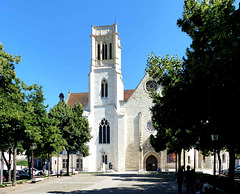
According to tradition, a church dedicated to Saint Caprais was built at the beginning of the 5th century. A basilica dedicated to Saint Caprais certainly existed in 580, since Grégoire de Tours cites it on that date.
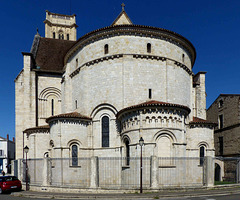
Agen Cathedral's structure dates to the 12th century, when it was built as a collegiate church of canons dedicated to Saint Caprasius of Agen on the foundations of a basilica sacked by the Normans in 853 but thereafter restored. It was sacked again in December 1561 during the Wars of Religion.
At the onset of the French Revolution in 1789 the church lost its religious function and was used as a fodder store before being reopened in 1796. It was elevated to the status of the cathedral of the Diocese of Agen in 1801, replacing the former cathedral dedicated to Saint Étienne, which was destroyed during the Revolution.
Agen - Cathédrale Saint-Caprais d'Agen
| |
|
|
The Gallo-Roman city of Aginnum, which existed here, was very populated and had an amphitheater that could accommodate more than 10,000 people. From the end of the 3rd century , the chronicles relate the martyrdoms of Saint Caprais and Saint Foy, who are said to be buried in Aginnum. The first known bishop, named Phébade, is documented a century later.
Over the following centuries, Agen was invaded by the Vandals, the Visigoths, and the Franks before being attacked by the Vikings in the 9th century. Historians have noted three invasions: in 843, 853, and the last in 922. A great loss for Agen was when at the end of the 9th century monks from Conques could steal the relics of St. Foy and transfer them to Conques (where they still are).
In the 13th and 14th centuries, the city was contested between the English and the French. In the early stages of the Hundred Years' War, it came to the English but was conquered and recaptured twice. In 1372, the Duke of Anjou established his headquarters here. Although he lost the city the next year, he was able to retake it by 1374. While thereafter part of the towns and castles of Agenais were temporarily under English rule, Agen remained almost permanently in French hands until the end of the war.
According to tradition, a church dedicated to Saint Caprais was built at the beginning of the 5th century. A basilica dedicated to Saint Caprais certainly existed in 580, since Grégoire de Tours cites it on that date.
Agen Cathedral's structure dates to the 12th century, when it was built as a collegiate church of canons dedicated to Saint Caprasius of Agen on the foundations of a basilica sacked by the Normans in 853 but thereafter restored. It was sacked again in December 1561 during the Wars of Religion.
At the onset of the French Revolution in 1789 the church lost its religious function and was used as a fodder store before being reopened in 1796. It was elevated to the status of the cathedral of the Diocese of Agen in 1801, replacing the former cathedral dedicated to Saint Étienne, which was destroyed during the Revolution.
Agen - Cathédrale Saint-Caprais d'Agen
| |
|
The Gallo-Roman city of Aginnum, which existed here, was very populated and had an amphitheater that could accommodate more than 10,000 people. From the end of the 3rd century , the chronicles relate the martyrdoms of Saint Caprais and Saint Foy, who are said to be buried in Aginnum. The first known bishop, named Phébade, is documented a century later.
Over the following centuries, Agen was invaded by the Vandals, the Visigoths, and the Franks before being attacked by the Vikings in the 9th century. Historians have noted three invasions: in 843, 853, and the last in 922. A great loss for Agen was when at the end of the 9th century monks from Conques could steal the relics of St. Foy and transfer them to Conques (where they still are).
In the 13th and 14th centuries, the city was contested between the English and the French. In the early stages of the Hundred Years' War, it came to the English but was conquered and recaptured twice. In 1372, the Duke of Anjou established his headquarters here. Although he lost the city the next year, he was able to retake it by 1374. While thereafter part of the towns and castles of Agenais were temporarily under English rule, Agen remained almost permanently in French hands until the end of the war.
According to tradition, a church dedicated to Saint Caprais was built at the beginning of the 5th century. A basilica dedicated to Saint Caprais certainly existed in 580, since Grégoire de Tours cites it on that date.
Agen Cathedral's structure dates to the 12th century, when it was built as a collegiate church of canons dedicated to Saint Caprasius of Agen on the foundations of a basilica sacked by the Normans in 853 but thereafter restored. It was sacked again in December 1561 during the Wars of Religion.
At the onset of the French Revolution in 1789 the church lost its religious function and was used as a fodder store before being reopened in 1796. It was elevated to the status of the cathedral of the Diocese of Agen in 1801, replacing the former cathedral dedicated to Saint Étienne, which was destroyed during the Revolution.
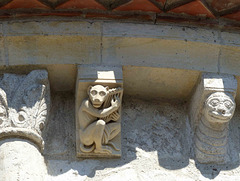
There are lots of weathered corbels under the roof. Some have been replaced by copies meanwhile.
Agen - Cathédrale Saint-Caprais d'Agen
| |
|
|
The Gallo-Roman city of Aginnum, which existed here, was very populated and had an amphitheater that could accommodate more than 10,000 people. From the end of the 3rd century , the chronicles relate the martyrdoms of Saint Caprais and Saint Foy, who are said to be buried in Aginnum. The first known bishop, named Phébade, is documented a century later.
Over the following centuries, Agen was invaded by the Vandals, the Visigoths, and the Franks before being attacked by the Vikings in the 9th century. Historians have noted three invasions: in 843, 853, and the last in 922. A great loss for Agen was when at the end of the 9th century monks from Conques could steal the relics of St. Foy and transfer them to Conques (where they still are).
In the 13th and 14th centuries, the city was contested between the English and the French. In the early stages of the Hundred Years' War, it came to the English but was conquered and recaptured twice. In 1372, the Duke of Anjou established his headquarters here. Although he lost the city the next year, he was able to retake it by 1374. While thereafter part of the towns and castles of Agenais were temporarily under English rule, Agen remained almost permanently in French hands until the end of the war.
According to tradition, a church dedicated to Saint Caprais was built at the beginning of the 5th century. A basilica dedicated to Saint Caprais certainly existed in 580, since Grégoire de Tours cites it on that date.
Agen Cathedral's structure dates to the 12th century, when it was built as a collegiate church of canons dedicated to Saint Caprasius of Agen on the foundations of a basilica sacked by the Normans in 853 but thereafter restored. It was sacked again in December 1561 during the Wars of Religion.
At the onset of the French Revolution in 1789 the church lost its religious function and was used as a fodder store before being reopened in 1796. It was elevated to the status of the cathedral of the Diocese of Agen in 1801, replacing the former cathedral dedicated to Saint Étienne, which was destroyed during the Revolution.
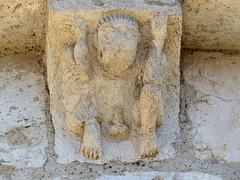
There are lots of weathered corbels under the roof. Carved on to this corbel is a male exhibitionist.
Agen - Musée des Beaux-Arts
| |
|
|
The Gallo-Roman city of Aginnum, which existed here, was very populated and had an amphitheater that could accommodate more than 10,000 people. From the end of the 3rd century , the chronicles relate the martyrdoms of Saint Caprais and Saint Foy, who are said to be buried in Aginnum. The first known bishop, named Phébade, is documented a century later.
Over the following centuries, Agen was invaded by the Vandals, the Visigoths, and the Franks before being attacked by the Vikings in the 9th century. Historians have noted three invasions: in 843, 853, and the last in 922. A great loss for Agen was when at the end of the 9th century monks from Conques could steal the relics of St. Foy and transfer them to Conques (where they still are).
In the 13th and 14th centuries, the city was contested between the English and the French. In the early stages of the Hundred Years' War, it came to the English but was conquered and recaptured twice. In 1372, the Duke of Anjou established his headquarters here. Although he lost the city the next year, he was able to retake it by 1374. While thereafter part of the towns and castles of Agenais were temporarily under English rule, Agen remained almost permanently in French hands until the end of the war.
The Musée des Beaux-Arts is lodged in four magnificent Renaissance mansion houses which open out on to fine inner courtyards.
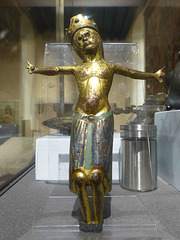
The "Tresor de Castillones" consists of 10 pieces of medieval goldsmithery. It was discovered in Castillones, a fortified town, before 1907.
This cross is one of the pieces found.
Agen - Musée des Beaux-Arts
| |
|
The Gallo-Roman city of Aginnum, which existed here, was very populated and had an amphitheater that could accommodate more than 10,000 people. From the end of the 3rd century , the chronicles relate the martyrdoms of Saint Caprais and Saint Foy, who are said to be buried in Aginnum. The first known bishop, named Phébade, is documented a century later.
Over the following centuries, Agen was invaded by the Vandals, the Visigoths, and the Franks before being attacked by the Vikings in the 9th century. Historians have noted three invasions: in 843, 853, and the last in 922. A great loss for Agen was when at the end of the 9th century monks from Conques could steal the relics of St. Foy and transfer them to Conques (where they still are).
In the 13th and 14th centuries, the city was contested between the English and the French. In the early stages of the Hundred Years' War, it came to the English but was conquered and recaptured twice. In 1372, the Duke of Anjou established his headquarters here. Although he lost the city the next year, he was able to retake it by 1374. While thereafter part of the towns and castles of Agenais were temporarily under English rule, Agen remained almost permanently in French hands until the end of the war.
The
Musée des Beaux-Arts is lodged in four magnificent Renaissance mansion houses which open out on to fine inner courtyards.
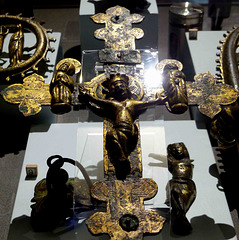
The "Tresor de Castillones" consists of 10 pieces of medieval goldsmithery. It was discovered in Castillones, a fortified town, before 1907.
This cross is one of the pieces found.
Jump to top
RSS feed- Latest items - Subscribe to the latest items added to this album
- ipernity © 2007-2026
- Help & Contact
|
Club news
|
About ipernity
|
History |
ipernity Club & Prices |
Guide of good conduct
Donate | Group guidelines | Privacy policy | Terms of use | Statutes | In memoria -
Facebook
X
