


Lot-et-Garonne (47) and Gironde (33)

Fotos taken in the départements Lot-et-Garonne and Gironde, meanwhile parts of "Nouvelle-Aquitaine" region.
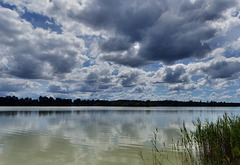
Approaching Arsac
| |
|
I was surprised, that there is no wine growing south of Margaux. The region is flat and sandy. A heathland with pine forests. North of Arsac are some large ponds.
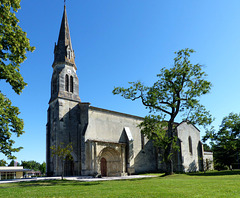
Arsac - Saint-Germain
| |
|
Early morning in Arsac. Saint-Germain was erected in the second half of the 19th century. The architects "saved" the Romanesque portal of the preceding church.
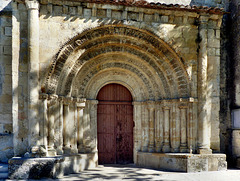
Arsac - Saint-Germain
| |
|
|
Early morning in Arsac. Saint-Germain was erected in the second half of the 19th century. The architects "saved" the Romanesque portal of the preceding church, seen here. It was created in the typical "style saintongeais". As it was carved from soft limestones, it is very weathered.
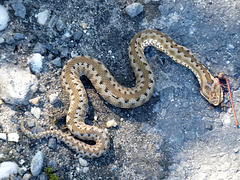
Arsac - Snake
| |
|
South of Arsac I walked through heathland again, but for a long stretch I had to follow a busy road, where I found this small snake. Most snakes I ever saw - were killed. Roadkill.
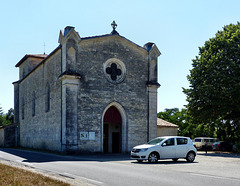
Le Pian-Médoc - Saint-Seurin
| |
|
I did a little detour to see Saint-Seurin, a Romanesque structure, outside today´s center of Le Pian-Médoc.
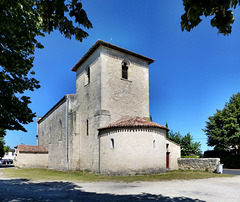
Le Pian-Médoc - Saint-Seurin
| |
|
I did a little detour to see Saint-Seurin, a Romanesque structure, outside today´s center of Le Pian-Médoc.

Blanquefort - Horses
| |
|
Blanquefort is already a northern suburb of Bordeaux. Approaching Blanquefort I passed a huge horse farm, where many dozens of horses grazed in the meadows. In Blanquefort I took a bus into the center of Bordeaux, as I do not really like to walk the sidewalks in large cities.

Bordeaux - Monument aux Girondins
| |
|
The Place des Quinconces hosts the "Monument aux Girondins", that was erected end of the 19th century to remember an honour the deputies of the Gironde, who were victims of the terror during the French Revolution. A great place to start the evening, after having reached Bordeaux.

Bordeaux - Monument aux Girondins
| |
|
The Place des Quinconces hosts the "Monument aux Girondins", that was erected end of the 19th century to remember an honour the deputies of the Gironde, who were victims of the terror during the French Revolution. A great place to start the evening, after having reached Bordeaux. To stand near to the fountains can be a refreshing experience after a hot day.

Bordeaux - L'Entrecôte
| |
|
Some years ago I saw for the first time people standing in a queue in front of a restaurant. This was in Toulouse and the restaurant was named "L'Entrecôte".
Meanwhile I know, that there are five "L'Entrecôte"- restaurants in France (Toulouse, Bordeaux, Nantes, Montpellier, Lyon).
Only one dish is served: "Steak frites", a very common and popular dish in France. I have tried it here in Bordeaux. Très bien!
www.entrecote.fr
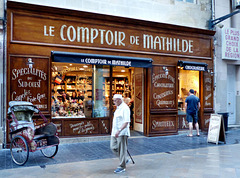
Bordeaux - Le Comptoir de Mathilde
| |
|
Le Comptoir de Mathilde looks like a hundred years old, but it is indeed pretty new. These shops can be found all over France, and to create an "old fashioned" look and touch - is a clever marketing idea.

Bordeaux - Place de la Bourse
| |
|
Moon over the Place de la Bourse.
The place was created between 1730 and 1755, after the medieval city walls got teared down. Up to the Revolution the place´s name was "Place Royale" and a statue of Louis XV stood in the center. The name then changed to "Place de la Liberté" and the statue got replaced by a liberty pole. Under Napoleon I this was the "Place Impériale". Since 1869 the "Fontaine des Trois Grâces" (Fountain of the three Graces) is installed in the center.
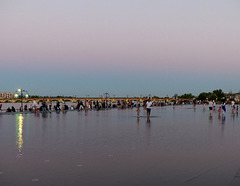
Bordeaux - Miroir d'eau
| |
|
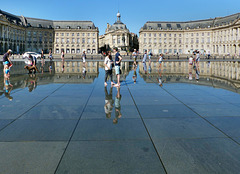
Late evening at the "Miroir d'eau" (= water mirror), a very shallow pond between the "Place de la Bourse" and the river Garonne. The water here only stands about 2cm high. The pond, that has even more "features", covers an area of more than 3000m² - and is loved not only by kids.
Bordeaux - Miroir d'eau
| |
|
I had seen (and walked) the "Miroir d'eau" (= water mirror), a very shallow pond between the "Place de la Bourse" and the river Garonne, late evening and just had to come back next morning. The water here only stands about 2cm high. The pond covers an area of more than 3000m² - and is loved not only by kids.
Bordeaux - Miroir d'eau
| |
|
|
|
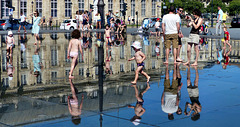
I had seen the "Miroir d'eau" (= water mirror), a very shallow pond between the "Place de la Bourse" and the river Garonne, late evening and just had to come back next morning.
The water here only stands about 2cm high. The pond covers an area of more than 3000m² - and is loved not only by kids.
Bordeaux - Saint-Seurin
| |
|
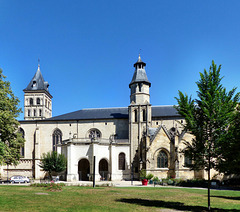
Saint-Seurin was originally built outside the city walls close to an ancient necropolis. The Abbey of St. Seurin bears the name of the venerated fourth bishop of Bordeaux. A first building, confirmed towards mid 5th century, got destroyed by the Normans in the 8th century. It was reconstructed above the crypt of St. Seurin from the 11th to 13th centuries.
The church underwent many modifications and got a new facade during the 19th century. Behind this facade parts of the Romanesque portal got saved.
Bordeaux was one of the major halts on the Via Turonensis. The grave of Saint-Seurin was an important place for the many pilgrims. Another precious relic, shown here, was the ivory horn of Roland, who died at Roncevaux and whose (legendary) burial place most pilgrims will have seen in Blaye. Tradition claims that the horn "olifant", still reported in the 17th century and lost before the French Revolution, had been left by the Charlemagne on the altar of St. Seurin.
Bordeaux - Saint-Seurin
| |
|
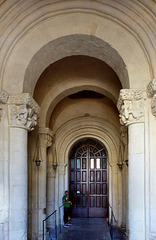
Saint-Seurin was originally built outside the city walls close to an ancient necropolis. The Abbey of St. Seurin bears the name of the venerated fourth bishop of Bordeaux. A first building, confirmed towards mid 5th century, got destroyed by the Normans in the 8th century. It was reconstructed above the crypt of St. Seurin from the 11th to 13th centuries.
The church underwent many modifications and got a new facade during the 19th century. Behind this facade parts of the Romanesque portal - seen here - got saved.
Bordeaux was one of the major halts on the Via Turonensis. The grave of Saint-Seurin was an important place for the many pilgrims. Another precious relic, shown here, was the ivory horn of Roland, who died at Roncevaux and whose (legendary) burial place most pilgrims will have seen in Blaye. Tradition claims that the horn "olifant", still reported in the 17th century and lost before the French Revolution, had been left by the Charlemagne on the altar of St. Seurin.
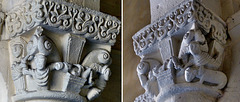
Bordeaux - Saint-Seurin
| |
|
Saint-Seurin was originally built outside the city walls close to an ancient necropolis. The Abbey of St. Seurin bears the name of the venerated fourth bishop of Bordeaux. A first building, confirmed towards mid 5th century, got destroyed by the Normans in the 8th century. It was reconstructed above the crypt of St. Seurin from the 11th to 13th centuries.
The church underwent many modifications and got a new facade during the 19th century. Behind this facade parts of the Romanesque portal got saved. This capital (seen from two sides) depicts Abraham´s sacrifice of Isaac (Genesis 22).
Bordeaux was one of the major halts on the Via Turonensis. The grave of Saint-Seurin was an important place for the many pilgrims. Another precious relic, shown here, was the ivory horn of Roland, who died at Roncevaux and whose (legendary) burial place most pilgrims will have seen in Blaye. Tradition claims that the horn "olifant", still reported in the 17th century and lost before the French Revolution, had been left by the Charlemagne on the altar of St. Seurin.
Jump to top
RSS feed- Latest items - Subscribe to the latest items added to this album
- ipernity © 2007-2026
- Help & Contact
|
Club news
|
About ipernity
|
History |
ipernity Club & Prices |
Guide of good conduct
Donate | Group guidelines | Privacy policy | Terms of use | Statutes | In memoria -
Facebook
X
