


Lower Saxony, Niedersachsen, Basse-Saxe

A collection of photos - taken in Lower Saxony.
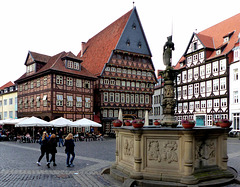
Hildesheim - Knochenhaueramtshaus
| |
|
|
Louis the Pious founded the bishopric of Hildesheim in 815. The settlement developed into a town and was granted market rights by King Otto III in 983. Craftsmen and merchants were attracted and the city developed into an important community. By 1167, Hildesheim was an almost completely walled market settlement.
At the beginning of the 13th century, Hildesheim had about 5,000 inhabitants, and when Hildesheim received its city charter in 1249, it was one of the largest cities in northern Germany. The clergy ruled Hildesheim for four centuries before a town hall was built and the citizens gained influence and independence. In 1367, Hildesheim became a member of the Hanseatic League. But what is now called Hildesheim was various small "suburbs". After centuries of (sometimes armed) disputes, it was not until the end of the 16th century that a union was created and subsequently at least the inner wall was taken down Old and New Town.
During the Thirty Years' War, Hildesheim was besieged and occupied several times. In 1813, after the Napoleonic Wars, the town became part of the Kingdom of Hanover, which was annexed by the Kingdom of Prussia as a province after the Austro-Prussian War in 1866.
The air raids on Hildesheim in 1944/45 destroyed large parts of the city. Of the 1500 half-timbered houses, only 200 remained. 90 percent of the historic old town was destroyed in the firestorm.
-
The Knochenhaueramtshaus (Butcher's Guild Hall) is one of the largest structures in the Historic Market of Hildesheim. With its 7 floors and a height of 26 meters, it is considered to be one of the tallest half-timbered houses in Germany.
It was originally built in 1529 in a Gothic style, and was used as a meeting place of the butchers' guild, which was a very wealthy and influential guild in Hildesheim in the Middle Ages. In 1884, the 4th, 5th, 6th, and 7th floors were destroyed by a fire, but rebuilt. immediately.
During WWII the City Council contemplated the dismantlement of the house, but this proved to be impossible.
On 22 March 1945, the half-timbered houses of the market place including the Knochenhaueramtshaus were destroyed by incendiary bombs. In the 1950s the houses were replaced by concrete buildings with flat roofs.
At the beginning of the 1980s, the City Council decided to tear down the buildings and reconstruct the historic Market Place. Many inhabitants donated money to the project. The foundation stone was laid on 27 October 1987and the reconstruction was completed in December 1989.
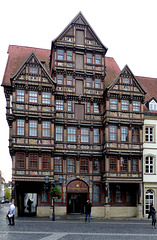
Hildesheim - Wedekindhaus
| |
|
|
|
Louis the Pious founded the bishopric of Hildesheim in 815. The settlement developed into a town and was granted market rights by King Otto III in 983. Craftsmen and merchants were attracted and the city developed into an important community. By 1167, Hildesheim was an almost completely walled market settlement.
At the beginning of the 13th century, Hildesheim had about 5,000 inhabitants, and when Hildesheim received its city charter in 1249, it was one of the largest cities in northern Germany. The clergy ruled Hildesheim for four centuries before a town hall was built and the citizens gained influence and independence. In 1367, Hildesheim became a member of the Hanseatic League. But what is now called Hildesheim was various small "suburbs". After centuries of (sometimes armed) disputes, it was not until the end of the 16th century that a union was created and subsequently at least the inner wall was taken down Old and New Town.
During the Thirty Years' War, Hildesheim was besieged and occupied several times. In 1813, after the Napoleonic Wars, the town became part of the Kingdom of Hanover, which was annexed by the Kingdom of Prussia as a province after the Austro-Prussian War in 1866.
The air raids on Hildesheim in 1944/45 destroyed large parts of the city. Of the 1500 half-timbered houses, only 200 remained. 90 percent of the historic old town was destroyed in the firestorm.
-
The Wedekindhaus is a half-timbered house in Renaissance style on the south side of the market square. It was originally built in 1598 diagonally opposite the town hall by the merchant Hans Storre as a residential and commercial building.
The bombing of Hildesheim on March 22, 1945, resulted in the total destruction of the house. In the course of the overall reconstruction of the historic market square in the 1980s, the facade of the Wedekindhaus was reconstructed largely true to the original. Behind the facade, front is the connected new building of the headquarters of the Sparkasse Hildesheim.

Hildesheim - Tempelhaus
| |
|
|
Louis the Pious founded the bishopric of Hildesheim in 815. The settlement developed into a town and was granted market rights by King Otto III in 983. Craftsmen and merchants were attracted and the city developed into an important community. By 1167, Hildesheim was an almost completely walled market settlement.
At the beginning of the 13th century, Hildesheim had about 5,000 inhabitants, and when Hildesheim received its city charter in 1249, it was one of the largest cities in northern Germany. The clergy ruled Hildesheim for four centuries before a town hall was built and the citizens gained influence and independence. In 1367, Hildesheim became a member of the Hanseatic League. But what is now called Hildesheim was various small "suburbs". After centuries of (sometimes armed) disputes, it was not until the end of the 16th century that a union was created and subsequently at least the inner wall was taken down Old and New Town.
During the Thirty Years' War, Hildesheim was besieged and occupied several times. In 1813, after the Napoleonic Wars, the town became part of the Kingdom of Hanover, which was annexed by the Kingdom of Prussia as a province after the Austro-Prussian War in 1866.
The air raids on Hildesheim in 1944/45 destroyed large parts of the city. Of the 1500 half-timbered houses, only 200 remained. 90 percent of the historic old town was destroyed in the firestorm.
-
The Tempelhaus is a Gothic patrician house on the south side of the market square, built around 1350. In the 16th century, the house passed into the hands of the von Harlessem family, It remained with this family until 1805. The Renaissance bay window, created in 1591, shows in its parapet fields, in addition to other coats of arms of the von Harlessem family.
The devastating bombing on March 22, 1945, destroyed almost all the buildings on the market square of the old town, but the facade with the two attached turrets and the oriel remained largely undamaged. The Temple House was rebuilt as early as 1952.

Hildesheim - Umgestülpter Zuckerhut
| |
|
|
Louis the Pious founded the bishopric of Hildesheim in 815. The settlement developed into a town and was granted market rights by King Otto III in 983. Craftsmen and merchants were attracted and the city developed into an important community. By 1167, Hildesheim was an almost completely walled market settlement.
At the beginning of the 13th century, Hildesheim had about 5,000 inhabitants, and when Hildesheim received its city charter in 1249, it was one of the largest cities in northern Germany. The clergy ruled Hildesheim for four centuries before a town hall was built and the citizens gained influence and independence. In 1367, Hildesheim became a member of the Hanseatic League. But what is now called Hildesheim was various small "suburbs". After centuries of (sometimes armed) disputes, it was not until the end of the 16th century that a union was created and subsequently at least the inner wall was taken down Old and New Town.
During the Thirty Years' War, Hildesheim was besieged and occupied several times. In 1813, after the Napoleonic Wars, the town became part of the Kingdom of Hanover, which was annexed by the Kingdom of Prussia as a province after the Austro-Prussian War in 1866.
The air raids on Hildesheim in 1944/45 destroyed large parts of the city. Of the 1500 half-timbered houses, only 200 remained. 90 percent of the historic old town was destroyed in the firestorm.
-
The "Umgestülte Zuckerhut" (Upended Sugarloaf) is a small half-timbered building characterized by bold projections on three facade fronts. The inverted conical shape, which widens upwards in the view, as a result, is said to be reminiscent of an upside-down sugar loaf. The reason for the unusual construction method was the utilization of a small plot of land. The first floor of the house has a floor area of only 17m², while the second floor has an area of 29m².
The original half-timbered building had been built around 1510. It was destroyed during the air raid on Hildesheim on March 22, 1945.
The 2009-2010 reconstruction of the Umgestülpter Zuckerhut was not limited to the exterior of the facades alone but included the complete carpentry construction.

Hildesheim - St. Andreas
| |
|
|
Louis the Pious founded the bishopric of Hildesheim in 815. The settlement developed into a town and was granted market rights by King Otto III in 983. Craftsmen and merchants were attracted and the city developed into an important community. By 1167, Hildesheim was an almost completely walled market settlement.
At the beginning of the 13th century, Hildesheim had about 5,000 inhabitants, and when Hildesheim received its city charter in 1249, it was one of the largest cities in northern Germany. The clergy ruled Hildesheim for four centuries before a town hall was built and the citizens gained influence and independence. In 1367, Hildesheim became a member of the Hanseatic League. But what is now called Hildesheim was various small "suburbs". After centuries of (sometimes armed) disputes, it was not until the end of the 16th century that a union was created and subsequently at least the inner wall was taken down Old and New Town.
During the Thirty Years' War, Hildesheim was besieged and occupied several times. In 1813, after the Napoleonic Wars, the town became part of the Kingdom of Hanover, which was annexed by the Kingdom of Prussia as a province after the Austro-Prussian War in 1866.
The air raids on Hildesheim in 1944/45 destroyed large parts of the city. Of the 1500 half-timbered houses, only 200 remained. 90 percent of the historic old town was destroyed in the firestorm.
-
The earliest church building here was a simple pre-Romanesque chapel, which already existed at the death of Bishop Bernward in 1022. During the Romanesque period, the center of the market and workshops was relocated to near St. Andreas and the chapel was subsequently replaced with a romanesque church with a strong westwork.
The building of the gothic church, in the basilica style and romanesque westwork, was begun at the end of the 14th century. By 1504, the nave with its side altars was finished and all that remained to be completed was the tower. This was only done in 1883-1890 when the tower reached its current height of about 114m.
St. Andreas represented bourgeois self-confidence in the High Middle Ages in comparison to the lordship of the Bishops, manifested in the cathedral. During the Reformation St. Andreas became the first church in Hildesheim to support Lutheranism in 1542.
The church burned down during WWII in March 1945, and only the ruined outer wall remained standing. From 1956-1965, St. Andreas was completely rebuilt as an almost exact copy of the original.

Hildesheim - St. Andreas
| |
|
|
Louis the Pious founded the bishopric of Hildesheim in 815. The settlement developed into a town and was granted market rights by King Otto III in 983. Craftsmen and merchants were attracted and the city developed into an important community. By 1167, Hildesheim was an almost completely walled market settlement.
At the beginning of the 13th century, Hildesheim had about 5,000 inhabitants, and when Hildesheim received its city charter in 1249, it was one of the largest cities in northern Germany. The clergy ruled Hildesheim for four centuries before a town hall was built and the citizens gained influence and independence. In 1367, Hildesheim became a member of the Hanseatic League. But what is now called Hildesheim was various small "suburbs". After centuries of (sometimes armed) disputes, it was not until the end of the 16th century that a union was created and subsequently at least the inner wall was taken down Old and New Town.
During the Thirty Years' War, Hildesheim was besieged and occupied several times. In 1813, after the Napoleonic Wars, the town became part of the Kingdom of Hanover, which was annexed by the Kingdom of Prussia as a province after the Austro-Prussian War in 1866.
The air raids on Hildesheim in 1944/45 destroyed large parts of the city. Of the 1500 half-timbered houses, only 200 remained. 90 percent of the historic old town was destroyed in the firestorm.
-
The earliest church building here was a simple pre-Romanesque chapel, which already existed at the death of Bishop Bernward in 1022. During the Romanesque period, the center of the market and workshops was relocated to near St. Andreas and the chapel was subsequently replaced with a romanesque church with a strong westwork.
The building of the gothic church, in the basilica style and romanesque westwork, was begun at the end of the 14th century. By 1504, the nave with its side altars was finished and all that remained to be completed was the tower. This was only done in 1883-1890 when the tower reached its current height of about 114m.
St. Andreas represented bourgeois self-confidence in the High Middle Ages in comparison to the lordship of the Bishops, manifested in the cathedral. During the Reformation St. Andreas became the first church in Hildesheim to support Lutheranism in 1542.
The church burned down during WWII in March 1945, and only the ruined outer wall remained standing. From 1956-1965, St. Andreas was completely rebuilt as an almost exact copy of the original.

Hildesheim - St. Andreas
| |
|
|
Louis the Pious founded the bishopric of Hildesheim in 815. The settlement developed into a town and was granted market rights by King Otto III in 983. Craftsmen and merchants were attracted and the city developed into an important community. By 1167, Hildesheim was an almost completely walled market settlement.
At the beginning of the 13th century, Hildesheim had about 5,000 inhabitants, and when Hildesheim received its city charter in 1249, it was one of the largest cities in northern Germany. The clergy ruled Hildesheim for four centuries before a town hall was built and the citizens gained influence and independence. In 1367, Hildesheim became a member of the Hanseatic League. But what is now called Hildesheim was various small "suburbs". After centuries of (sometimes armed) disputes, it was not until the end of the 16th century that a union was created and subsequently at least the inner wall was taken down Old and New Town.
During the Thirty Years' War, Hildesheim was besieged and occupied several times. In 1813, after the Napoleonic Wars, the town became part of the Kingdom of Hanover, which was annexed by the Kingdom of Prussia as a province after the Austro-Prussian War in 1866.
The air raids on Hildesheim in 1944/45 destroyed large parts of the city. Of the 1500 half-timbered houses, only 200 remained. 90 percent of the historic old town was destroyed in the firestorm.
-
The earliest church building here was a simple pre-Romanesque chapel, which already existed at the death of Bishop Bernward in 1022. During the Romanesque period, the center of the market and workshops was relocated to near St. Andreas and the chapel was subsequently replaced with a romanesque church with a strong westwork.
The building of the gothic church, in the basilica style and romanesque westwork, was begun at the end of the 14th century. By 1504, the nave with its side altars was finished and all that remained to be completed was the tower. This was only done in 1883-1890 when the tower reached its current height of about 114m.
St. Andreas represented bourgeois self-confidence in the High Middle Ages in comparison to the lordship of the Bishops, manifested in the cathedral. During the Reformation St. Andreas became the first church in Hildesheim to support Lutheranism in 1542.
The church burned down during WWII in March 1945, and only the ruined outer wall remained standing. From 1956-1965, St. Andreas was completely rebuilt as an almost exact copy of the original.
The nave

Hildesheim - St. Michaeliskirche
| |
|
|
|
Louis the Pious founded the bishopric of Hildesheim in 815. The settlement developed into a town and was granted market rights by King Otto III in 983. Craftsmen and merchants were attracted and the city developed into an important community. By 1167, Hildesheim was an almost completely walled market settlement.
At the beginning of the 13th century, Hildesheim had about 5,000 inhabitants, and when Hildesheim received its city charter in 1249, it was one of the largest cities in northern Germany. The clergy ruled Hildesheim for four centuries before a town hall was built and the citizens gained influence and independence. In 1367, Hildesheim became a member of the Hanseatic League. But what is now called Hildesheim was various small "suburbs". After centuries of (sometimes armed) disputes, it was not until the end of the 16th century that a union was created and subsequently at least the inner wall was taken down Old and New Town.
During the Thirty Years' War, Hildesheim was besieged and occupied several times. In 1813, after the Napoleonic Wars, the town became part of the Kingdom of Hanover, which was annexed by the Kingdom of Prussia as a province after the Austro-Prussian War in 1866.
The air raids on Hildesheim in 1944/45 destroyed large parts of the city. Of the 1500 half-timbered houses, only 200 remained. 90 percent of the historic old town was destroyed in the firestorm.
-
St. Michaeliskirche is an Ottonian, early Romanesque church. It was the abbey church of the Benedictine abbey until the Reformation. Today it is a shared church, the main church being Lutheran and the crypt being Roman Catholic.
Bishop Bernward of Hildesheim (996–1022) founded the monastery just a half kilometer north of the city walls. He set the first stone for the new church in 1010. Construction continued under Bishop Godehard, who completed the work in 1031 and reconsecrated the church. The church has double choirs east and west and six towers, two large ones over the crossings east and west, and four other tall and narrow ones attached to the small sides of the two transepts.
When the people of Hildesheim became Protestant in 1542, St. Michael's became Lutheran, but the Benedictine monastery operated here until it was secularized in 1803. Monks continued to use the church, especially its western choir and crypt, down to that moment.
St. Michael's Church was heavily damaged in an air raid during World War II on 22 March 1945, but reconstruction was begun in 1950 and completed in 1957. In 1985, the church became a UNESCO World Cultural Heritage site, along with the Cathedral of Hildesheim.
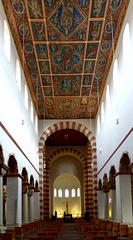
Hildesheim - St. Michaeliskirche
| |
|
|
Louis the Pious founded the bishopric of Hildesheim in 815. The settlement developed into a town and was granted market rights by King Otto III in 983. Craftsmen and merchants were attracted and the city developed into an important community. By 1167, Hildesheim was an almost completely walled market settlement.
At the beginning of the 13th century, Hildesheim had about 5,000 inhabitants, and when Hildesheim received its city charter in 1249, it was one of the largest cities in northern Germany. The clergy ruled Hildesheim for four centuries before a town hall was built and the citizens gained influence and independence. In 1367, Hildesheim became a member of the Hanseatic League. But what is now called Hildesheim was various small "suburbs". After centuries of (sometimes armed) disputes, it was not until the end of the 16th century that a union was created and subsequently at least the inner wall was taken down Old and New Town.
During the Thirty Years' War, Hildesheim was besieged and occupied several times. In 1813, after the Napoleonic Wars, the town became part of the Kingdom of Hanover, which was annexed by the Kingdom of Prussia as a province after the Austro-Prussian War in 1866.
The air raids on Hildesheim in 1944/45 destroyed large parts of the city. Of the 1500 half-timbered houses, only 200 remained. 90 percent of the historic old town was destroyed in the firestorm.
-
St. Michaeliskirche is an Ottonian, early Romanesque church. It was the abbey church of the Benedictine abbey until the Reformation. Today it is a shared church, the main church being Lutheran and the crypt being Roman Catholic.
Bishop Bernward of Hildesheim (996–1022) founded the monastery just a half kilometer north of the city walls. He set the first stone for the new church in 1010. Construction continued under Bishop Godehard, who completed the work in 1031 and reconsecrated the church. The church has double choirs east and west and six towers, two large ones over the crossings east and west, and four other tall and narrow ones attached to the small sides of the two transepts.
When the people of Hildesheim became Protestant in 1542, St. Michael's became Lutheran, but the Benedictine monastery operated here until it was secularized in 1803. Monks continued to use the church, especially its western choir and crypt, down to that moment.
St. Michael's Church was heavily damaged in an air raid during World War II on 22 March 1945, but reconstruction was begun in 1950 and completed in 1957. In 1985, the church became a UNESCO World Cultural Heritage site, along with the Cathedral of Hildesheim.
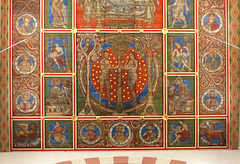
The painted wooden ceiling measures 27.6 × 8.7 meters and consists of 1300 oak boards.
The theme of the painting is the root of Jesse. This genealogical tree of Jesus appears divided into eight main panels.
The ceiling was removed in 1943 and stored in different places. Thus, the original boards used survived the Second World War. Before it was reattached in 1960, all parts of the painting were cleaned and restored.
A dendrochronological examination in 1999 proved a felling date of the oaks used for the ceiling between 1190 and 1220. Thus, the painting was created only around 1230.
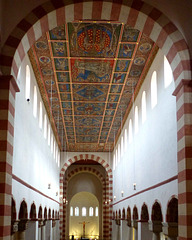
Hildesheim - St. Michaeliskirche
| |
|
|
|
Louis the Pious founded the bishopric of Hildesheim in 815. The settlement developed into a town and was granted market rights by King Otto III in 983. Craftsmen and merchants were attracted and the city developed into an important community. By 1167, Hildesheim was an almost completely walled market settlement.
At the beginning of the 13th century, Hildesheim had about 5,000 inhabitants, and when Hildesheim received its city charter in 1249, it was one of the largest cities in northern Germany. The clergy ruled Hildesheim for four centuries before a town hall was built and the citizens gained influence and independence. In 1367, Hildesheim became a member of the Hanseatic League. But what is now called Hildesheim was various small "suburbs". After centuries of (sometimes armed) disputes, it was not until the end of the 16th century that a union was created and subsequently at least the inner wall was taken down Old and New Town.
During the Thirty Years' War, Hildesheim was besieged and occupied several times. In 1813, after the Napoleonic Wars, the town became part of the Kingdom of Hanover, which was annexed by the Kingdom of Prussia as a province after the Austro-Prussian War in 1866.
The air raids on Hildesheim in 1944/45 destroyed large parts of the city. Of the 1500 half-timbered houses, only 200 remained. 90 percent of the historic old town was destroyed in the firestorm.
-
St. Michaeliskirche is an Ottonian, early Romanesque church. It was the abbey church of the Benedictine abbey until the Reformation. Today it is a shared church, the main church being Lutheran and the crypt being Roman Catholic.
Bishop Bernward of Hildesheim (996–1022) founded the monastery just a half kilometer north of the city walls. He set the first stone for the new church in 1010. Construction continued under Bishop Godehard, who completed the work in 1031 and reconsecrated the church. The church has double choirs east and west and six towers, two large ones over the crossings east and west, and four other tall and narrow ones attached to the small sides of the two transepts.
When the people of Hildesheim became Protestant in 1542, St. Michael's became Lutheran, but the Benedictine monastery operated here until it was secularized in 1803. Monks continued to use the church, especially its western choir and crypt, down to that moment.
St. Michael's Church was heavily damaged in an air raid during World War II on 22 March 1945, but reconstruction was begun in 1950 and completed in 1957. In 1985, the church became a UNESCO World Cultural Heritage site, along with the Cathedral of Hildesheim.
The painted wooden ceiling measures 27.6 × 8.7 meters and consists of 1300 oak boards.
The theme of the painting is the root of Jesse. This genealogical tree of Jesus appears divided into eight main panels.
The ceiling was removed in 1943 and stored in different places. Thus, the original boards used survived the Second World War. Before it was reattached in 1960, all parts of the painting were cleaned and restored.
A dendrochronological examination in 1999 proved a felling date of the oaks used for the ceiling between 1190 and 1220. Thus, the painting was created only around 1230.
Hildesheim - St. Michaeliskirche
| |
|
|
Louis the Pious founded the bishopric of Hildesheim in 815. The settlement developed into a town and was granted market rights by King Otto III in 983. Craftsmen and merchants were attracted and the city developed into an important community. By 1167, Hildesheim was an almost completely walled market settlement.
At the beginning of the 13th century, Hildesheim had about 5,000 inhabitants, and when Hildesheim received its city charter in 1249, it was one of the largest cities in northern Germany. The clergy ruled Hildesheim for four centuries before a town hall was built and the citizens gained influence and independence. In 1367, Hildesheim became a member of the Hanseatic League. But what is now called Hildesheim was various small "suburbs". After centuries of (sometimes armed) disputes, it was not until the end of the 16th century that a union was created and subsequently at least the inner wall was taken down Old and New Town.
During the Thirty Years' War, Hildesheim was besieged and occupied several times. In 1813, after the Napoleonic Wars, the town became part of the Kingdom of Hanover, which was annexed by the Kingdom of Prussia as a province after the Austro-Prussian War in 1866.
The air raids on Hildesheim in 1944/45 destroyed large parts of the city. Of the 1500 half-timbered houses, only 200 remained. 90 percent of the historic old town was destroyed in the firestorm.
-
St. Michaeliskirche is an Ottonian, early Romanesque church. It was the abbey church of the Benedictine abbey until the Reformation. Today it is a shared church, the main church being Lutheran and the crypt being Roman Catholic.
Bishop Bernward of Hildesheim (996–1022) founded the monastery just a half kilometer north of the city walls. He set the first stone for the new church in 1010. Construction continued under Bishop Godehard, who completed the work in 1031 and reconsecrated the church. The church has double choirs east and west and six towers, two large ones over the crossings east and west, and four other tall and narrow ones attached to the small sides of the two transepts.
When the people of Hildesheim became Protestant in 1542, St. Michael's became Lutheran, but the Benedictine monastery operated here until it was secularized in 1803. Monks continued to use the church, especially its western choir and crypt, down to that moment.
St. Michael's Church was heavily damaged in an air raid during World War II on 22 March 1945, but reconstruction was begun in 1950 and completed in 1957. In 1985, the church became a UNESCO World Cultural Heritage site, along with the Cathedral of Hildesheim.
The painted wooden ceiling measures 27.6 × 8.7 meters and consists of 1300 oak boards.
The theme of the painting is the root of Jesse. This genealogical tree of Jesus appears divided into eight main panels.
The ceiling was removed in 1943 and stored in different places. Thus, the original boards used survived the Second World War. Before it was reattached in 1960, all parts of the painting were cleaned and restored.
A dendrochronological examination in 1999 proved a felling date of the oaks used for the ceiling between 1190 and 1220. Thus, the painting was created only around 1230.
Adam and Eve

Hildesheim - St. Michaeliskirche
| |
|
|
Louis the Pious founded the bishopric of Hildesheim in 815. The settlement developed into a town and was granted market rights by King Otto III in 983. Craftsmen and merchants were attracted and the city developed into an important community. By 1167, Hildesheim was an almost completely walled market settlement.
At the beginning of the 13th century, Hildesheim had about 5,000 inhabitants, and when Hildesheim received its city charter in 1249, it was one of the largest cities in northern Germany. The clergy ruled Hildesheim for four centuries before a town hall was built and the citizens gained influence and independence. In 1367, Hildesheim became a member of the Hanseatic League. But what is now called Hildesheim was various small "suburbs". After centuries of (sometimes armed) disputes, it was not until the end of the 16th century that a union was created and subsequently at least the inner wall was taken down Old and New Town.
During the Thirty Years' War, Hildesheim was besieged and occupied several times. In 1813, after the Napoleonic Wars, the town became part of the Kingdom of Hanover, which was annexed by the Kingdom of Prussia as a province after the Austro-Prussian War in 1866.
The air raids on Hildesheim in 1944/45 destroyed large parts of the city. Of the 1500 half-timbered houses, only 200 remained. 90 percent of the historic old town was destroyed in the firestorm.
-
St. Michaeliskirche is an Ottonian, early Romanesque church. It was the abbey church of the Benedictine abbey until the Reformation. Today it is a shared church, the main church being Lutheran and the crypt being Roman Catholic.
Bishop Bernward of Hildesheim (996–1022) founded the monastery just a half kilometer north of the city walls. He set the first stone for the new church in 1010. Construction continued under Bishop Godehard, who completed the work in 1031 and reconsecrated the church. The church has double choirs east and west and six towers, two large ones over the crossings east and west, and four other tall and narrow ones attached to the small sides of the two transepts.
When the people of Hildesheim became Protestant in 1542, St. Michael's became Lutheran, but the Benedictine monastery operated here until it was secularized in 1803. Monks continued to use the church, especially its western choir and crypt, down to that moment.
St. Michael's Church was heavily damaged in an air raid during World War II on 22 March 1945, but reconstruction was begun in 1950 and completed in 1957. In 1985, the church became a UNESCO World Cultural Heritage site, along with the Cathedral of Hildesheim.
On one of the sculpted capitals is the "Creation of Eve".

Hildesheim - St. Michaeliskirche
| |
|
|
Louis the Pious founded the bishopric of Hildesheim in 815. The settlement developed into a town and was granted market rights by King Otto III in 983. Craftsmen and merchants were attracted and the city developed into an important community. By 1167, Hildesheim was an almost completely walled market settlement.
At the beginning of the 13th century, Hildesheim had about 5,000 inhabitants, and when Hildesheim received its city charter in 1249, it was one of the largest cities in northern Germany. The clergy ruled Hildesheim for four centuries before a town hall was built and the citizens gained influence and independence. In 1367, Hildesheim became a member of the Hanseatic League. But what is now called Hildesheim was various small "suburbs". After centuries of (sometimes armed) disputes, it was not until the end of the 16th century that a union was created and subsequently at least the inner wall was taken down Old and New Town.
During the Thirty Years' War, Hildesheim was besieged and occupied several times. In 1813, after the Napoleonic Wars, the town became part of the Kingdom of Hanover, which was annexed by the Kingdom of Prussia as a province after the Austro-Prussian War in 1866.
The air raids on Hildesheim in 1944/45 destroyed large parts of the city. Of the 1500 half-timbered houses, only 200 remained. 90 percent of the historic old town was destroyed in the firestorm.
-
St. Michaeliskirche is an Ottonian, early Romanesque church. It was the abbey church of the Benedictine abbey until the Reformation. Today it is a shared church, the main church being Lutheran and the crypt being Roman Catholic.
Bishop Bernward of Hildesheim (996–1022) founded the monastery just a half kilometer north of the city walls. He set the first stone for the new church in 1010. Construction continued under Bishop Godehard, who completed the work in 1031 and reconsecrated the church. The church has double choirs east and west and six towers, two large ones over the crossings east and west, and four other tall and narrow ones attached to the small sides of the two transepts.
When the people of Hildesheim became Protestant in 1542, St. Michael's became Lutheran, but the Benedictine monastery operated here until it was secularized in 1803. Monks continued to use the church, especially its western choir and crypt, down to that moment.
St. Michael's Church was heavily damaged in an air raid during World War II on 22 March 1945, but reconstruction was begun in 1950 and completed in 1957. In 1985, the church became a UNESCO World Cultural Heritage site, along with the Cathedral of Hildesheim.
Bishop Bernward of Hildesheim had also donated this church as a burial church and designated the crypt as his burial place. The "Bernwardskrypta" was consecrated by him on Michaelmas Day, 29 September 1015.

Hildesheim - St. Michaeliskirche
| |
|
|
Louis the Pious founded the bishopric of Hildesheim in 815. The settlement developed into a town and was granted market rights by King Otto III in 983. Craftsmen and merchants were attracted and the city developed into an important community. By 1167, Hildesheim was an almost completely walled market settlement.
At the beginning of the 13th century, Hildesheim had about 5,000 inhabitants, and when Hildesheim received its city charter in 1249, it was one of the largest cities in northern Germany. The clergy ruled Hildesheim for four centuries before a town hall was built and the citizens gained influence and independence. In 1367, Hildesheim became a member of the Hanseatic League. But what is now called Hildesheim was various small "suburbs". After centuries of (sometimes armed) disputes, it was not until the end of the 16th century that a union was created and subsequently at least the inner wall was taken down Old and New Town.
During the Thirty Years' War, Hildesheim was besieged and occupied several times. In 1813, after the Napoleonic Wars, the town became part of the Kingdom of Hanover, which was annexed by the Kingdom of Prussia as a province after the Austro-Prussian War in 1866.
The air raids on Hildesheim in 1944/45 destroyed large parts of the city. Of the 1500 half-timbered houses, only 200 remained. 90 percent of the historic old town was destroyed in the firestorm.
-
St. Michaeliskirche is an Ottonian, early Romanesque church. It was the abbey church of the Benedictine abbey until the Reformation. Today it is a shared church, the main church being Lutheran and the crypt being Roman Catholic.
Bishop Bernward of Hildesheim (996–1022) founded the monastery just a half kilometer north of the city walls. He set the first stone for the new church in 1010. Construction continued under Bishop Godehard, who completed the work in 1031 and reconsecrated the church. The church has double choirs east and west and six towers, two large ones over the crossings east and west, and four other tall and narrow ones attached to the small sides of the two transepts.
When the people of Hildesheim became Protestant in 1542, St. Michael's became Lutheran, but the Benedictine monastery operated here until it was secularized in 1803. Monks continued to use the church, especially its western choir and crypt, down to that moment.
St. Michael's Church was heavily damaged in an air raid during World War II on 22 March 1945, but reconstruction was begun in 1950 and completed in 1957. In 1985, the church became a UNESCO World Cultural Heritage site, along with the Cathedral of Hildesheim.
Bishop Bernward of Hildesheim had also donated this church as a burial church and designated the crypt as his burial place. The "Bernward's Crypt" was consecrated by him on Michaelmas Day, 29 September 1015. After his death in 1022, he was buried here. His sarcophagus is now empty, the relics rest in the Magdalenenkirche.

Hildesheim - St. Michaeliskirche
| |
|
|
Louis the Pious founded the bishopric of Hildesheim in 815. The settlement developed into a town and was granted market rights by King Otto III in 983. Craftsmen and merchants were attracted and the city developed into an important community. By 1167, Hildesheim was an almost completely walled market settlement.
At the beginning of the 13th century, Hildesheim had about 5,000 inhabitants, and when Hildesheim received its city charter in 1249, it was one of the largest cities in northern Germany. The clergy ruled Hildesheim for four centuries before a town hall was built and the citizens gained influence and independence. In 1367, Hildesheim became a member of the Hanseatic League. But what is now called Hildesheim was various small "suburbs". After centuries of (sometimes armed) disputes, it was not until the end of the 16th century that a union was created and subsequently at least the inner wall was taken down Old and New Town.
During the Thirty Years' War, Hildesheim was besieged and occupied several times. In 1813, after the Napoleonic Wars, the town became part of the Kingdom of Hanover, which was annexed by the Kingdom of Prussia as a province after the Austro-Prussian War in 1866.
The air raids on Hildesheim in 1944/45 destroyed large parts of the city. Of the 1500 half-timbered houses, only 200 remained. 90 percent of the historic old town was destroyed in the firestorm.
-
St. Michaeliskirche is an Ottonian, early Romanesque church. It was the abbey church of the Benedictine abbey until the Reformation. Today it is a shared church, the main church being Lutheran and the crypt being Roman Catholic.
Bishop Bernward of Hildesheim (996–1022) founded the monastery just a half kilometer north of the city walls. He set the first stone for the new church in 1010. Construction continued under Bishop Godehard, who completed the work in 1031 and reconsecrated the church. The church has double choirs east and west and six towers, two large ones over the crossings east and west, and four other tall and narrow ones attached to the small sides of the two transepts.
When the people of Hildesheim became Protestant in 1542, St. Michael's became Lutheran, but the Benedictine monastery operated here until it was secularized in 1803. Monks continued to use the church, especially its western choir and crypt, down to that moment.
St. Michael's Church was heavily damaged in an air raid during World War II on 22 March 1945, but reconstruction was begun in 1950 and completed in 1957. In 1985, the church became a UNESCO World Cultural Heritage site, along with the Cathedral of Hildesheim.
Bishop Bernward of Hildesheim had also donated this church as a burial church and designated the crypt as his burial place. The "Bernward's Crypt" was consecrated by him on Michaelmas Day, 29 September 1015.
Bernward, founder of the church.

Hildesheim - St. Michaeliskirche
| |
|
|
Louis the Pious founded the bishopric of Hildesheim in 815. The settlement developed into a town and was granted market rights by King Otto III in 983. Craftsmen and merchants were attracted and the city developed into an important community. By 1167, Hildesheim was an almost completely walled market settlement.
At the beginning of the 13th century, Hildesheim had about 5,000 inhabitants, and when Hildesheim received its city charter in 1249, it was one of the largest cities in northern Germany. The clergy ruled Hildesheim for four centuries before a town hall was built and the citizens gained influence and independence. In 1367, Hildesheim became a member of the Hanseatic League. But what is now called Hildesheim was various small "suburbs". After centuries of (sometimes armed) disputes, it was not until the end of the 16th century that a union was created and subsequently at least the inner wall was taken down Old and New Town.
During the Thirty Years' War, Hildesheim was besieged and occupied several times. In 1813, after the Napoleonic Wars, the town became part of the Kingdom of Hanover, which was annexed by the Kingdom of Prussia as a province after the Austro-Prussian War in 1866.
The air raids on Hildesheim in 1944/45 destroyed large parts of the city. Of the 1500 half-timbered houses, only 200 remained. 90 percent of the historic old town was destroyed in the firestorm.
-
St. Michaeliskirche is an Ottonian, early Romanesque church. It was the abbey church of the Benedictine abbey until the Reformation. Today it is a shared church, the main church being Lutheran and the crypt being Roman Catholic.
Bishop Bernward of Hildesheim (996–1022) founded the monastery just a half kilometer north of the city walls. He set the first stone for the new church in 1010. Construction continued under Bishop Godehard, who completed the work in 1031 and reconsecrated the church. The church has double choirs east and west and six towers, two large ones over the crossings east and west, and four other tall and narrow ones attached to the small sides of the two transepts.
When the people of Hildesheim became Protestant in 1542, St. Michael's became Lutheran, but the Benedictine monastery operated here until it was secularized in 1803. Monks continued to use the church, especially its western choir and crypt, down to that moment.
St. Michael's Church was heavily damaged in an air raid during World War II on 22 March 1945, but reconstruction was begun in 1950 and completed in 1957. In 1985, the church became a UNESCO World Cultural Heritage site, along with the Cathedral of Hildesheim.
The triumphal cross
Hildesheim - St. Michaeliskirche
| |
|
|
Louis the Pious founded the bishopric of Hildesheim in 815. The settlement developed into a town and was granted market rights by King Otto III in 983. Craftsmen and merchants were attracted and the city developed into an important community. By 1167, Hildesheim was an almost completely walled market settlement.
At the beginning of the 13th century, Hildesheim had about 5,000 inhabitants, and when Hildesheim received its city charter in 1249, it was one of the largest cities in northern Germany. The clergy ruled Hildesheim for four centuries before a town hall was built and the citizens gained influence and independence. In 1367, Hildesheim became a member of the Hanseatic League. But what is now called Hildesheim was various small "suburbs". After centuries of (sometimes armed) disputes, it was not until the end of the 16th century that a union was created and subsequently at least the inner wall was taken down Old and New Town.
During the Thirty Years' War, Hildesheim was besieged and occupied several times. In 1813, after the Napoleonic Wars, the town became part of the Kingdom of Hanover, which was annexed by the Kingdom of Prussia as a province after the Austro-Prussian War in 1866.
The air raids on Hildesheim in 1944/45 destroyed large parts of the city. Of the 1500 half-timbered houses, only 200 remained. 90 percent of the historic old town was destroyed in the firestorm.
-
St. Michaeliskirche is an Ottonian, early Romanesque church. It was the abbey church of the Benedictine abbey until the Reformation. Today it is a shared church, the main church being Lutheran and the crypt being Roman Catholic.
Bishop Bernward of Hildesheim (996–1022) founded the monastery just a half kilometer north of the city walls. He set the first stone for the new church in 1010. Construction continued under Bishop Godehard, who completed the work in 1031 and reconsecrated the church. The church has double choirs east and west and six towers, two large ones over the crossings east and west, and four other tall and narrow ones attached to the small sides of the two transepts.
When the people of Hildesheim became Protestant in 1542, St. Michael's became Lutheran, but the Benedictine monastery operated here until it was secularized in 1803. Monks continued to use the church, especially its western choir and crypt, down to that moment.
St. Michael's Church was heavily damaged in an air raid during World War II on 22 March 1945, but reconstruction was begun in 1950 and completed in 1957. In 1985, the church became a UNESCO World Cultural Heritage site, along with the Cathedral of Hildesheim.
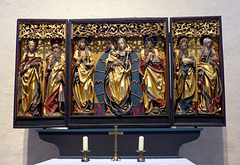
The altar was created around 1520 and was originally placed in the church of the Johannisstift. In the course of the Reformation, it was transferred to the now Protestant Martinikirche, the former church of the Franciscan monastery. In the middle of the 19th century, the church was profaned and used as a museum. The congregation moved (back) to St. Michaeliskirche in 1857 and brought the altar possibly as a replacement. However, the two outer wings, painted on both sides, were sold to the Museum Society and are now in the possession of the City Museum.
Seven saints dressed in golden robes can be seen. In the center is Mary with the infant Jesus. At her side are John the Evangelist on the left and John the Baptist on the right.

Hildesheim
| |
|
|
Louis the Pious founded the bishopric of Hildesheim in 815. The settlement developed into a town and was granted market rights by King Otto III in 983. Craftsmen and merchants were attracted and the city developed into an important community. By 1167, Hildesheim was an almost completely walled market settlement.
At the beginning of the 13th century, Hildesheim had about 5,000 inhabitants, and when Hildesheim received its city charter in 1249, it was one of the largest cities in northern Germany. The clergy ruled Hildesheim for four centuries before a town hall was built and the citizens gained influence and independence. In 1367, Hildesheim became a member of the Hanseatic League. But what is now called Hildesheim was various small "suburbs". After centuries of (sometimes armed) disputes, it was not until the end of the 16th century that a union was created and subsequently at least the inner wall was taken down Old and New Town.
During the Thirty Years' War, Hildesheim was besieged and occupied several times. In 1813, after the Napoleonic Wars, the town became part of the Kingdom of Hanover, which was annexed by the Kingdom of Prussia as a province after the Austro-Prussian War in 1866.
The air raids on Hildesheim in 1944/45 destroyed large parts of the city. Of the 1500 half-timbered houses, only 200 remained. 90 percent of the historic old town was destroyed in the firestorm.
-
A small area in the southern part of the old town, the area around the Godehardikirche, remained largely intact during the war.
Jump to top
RSS feed- Latest items - Subscribe to the latest items added to this album
- ipernity © 2007-2026
- Help & Contact
|
Club news
|
About ipernity
|
History |
ipernity Club & Prices |
Guide of good conduct
Donate | Group guidelines | Privacy policy | Terms of use | Statutes | In memoria -
Facebook
X
