

Martin M. Miles' photos

Valença - Igreja de Santo Estevão
| |
|
A large chair stands behind the altar of the Igreja de Santo Estevão. I was told, that this is the chair of a bishop, who never came. In Tui (Spain), just 4kms away on the other side of the Minho, resides the bishop. The Portuguese would have liked to have him here - and even gave him a chair, but he never moved over.

Tui - Cathedral de Santa Maria
| |
|
Sunshine in the gothic cloister of the Cathedral de Santa Maria in Tui. Sarcophags line up on the left.
Padron - Herbón
| |
|
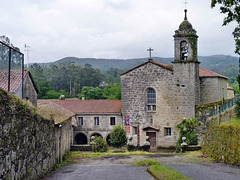
One of the popular dishes in Galicia is named "Pimentos de Padrón" and most of the pimentos (peppers) come from the village Herbon, next to Padron. In August there is even a "Festa do Pemento de Padrón" - in this monastery. Herbon not has only many Pimentos, but as well a high density of small but aggressive dogs.
Santiago de Compostela - Cathedral
| |
|
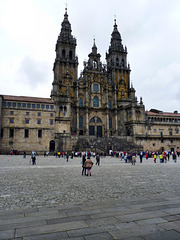
So - - finally - - I reached the Praza do Obradoiro just before noon, and saw the western, baroque facade of the Cathedral. I felt strange...
Santiago de Compostela - Cathedral
| |
|
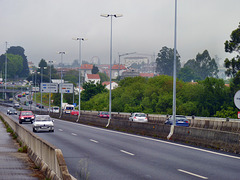
Rain again. Somewhere in the outskirts of Santiago I had to change onto the N550, and so walked on the left side of the main road for some kilometers. Then I saw the cathedral the first time. On the horizont - in the middle of a Ferris-wheel.

Teo - The Bar
| |
|
This is the counter of the only bar (and shop) I found near to the "Alberge" in Teo. It´s a really nice one - and delicious, hot coffee is served there in small cups.

Padron - Iglesia Santiago Apóstol
| |
|
Legend tells, that the body of St. James was brought to this place in a boat from stone. The boat was moored onto a roman milestone (or altar), called "pedron" in Spanish, giving the place the name "Padron" later. The stone is still in place, and the church "Santiago Apóstol" was built over the stone on the other side of the bridge. Padron was not only place of hostile visits of vikings and normans in the 10./11. century, but for many pilgrims who reached Spain by boat, the starting point of their walk.
Caldas de Reis - Roman Bridge
| |
|
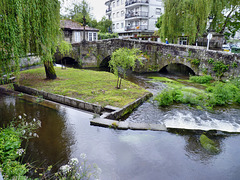
Caldas de Reis is known for it´s hot springs, that have cured people since thousands of years. The Romans called the settlement "Aquis Celenis" - and left this bridge.
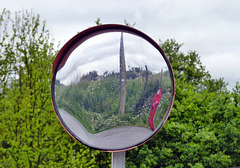
Rain - Approaching Caldas de Reis
| |
|
It rained the whole day. I walked from Pontevedra to Caldas de Reis. Here you see me in a magic, flattering mirror, wearing my red raincoat. I seem to be slender and willowy .

Ponteverda - Santa Maria la Mayor
| |
|
Shown on the right side of the facade is "Saint Jerome" (Hieronymus, 347-420), who translated the Bible into Latin ("Vulgate"). His attributes are the lion and the skull. Here he is wearing glasses! Pretty modern for a carving from around 1550.

Ponteverda - Santa Maria la Mayor
| |
|
During the "golden era" of Pontevedra, within the 16. century, the guild of fishermen was so wealthy, that they could finance the building of this church. The Renaissance-facade, seen here, was created by Cornelis de Holanda, an artist, who worked all over Galicia. Since 1962 the church is a "Basilica Minor".

Ponteverda - Iglesia de la Peregrina
| |
|
|
This church is dedicated to the "Pilgim Virgin Mary" ("Virxe Peregrina"). Built in very late baroque style (1778 ) it features a layout in form of a scallop-shell, the symbol of pilgrimage to Santiago since the early beginnings.

Approaching Pontevedra
| |
|
Walking uphill on the old roman road XIX. The usage over the centuries has clearly left marks here, that look like rails. The gauge of the carts did obviosly not change over that whole time.

Approaching Arcade

Redondela - Viaduct
| |
|
Redondela has lots of things to offer. Two giant railroad-bridges cross the town. This one finished in 1876, the second one in 1884. Hightech of the 19th century! An "Albergue de Peregrinos" in the "Casa da Torre" an historic renaissance-building, a 15th century parish-church (open in the evenings) - and the "Nautilus" a formidable but affordable restaurant, where I found the advise of Emilio and Fernando, two spanish gentlemen, - and so had - thanks to them - a remarkable dinner.

Near Mos
| |
|
There are many "cruceiros" along the way. Near the village of Mos old and modern times met
and mixed perfectly. The scene reminded me of Lenin´s sentence "Communism is Soviet power
plus the electrification of the whole country."

O Porriño
| |
|
What the worldfamous "Flat Iron Building" is for Manhattan is
this building for O Porriño. Here is the Grand Cousin:
www.flickr.com/photos/25830962@N06/3781497151/

O Porriño
| |
|
Over more than two hours all walkers admire the picturesque and smelly industrial area of O Porriño. Lots of granite slabs are produced - and thousands french cars are stored here.
