

Martin M. Miles' photos
Osnabrueck - St. Marien
| |
|
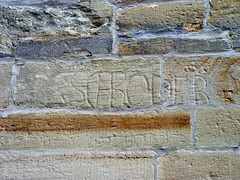
To the south St. Marien church faces the market and is an architectural neighbour of the town hall and the weigh house. St. Marien church is a gothic hall church, that was used as a meeting place for the protestant parties during the years of negotiating before the "Peace of Westpahlia" treaties were signed in 1648. Osnabrueck was hit by more than 180.000 bombs during WWII. St. Marien burnt out - and was rebuilt in the 1950s. The northern wall (not facing the market) is covered by carved grafittis. Obviously this wall survived the bombings and kept pretty untouched during the rebuilding.
I read "SCHRODER" in the middle. A pretty common german name. One of the last german chancellors was Mr. Schröder.
Osnabrueck - Town Hall
| |
|
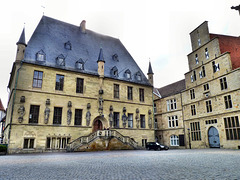
1648 a peace treaty was signed in this town hall, a second one was signed in neighboring Muenster. Both forming the "Peace of Westphalia", that ended the Thirty Years' War (1618–1648) in the Holy Roman Empire, and the Eighty Years' War (1568–1648) between Spain and the Netherlands. The treaties ended as well diplomatic conference, that lasted five years. Muenster housed the catholic parties, Osnabrueck the protestant parties. This "pax universalis" gave orientation to european history upto the french revolution. The building on the right was the public weigh house, built 1532. In the sky on the very right is a gargoyle of the lutherian St. Mary church (used be the swedish delegation during the peace-conference). Like the town hall, the weigh house and most other houses around the market it was bombed and burnt down during WWII. The whole area was rebuilt in the 1950s.

Osnabrueck - Cathedral St. Peter
| |
|
The bishop´s see was founded by Charlemagne around 780. The first church here, was destroyed by the Normans about 100 years later. After a great fire, that burnt down most of the town around 1100, the cathedral was built over a long period, so it is a mix of late- romanesque and gothic style.
The old cloister, next to the cathedral St. Peter, houses the graveyard today.
Blesle - St. Piere
| |
|
A convent under the patronage of St. Peter was founded in Blesle within the 9th century by Ermengarde d’Auvergne, the mother of Guillaume le Pieux, who founded Cluny in 910. The construction of St. Piere (now a parish church) started end of 11th century. Within a hunderd years, most of the church was built, only the south portal, the tower and parts of the apse were done in the 14th century. "L'église Saint-Pierre" is remarkable for it´s interesting layout and the richness of romanesque carvings inside and outside.
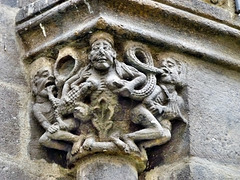
Here one of the capitals outside the apse. A carving of "Luxuria", standing for lust, one of the "Seven Deadly Sins". Luxuria is mostly carved, breastfeeding two snakes. Here it is a snake and large frog. The frog itself is a symbol of vanity and lust. Both animals have obviously "excaped" from the two male figures on the side. The leftone holding a round object (tambourine?), the rightone wearing a kind of necklace, maybe a form of moneybag. Note that the Luxuria´s legs are lost, only the two feet and a part of a tigh (next to the frog) survived the times.
Blesle - St. Piere
| |
|
A convent under the patronage of St. Peter was founded in Blesle within the 9th century by Ermengarde d’Auvergne, the mother of Guillaume le Pieux, who founded Cluny on 910. The construction of St. Piere (now a parish church) started end of 11th century. Within a hunderd years, most of the church was built, only the south portal, the tower and parts of the apse were done in the 14th century. "L'église Saint-Pierre" is remarkable for it´s interesting layout and the richness of romanesque
carvings inside and outside.
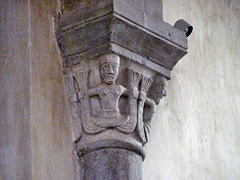
A capital in the transept shows these pale looking mermaids, wearing a headdress. I have the impression, that the capital had four sides once - and so four mermaids, but as a wall was built later - only two of them a visible. These are the collegues of the colourful mairmaid in the nave of the St. Pierre, which is probably more than 100 years younger.
Blesle - St. Piere
| |
|
|
A convent under the patronage of St. Peter was founded in Blesle within the 9th century by Ermengarde d’Auvergne, the mother of Guillaume le Pieux, who founded Cluny on 910. The construction of St. Piere (now a parish church) started end of 11th century. Within a hunderd years, most of the church was built, only the south portal, the tower and parts of the apse were done in the 14th century. "L'église Saint-Pierre" is remarkable for it´s interesting layout and the richness of romanesque
carvings inside and outside.
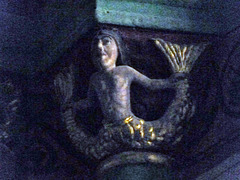
One of the capitals shows the carving of a mermaid. She is very colourful and golden fish scales are on her two tails. Actually she has a "collegue" in the transept.
Blesle - St. Piere
| |
|
A convent under the patronage of St. Peter was founded in Blesle within the 9th century by Ermengarde d’Auvergne, the mother of Guillaume le Pieux, who founded Cluny on 910. The construction of St. Piere (now a parish church) started end of 11th century. Within a hunderd years, most of the church was built, only the south portal, the tower and parts of the apse were done in the 14th century. "L'église Saint-Pierre" is remarkable for it´s interesting layout and the richness of romanesque
carvings inside and outside.
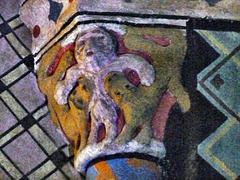
One of the capitals shows this - strange - person. This could be - a "Master of the Beasts" eg. "Daniel in the Lions Den" - or a "Luxuria", breastfeeding two lions (instead of the ordinary snakes).
I would be grateful, if you can give me a hint.
Paray-le-Monial - Basilique du Sacré Coeur
| |
|
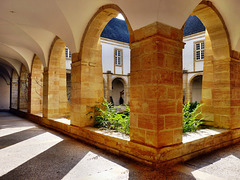
The "Basilique du Sacré Coeur" in Paray-le-Monial. The monastry existing since 974 became a dependency of nearby Cluny in 999. The first church "Paray I" was consecrated by Odilo of Cluny already in 1004. Though enlarged later to "Paray II" by the still existing westwork and narthex, Hugh of Cluny started the building of now existing church "Paray III" in 1090. As it has lots of similarities to the only little older "Cluny III", it is sometimes called "Small Cluny".
The cloister adjoining the romanesque basilique was built within the 18th century.
Paray-le-Monial - Basilique du Sacré Coeur
| |
|
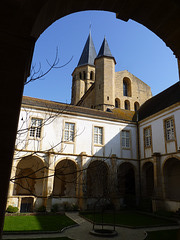
The "Basilique du Sacré Coeur" in Paray-le-Monial. The monastry existing since 974 became a dependency of nearby Cluny in 999. The first church "Paray I" was consecrated by Odilo of Cluny already in 1004. Though
enlarged later to "Paray II" by the still existing westwork and narthex, Hugh of Cluny started the building of now existing church "Paray III" in 1090. As it has lots of similarities to the only little older "Cluny III", it is sometimes called "Small Cluny".
The cloister adjoining the romanesque basilique was built within the 18th century.
Paray-le-Monial - Basilique du Sacré Coeur
| |
|
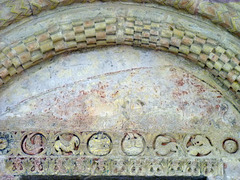
The "Basilique du Sacré Coeur" in Paray-le-Monial. The monastry existing since 974 became a dependency of nearby Cluny in 999. The first church "Paray I" was consecrated by Odilo of Cluny already in 1004. Though enlarged later to "Paray II" by the still existing westwork and narthex, Hugh of Cluny started the building of now existing church "Paray III" in 1090. As it has lots of similarities to the only little older "Cluny III", it is sometimes called "Small Cluny".
Here are the 8 medallions of the lintel. The very left one (sorry for the cut), shows a rosette, the very left one a small round children face, that could be a sample for Konrad Lorenz´
cuteness-concept. Then left and rigt are two pairs of mythic animals. The two medallions in the middle show two rotated faces, licking the edge of the lintel. I could not find out the meaning of that very strange behaviour - at the prominent "point of entry".
Paray-le-Monial - Basilique du Sacré Coeur
| |
|
Paray-le-Monial - Basilique du Sacré Coeur
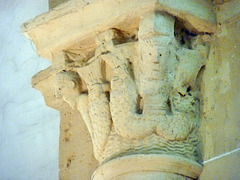
The "Basilique du Sacré Coeur" in Paray-le-Monial. The monastry existing since 974 became a dependency of nearby Cluny in 999. The first church "Paray I" was consecrated by Odilo of Cluny already in 1004. Though enlarged later to "Paray II" by the still existing westwork and narthex,abbot Hugh of Cluny started the building of now existing church "Paray III" in 1090. As it has lots of similarities to the only little older "Cluny III", it is sometime called "Small Cluny".
Here are two bearded mermen from one of the pillars in the interior of the basilique. Look for their friend the mermaid - on the other photo!
Paray-le-Monial - Basilique du Sacré Coeur
| |
|
The "Basilique du Sacré Coeur" in Paray-le-Monial. The monastry existing since 974
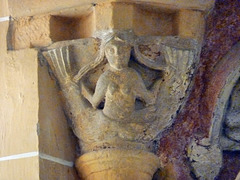
became a dependency of nearby Cluny in 999. The first church "Paray I" was consecrated by Odilo of Cluny already in 1004. Though enlarged later to "Paray II" by the still existing westwork and narthex,abbot Hugh of Cluny started the building of now existing church "Paray III" in 1090. As it has lots of similarities to the only little older "Cluny III", it is sometimes called "Small Cluny".
Here is a mermaid from one of the pillars in the interior of the basilique. Look for her friend the merman - on the other photo!
Paray-le-Monial - Basilique du Sacré Coeur
| |
|
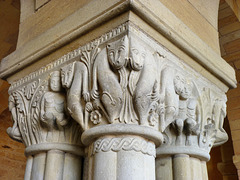
The "Basilique du Sacré Coeur" in Paray-le-Monial. The monastry existing since 974
became a dependency of nearby Cluny in 999. The first church "Paray I" was consecrated by Odilo of Cluny already in 1004. Though enlarged later to "Paray II" by the still existing westwork and narthex,abbot Hugh of Cluny started the building of now existing church "Paray III" in 1090. As it has lots of similarities to the only little older "Cluny III", it is sometimes called "Small Cluny". Here the capital of one of the massive (quadruple) pillars of the narthex. As the narthex belongs to "Paray II" they are probably carved around 1050.
Paray-le-Monial - Basilique du Sacré Coeur
| |
|
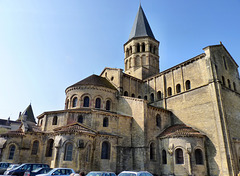
The "Basilique du Sacré Coeur" in Paray-le-Monial. The monastry existing since 974 became a dependency of nearby Cluny in 999. The first church "Paray I" was consecrated by Odilo of Cluny already in 1004. Though enlarged later to "Paray II", abbot Hugh of Cluny started the building of now existing church "Paray III" in 1090. As it has lots of similarities to the only little older "Cluny III", it is sometime called "Small Cluny". Looking onto the east end, the Cluny-influenced romanesque design is clearly visible. There is a cruciform plan, here to be seen is the transept, the crossing tower, the rectangular end of the nave, the halfround apse, surrounded by an ambulatory and the apsidal chapels.
Osnabrueck - Cathedral St. Peter
| |
|
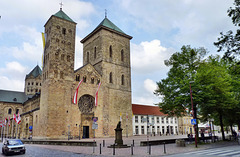
The bishop´s see was founded by Charlemagne around 780. The first church here, was destroyed by the Normans. After a great fire, that burnt down most of the town around 1100, the cathedral was built over a long period, so it is a mix of late romanesque and gothic style. Clearly romanesque are the left tower of the westwork, the left wall and the crossing tower. The right tower was similar to the left upto 1502, when it had to be enlarged, as the new ordered bells where just too heavy for the old tower. During WWII Osnabrueck got heavily bombed and the cathedral burnt down, It was rebuilt in the 1950s. In the foreground is the statue of a lion. This is the copy of the original (today in a museum), given to the town by Henry the Lion (1129–1195). It is dubbed "Loewenpudel" (Lion-Poodle), as it really looks like a mixture of these two creatures.
Osnabrueck - St. Johann
| |
|
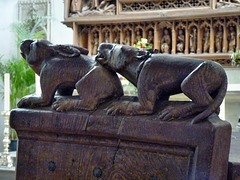
The carving, topping the end of the right row of choir-stalls in St. Johann (Baptist), shows a dog catching a hare. The dog seems strange. It is small compared to the hare, the head is donkey-like, the teeth are clearly thatones of a herbivore.
Osnabrueck - St. Johann
| |
|
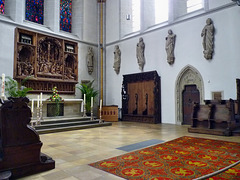
The choir of St. Johann (Baptist). Consecrated in 1292 this is one of the oldest large gothic hall churches in Germany. Only a few choir stalls have "survived" the centuries. The altar was carved in 1512. Hinges on the sides show, that originally this was winged altar, but the wings got lost. All the windows are new. The life-size figures of the apostles on the walls were carved from sandstone around 1400.
Osnabrueck - St. Johann
| |
|
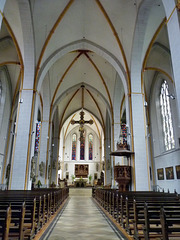
The nave and the two aisles of the former collegiat church St. Johann (Baptist). High, wide, clear. Consecrated in 1292 St. Johann is one of the oldest large gothic hall churches in Germany - and so may be connected to the cathedral and the Bartholomew Chapel in Paderborn. St. Johann may have influenced the masters who built the (smaller) St. Marien church in Lemgo, only a few decades younger. Paderborn and Lemgo are about 100km southeast.
Here is the nave of St. Marien, Lemgo.
www.flickr.com/photos/martin-m-miles/4337778515/
