

Martin M. Miles' photos

Near Saint-Germain-Lembron
| |
|
Crossing the the Auvergne. Heading north on a misty morning. Approaching the small town of Saint-Germain-Lembron.....- - - all of a sudden, on the left of the D909, we saw a work of art. A life-sized still life. It was titled "Landscape with Furniture".

Magdeburg - Cathedral
| |
|
A baroque statue of a bishop to the right, a whalebone to the left. A curiosity in the Magdeburg Cathedral. I have no idea, what a whalebone "means" or what it stands for. It may be connected to Matthew 12:38-41
"For as Jonas was three days and three nights in the whale's belly; so shall
the Son of man be three days and three nights in the heart of the earth."
There are a couple of churches, that display whalebones.
Cologne (Germany):
www.flickr.com/photos/roland-rossner/2786317321/
Herford (Germany):
www.flickr.com/photos/martin-m-miles/4765219389/
Gandersheim (Germany):
www.flickr.com/photos/martin-m-miles/5706420469/
Rieupeyroux (France):
www.flickr.com/photos/lionfranc37/5340136898/in/contacts/
Krakow (Poland)
www.flickr.com/photos/tanya780/2740547999/

Magdeburg - Cathedral
| |
|
The cathedral, officially called "Cathedral of Saints Catherine and Maurice", hosts the oldest known image depicting Saint Maurice as a Moor, carved around 1250. This statue of Saint Maurice is clearly younger, but as well, shows an armoured knight, who is obviously an ethnic African.
Here is the older statue of Saint Maurice:
www.flickr.com/photos/martin-m-miles/4329165066/

Magdeburg - Cathedral
| |
|
The construction of the "Cathedral of Saints Catherine and Maurice" started 1209. Two years ago, the church that had been on this place since 932, burnt down with most of the town on Good Friday . This
is one of the oldest churches in Germany, clearly influenced by the then new gothic style, developed in France. Otto I the Great and his wife Edith of England have their graves here (see below). The steeples (finished 1520) seen here from the cloister are about 100m in height. The cloister itself dates back to 1160, when it was used by the benedictine monks of the monastry "St. Maurice".
During the Thirty Years' War (1618–1648) Magdeburg was raided and probably 20.000 inhabitants lost their lives. A small group of 4000 people survived the "Sack of Magdeburg" by seeking refuge in the cathedral. Begging on his knees before the conqueror the head priest saved them.
Here is the grave of the "royal couple":
www.flickr.com/photos/martin-m-miles/4328456651/

Lempdes-sur-Allagnon
| |
|
One of the capitals in the romanesque Église Saint-Géraud in Lempdes-sur-Allagnon, shows this smiling colourful mermaid. She looks so different from the mermaids I found sofar. Just small addons to her feet make clear that there are fins. On the right a bearded face. There is an article on mermaids in Ireland, titled "Lusty Ladies" . Maybe she is a "Lusty Lady". It was so dark in this corner of the church, that I used a little torchlite.
Here is the article:
homepage.eircom.net/~archaeology/three/mermaid.htm
Here is the

Lempdes-sur-Allagnon
| |
|
One of the capitals near the choir in the dark romanesque Église Saint-Géraud in Lempdes-sur-Allagnon, shows this two bearded mermen. They are accompanied by a mermaid on another capital. Sorry for the bad quality of the photo. I hate to use the flashlite within churches.

Lempdes-sur-Allagnon
| |
|
The interior of the Église Saint-Géraud. Most light coming in from the enlarged (?) transept and the window in the choir. A wide nave and very narrow aisle to the right. The rear end, from where the photo was taken, seems to have been modified a bit, the barrel vaulted nave and the choir seem unchanged. Some interesting carved romanesque capitals are on the pillars near the choir.
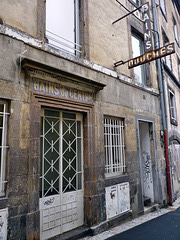
Clermont-Ferrand
| |
|
Unfortunately the "Bains du Central" were closed. when I found the
place. I would have loved, to see the interior of the bulilding.

Herford - St. Jakobi
| |
|
Built within the 13./14. century, for hundreds of years this church was used by the many pilgrims on their way to Santiago de Compostela. Pope Julius II confirmed in 1510 the status of "St. Jakobi" as a church just for the Santiago-pilgrims. Due to the "Herford Vision", the oldest known Marian apparition north of the Alpes (940 or 1011), Herford had a great attraction to these. The town offered four hospitals to the pilgrims at that time. After the reformation, when catholic pilgrims were not favourable visitors any longer, the city-council closed the church - and was used as a stable. In 1590 it was reopened - as a lutheran church, what it still is.
A strange object shown in the St. Jakobi church is this rib of a whale. It was given to the church by the former mayor of Herford Anton Brudtlacht in 1589. It is not the only whalebone in german churches
Even bigger bones can be seen in "St. Maria im Kapitol" in Cologne.
www.flickr.com/photos/roland-rossner/2786317321/
another is displayed in the Cathedral of Magdeburg:
www.flickr.com/photos/martin-m-miles/4795593117/
A huge whale-rib can be seen in Gandersheim abbey
www.flickr.com/photos/martin-m-miles/5706420469/
Meanwhile I have learned that these bones are called "hierozoika" a Greek word designating items from the animal world hallowed by being mentioned in the bible. Hundreds of such bones still hang in european churches. Mr. Nicholas Redman has published several books about. Here is his website: www.whalebones.co.uk/index.html

Herford - St. Johann
| |
|
After warlike situations, the collegiate which was in existence since 974 moved from Enger into the fortified town of Herford in 1414. Everything of value (of course the relics of Widukind) so came to Herford. The collegiate used the St. Johann church, as their collegiat church upto the secularisation in 1810.
Originally this gothic hall church was the parish church of the 1224 founded "new town"-area in Herford. The construction of the church started 1240. When the collegiate moved in, the church got a very valuable interior, which got lost, due to an iconoclasm, that took place here in 1532, when everything that could be moved out was moved out - and burnt. Only the choir, being owned by the collegiate, was spared out. All the baroque furniture, we see today was installed within the 17th century.
On the sides and on the galleries, the local guildes had their specific seats, that were proudly decorated. There were special seats for the guildes of weavers, bakers, shoemakers, tailors and others.

Herford - St. Johann
| |
|
After warlike situations, the collegiate which was in existence since 974 moved from Enger into the fortified town of Herford in 1414. Everything of value (of course the relics of Widukind) so came to Herford. The collegiate used the St. Johann church, as their collegiat church upto the secularisation in 1810.
Originally this gothic hall church was the parish church of the 1224 founded "new town"- area in Herford. The construction of the church started 1240. When the collegiate moved in, the church got a very valuable interior, which got lost, due to an iconoclasm, that took place here in 1532, when everything that could be moved out was moved out - and burnt. Only the choir, being owned by the collegiate, was spared out. All the baroque furniture, we see today was installed within the 17th century.

Enger - Stiftskirche
| |
|
The Stiftskirche (Collegiate Church) in the town of Enger in northeastern Westphalia. Here is the epitaph of Widukind, the pagan Saxon leader and Charlemagne´s chief opponent of during the Saxon Wars. Widukind was first mentioned 777, being the only saxonian leader not appearing to Charlemagnes court Paderborn. Upto 784 the Saxons battled the Franks, 785 Widukind surrendered and got baptized in (today french) Attigny. Charlemagne being the godfather. Many legends have developed around Widukind?s life. One tells, that he came to Enger, founded a church and lived here. There is no proof for that. Many historians assume, that Widukind was imprisoned after his baptism, as Charlemagne used to deal with "old opponents" that way. But there is no proof either. The oldest mentioning of Widukind´s grave in Enger goes back to 1216.
The church was built between the 12th and the 14th century. Obvioulsy the building started at the apse, as from there to the transpet, the style is romanesque. There is even a carved tympanum over the portal, displaying a "pankrator" in a mandorla with St. Mary and a bishop (probably St. Dionysius/St. Denis, first bishop of Paris) on the sides. From there on to left, the style is gothic.

Enger - Stiftskirche Widukind Epitaph
| |
|
The Stiftskirche (Collegiate Church) in the town of Enger in northeastern Westphalia. Here is the epitaph of Widukind, the pagan Saxon leader and the chief opponent to Charlemagne during the Saxon Wars. Widukind was first mentioned 777, being the only saxonian leader not coming to Charlemagne´s court in Paderborn. Upto 784 the Saxons battled the Franks opposing christianisation. 785 Widukind surrendered and got baptized in (today french) Attigny. Charlemagne being the godfather. Many legends have developed around Widukind´s life. One tells, that he came to Enger, founded a church and lived here. There is no proof for that. Many historians assume, that Widukind was imprisoned after his baptism, as Charlemagne used to deal with "old opponents" that way. But there is no proof either.
The Widukind-epitaph stands in the center of the choir, behind the winged altar. The base is dating back to early renaissance. It is topped by a romanesque carved slab. This slab now is secured by a plastic box. All over the epitaph are numerours graffitis. This epitaph was a center of pilgrimage, especially in the 19th century, so lots of graffitis date back to this time. Here below the "official" inscription:
F.A. ROLE 1849
IN
ENGER

Enger - Stiftskirche Widukind Epitaph
| |
|
The Stiftskirche (Collegiate Church) in the town of Enger in northeastern
Westphalia. Here is the epitaph of Widukind, the pagan Saxon leader and
the chief opponent of Charlemagne during the Saxon Wars. Widukind was
first mentioned 777, being the only saxonian leader not appearing to
Charlemagnes court Paderborn. Upto 784 the Saxons battled the Franks,
785 Widukind surrendered and got baptized in (today french) Attigny.
Charlemagne being the godfather. Many legends have developed around
Widukind´s life. One tells, that he came to Enger, founded a church and
lived here. There is no proof for that.
Many historians assume, that Widukind was imprisoned after his baptism,
as Charlemagne used to deal with "old opponents" that way. But there
is no proof either. The first mentioning of Widukind´s grave in Enger dates
back to 1216.
The romanesque carved slab tops the Widukind-epitaph. It shows the
lifesize carving of a laying male person, wearing a crown and holding a
sceptre. This carving was done around 1100 - and it is one of the oldest
of its kind in Germany. The slab now is covered and secured by a plastic
box. I could not get in a distance for a better shot.

Enger - Stiftskirche Widukind Epitaph
| |
|
The Stiftskirche (Collegiate Church) in the town of Enger in northeastern Westphalia. Here is the epitaph of Widukind, the pagan Saxon leader and the chief opponent to Charlemagne during the Saxon Wars. Widukind was first mentioned 777, being the only saxonian leader not coming to Charlemagne´s court in Paderborn. Upto 784 the Saxons battled the Franks opposing christianisation. 785 Widukind surrendered and got baptized in (today french) Attigny. Charlemagne being the godfather. Many legends have developed around Widukind´s life. One tells, that he came to Enger, founded a church and lived here. There is no proof for that. Many historians assume, that Widukind was imprisoned after his baptism, as Charlemagne used to deal with "old opponents" that way. But there is no proof either.
The Widukind-epitaph stands in the center of the choir, behind the winged altar. The base is probably dating back to the time of the early renaissance. It is topped by a carved slab, showing (lifesize) a male person, wearing a crown and holding a sceptre. This carving was done around 1100. In the 1970s archeologists found three skeletons of adult males in the nave. Already in medieval times bones, now shown in the little altar in the back, were believed to be Widukinds, but it came out, they belong to a female person. The epitaph has been a center of pilgrimage for a long time - and lots of graffitis cover the stones.

Enger - Stiftskirche
| |
|
|
|
The Stiftskirche (Collegiate Church) in the town of Enger in northeastern Westphalia. Here, behind the altar in the back, stands the epitaph of Widukind, the pagan Saxon leader and the chief opponent to Charlemagne during the Saxon Wars. Widukind was first mentioned 777, being the only saxonian leader not appearing to Charlemagne´s court in Paderborn. Upto 784 the Saxons battled the Franks, opposing christianisation. 785 Widukind surrendered and got baptized in (today french) Attigny. Charlemagne being the godfather. Many legends have developed around Widukind´s life. One tells, that he came to Enger, founded a church and lived here. There is no proof for that. Historians assume, that Widukind was imprisoned after his baptism, as Charlemagne used to deal with "old opponents" that way. But there is no proof either.
The church we see today, was built between the 12th and the 14th century. The transept and the choir being romanesque. Archeologists found out, that two church-buildings have been here before. The oldest dating back into the 9th century.

Osnabrueck - St. Marien
| |
|
To the south St. Marien church faces the market and is an architectural neighbour of the town hall and the weigh house. St. Marien church is a gothic hall church, that was used as a meeting place for the protestant parties during the years of negotiating before the "Peace of Westpahlia" treaties were signed in 1648. Osnabrueck was hit by more than 180.000 bombs during WWII. St. Marien burnt out - and was rebuilt in the 1950s. The northern wall (not facing the market) is covered by carved grafittis. Obviously this wall survived the bombings and kept pretty untouched during the rebuilding.
"MB CH" or "MB CR"

Osnabrueck - St. Marien
| |
|
To the south St. Marien church faces the market and is an architectural neighbour of the town hall and the weigh house. St. Marien church is a gothic hall church, that was used as a meeting place for the protestant parties during the years of negotiating before the "Peace of Westpahlia" treaties were signed in 1648. Osnabrueck was hit by more than 180.000 bombs during WWII. St. Marien burnt out - and was rebuilt in the 1950s. The northern wall (not facing the market) is covered by carved grafittis. Obviously this wall survived the bombings and kept pretty untouched during the rebuilding.
Only the year is clear in the black brick: 1807.
