

Martin M. Miles' photos
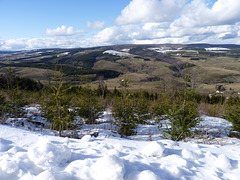
Walking up from L'Estampe
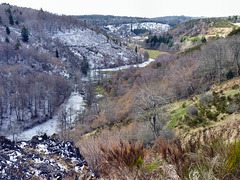
Cheylard-l'Évêque
| |
|
The village Cheylard-l'Évêque lies "just around the corner" at the end of this valley.
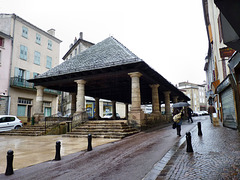
Langogne - The market hall
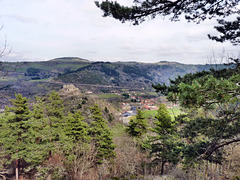
Goudet - The valley of the Loire
| |
|
Looking back to the valley of the Loire. On the right side Goudet is visible, the bridge over the Loire - and right - the ruins of the Château de Beaufort.
Florac - The Château
| |
|
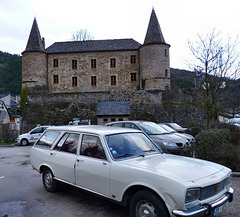
The "Château de Florac" is a actually 13th century castle, rebuilt in the 1650s after the religious wars. Today it hosts headquarters of the Cévennes National Park.
In front of the castle is another classical french symbol: a Peugeot 504! The Peugeot 504 was introduced 1968 and won the title "European Car of the Year" in 1969. The 504-station wagon was launched in 1970. Peugeot produced about three millions 504s in Europe upto 1983. The Peugeot 504 was succeded by the - Peugeot 505.
Monastier-sur-Gazeille - St. Chaffre
| |
|
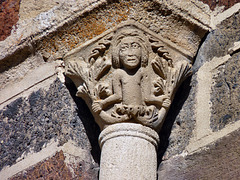
On a capitel, left to the entrance of the former abbey-church Saint Chaffre du Monastier-sur-Gazeille is this delicate, skinny, melancholic looking mermaid. A type typical for the romanesque churches in the Auvergne.
Mende - Paradis du Chien
| |
|
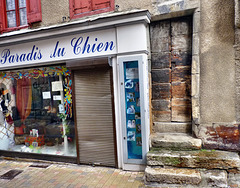
Well, we do not own a dog. So, when we were in Mende, we did not have a dog with us, what was good, as the "Paradis du Chien" in Mende was closed. Judging from the old wooden door and the stairs (right), the building probably looked pretty different, before it was changed into a paradise. But - on the other hand - can a paradise close at all? Shouldn´t a paradise not be open all day and night? Does hell has opening hours too?
Gorges du Tarn - Point Sublime
| |
|
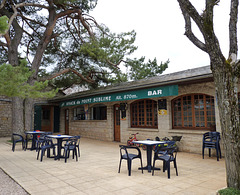
Not only the "Grand Canyon" in Arizona has a "Point Sublime". The "Gorges du Tarn" has a one as well. Other than in the US, here is a nice little, well-heated snackbar, that offers great "café au lait" in large cups. Merci beaucoup!
Saint-Jean-du-Gard
| |
|
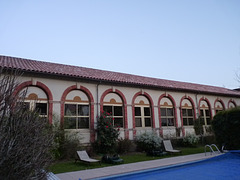
Saint-Jean-du-Gard prospered due breeding of the bombyx mori, the silk moth. There were more than 20 factories producing silk in the 19th century. The last silk-mill ceased production in the 1960 and now is a crumbling ruin. One of the factories was converted to a hotel.
www.hotel-bellugues.com/index.html
Saint-Jean-du-Gard
| |
|
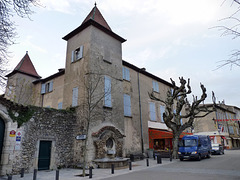
After Stevenson had reached Saint-Jean-du-Gard Stevenson he sold his donkey Modestine. Maybe here, in front of the chateau, next to the fontain (that shows his portrait today). The GR70 leads on to Alès, but Stevenson never walked that in 1878. He took a coach.
Saint-Jean-du-Gard - Col de Saint Pierre
| |
|
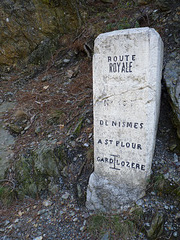
The Col de Saint Pierre is the last of all cols on the way to Saint- Jean-du-Gard.
Here the GR70 crosses an old "Route Royale".
Near Saint-Étienne-Vallée-Française
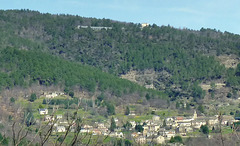
Saint-Germain-de-Calberte
| |
|
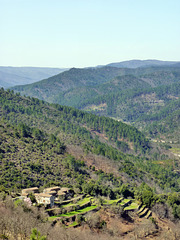
Looking back to Saint-Germain-de-Calberte. Visible up in the mountains is a huge horse-riding-camp - plus a hotel.
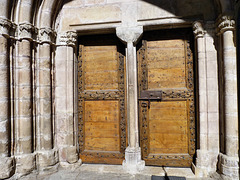
Saint-Germain-de-Calberte
| |
|
Unfortunately the parish-church in Saint-Germain-de-Calberte was locked. This is a protestant church. Still today about 90% of the people living in the Cévennes are Protestants. The "grandchildren" of the Camisard-Rebellion - - and the French Revolution....
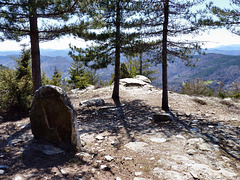
Les Cévennes
| |
|
A prehistoric menhir on the left and an open stone cist grave in the middle, further to the edge, facing south. There are quite some menhirs here in this part of the mountains.
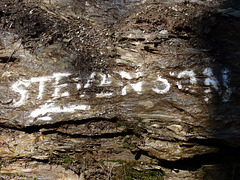
Les Cévennes
| |
|
From time to time, the red/white balisage of the GR70 was difficult to find. Here somebody used a spray-can to show the direction.
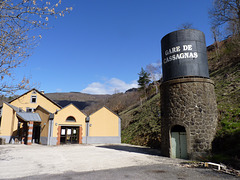
Cassagnas - The station
| |
|
Back on the GR70. The old station of Cassagnas (now a CdH, gite, restaurant) reminds on the days of steam trains.
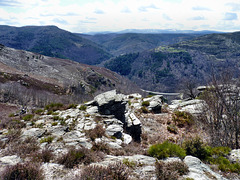
Approaching Cassagnas
| |
|
... no snow anymore. The temperature got milder. Here was spring. Walking south now was easy. The geology had changed as well from granite to glimmering mica slate.
