

tarboat's photos
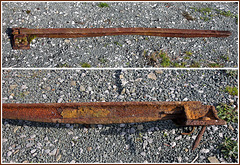
Fishbelly rail
| |
|
A recent discovery at Endon Wharf, Kerridge, is a piece of fishbelly rail from the tramroad built by William Clayton in the later 1830s to carry stone from his Endon Quarries to the sawmill by the Macclesfield Canal. The rails are 6ft long and fixed into the chairs with an iron pin as a wedge. The chairs were mounted onto the stone sleeper blocks using two spikes. Excavation of some track left in situ has revealed that the gauge of this tramway was 3ft 6ins.
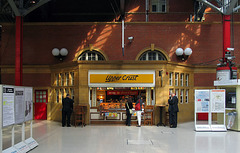
Upper Crust
| |
|
Yellow Great Central Railway terracotta blends surprisingly well with today's franchise experience at Marylebone Station in London. Best viewed large . The terracotta work is by Doulton.
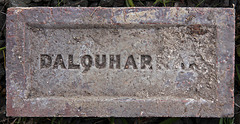
Dalquharran
| |
|
Dalquharran Brick & Tile Works was adjacent to the Romilly Colliery site at Wallacetown in the Parish of Dailly in Ayrshire. The works is believed to have operated from c1859 to c1915.
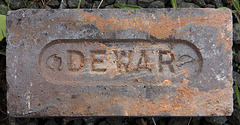
Dewar
| |
|
A Scottish brick but the brickworks from which it came is unknown. I have been able to ascertain that Dewar bricks were used in the viaduct at Tarrasfoot on the Langholm branch of the North British Railway in Dumfries & Galloway.
Thanks to Arthur Brickman (on Flickr) I now know that Dewar bricks came from the Drumpark Brickworks, Bargeddie, which operated from the late 1890's to 1977.
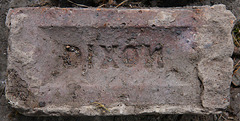
Dixon
| |
|
Probably a product of one of the brickworks operated by William Dixon Ltd., a company that had extensive coal and iron interests, chiefly in Lanarkshire.
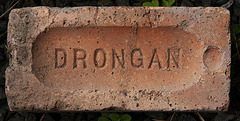
Drongan
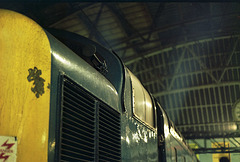
Tulyar
| |
|
December 1981, and the last days of the Deltics in British Railways service were nigh. A spirited run from Newcastle to Liverpool had just been completed by 55-015, Tulyar. On leaving the train I grabbed this view at the buffer stops in Lime Street station. The blue V of the exhausts stands out well in the station lights.
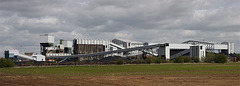
Kellingley Colliery
| |
|
The surface buildings for coal preparation and processing rather hide the winding towers at Kellingley when viewed from this angle.
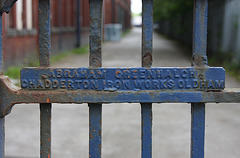
Abraham Greenhalgh, Chadderton Iron Works, Oldham
| |
|
Many of the cotton mills in the Oldham area have massive iron gates and gateposts at the entrance. This example at Briar Mill, Shaw, has the makers' name attached. Sadly, I have no further information about the Chadderton Iron Works.
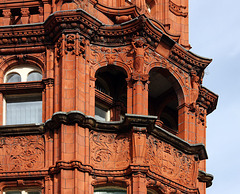
Municipal Buildings
| |
|
The terracotta decoration on the Municipal Buildings, Hewlett St, Wigan, is extensive and spectacular. Constructed in 1900 to the design of architects Bradshaw and Gass of Bolton, the building was originally built for the Royal London Friendly Society as seven shops with upper floor storage and private offices.
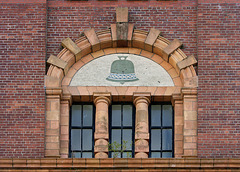
Bell Mill, Hathershaw
| |
|
The use of a mosaic image removed the need to write the name of this Mill on its tower. Built for the Bell Mill Co. Ltd. to the design of the firm of Potts, Son, & Hennings in 1904 this mill has a completely different look to a Stott product.
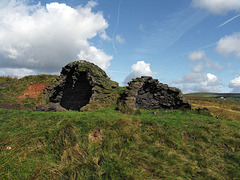
Broadhead Colliery Coke Ovens
| |
|
The 6 inch OS map surveyed in 1849/50 shows a series of coal pits on the moors north of Edgworth within Blackburn & Darwen. These are marked as comprising Broad-head Colliery and central to these workings are a series of beehive coke ovens to convert the small coal from the workings. By the late 19th century the pits were long abandoned and today can be identified by their collapsed shafts and associated spoil tips. The colliery remains and coke ovens are a scheduled ancient monument but this does not seem to mean that there is much chance of their preservation. What is left of the coke ovens are the fused shell and inner linings standing out of the moor as they slowly decay and disintegrate. A lonely place, which probably accounts for the survival of these few bits.
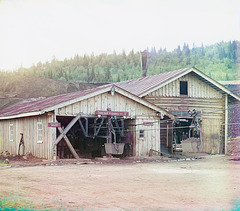
Tiazhelyi mine aerial ropeway
| |
|
A colour image made up from 3 plates showing an aerial ropeway at a mine in the Ural Mountains of Russia in 1910. I have been unable to discover anything about the mine, but suspect it was working iron ore.
It is taken from the Library of Congress collection and is listed as having no restrictions on publication. Forms part of: Sergei Mikhailovich Prokudin-Gorskii Collection (Library of Congress). LOT 10335-B, no. 363
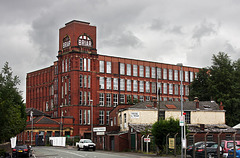
Briar Mill
| |
|
Briar Mill Ltd built this mill in 1906 to the design of Philip Sydney Stott. In 1915 the cotton spinning here was undertaken with 96,768 mule spindles and 25,088 ring spindles. IAfter bankruptcy the company was refloated as Briar Mill (1920) Ltd. In about 1955 the Lancashire Cotton Corporation took over, and in 1964 it [assed to Courtaulds Ltd. Converted as a warehouse and distribution centre of catalogue for J.D. Williams Ltd in 1968, it continues in this use along with the adjacent Lilac Mill to which it is now connected by a bridge. Current operations here are by Fulfillment Logistics, a division of J.D. Williams.
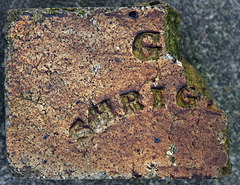
George Lambert, Pott Shrigley
| |
|
Whilst rooting about on the site of the alleged brick/lime kiln at the Kerridge Wharf on the Macclesfield Canal, I came across this firebrick. I reckon that it was lettered G L SHRIGLEY.
In c1820 George Lambert and Abraham Bury started a small brickworks near Brink Farm with one kiln to fire the bricks. When they needed to expand they moved to the site in Bakestonedale.By 1848 George Lambert was operating a coal and fireclay mine with associated Pott Brickworks on the south side of the road at Bakestonedale, Pott Shrigley. Lambert was still working the Pott Shrigley coal mine in 1884 but had relinquished the firebrick works to James Hall before 1878. By 1896 all had been absorbed into the business of William Hammond on the north side of the road. This firebrick must therefore date from between 1848 and 1878.
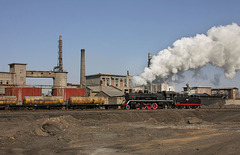
Baiyin for industry
| |
|
The Baiyin Non-ferrous Metal (Group) Co., Ltd. operate a proper industrial railway with proper industrial backgrounds. Just before the diesels began to take over the services here an SY shunts flat wagons in front of yellow sulphuric acid tanks. The background is one of the many copper, zinc, or lead processing plants in the area.
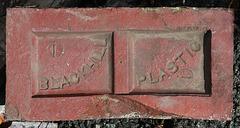
Blackhill Plastic
| |
|
The Blackhill brickworks was situated a short distancefrom the railway station at Entwistle, north of Bolton. The 1910 OS map shows the works with nine round kilns and a long tramway from a quarry to the north. There is a second tramway which runs under the main railway to an exchange wharf in the goods yard. By 1929 it had all gone.
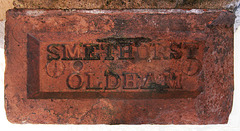
Smethurst, Oldham
| |
|
A new maker to me, seen on a trip around the terraced streets of Oldham.
S & J Smethurst, Grimbies Brick Works, Rochdale Road, Oldham. The 1890s OS maps show a works with a Hoffman type oval kiln adjacent to the junction of Booth Hill Lane and Godson Street. In 1869 John Smethurst is listed as owner of Salmon Field Colliery, Royton, Oldham. This was a short distance to the north-east of the brickworks.
