

tarboat's photos

South Ferriby Cement Works
| |
|
South Ferriby works was built in by 1938 by Eastwoods Humber Cement.The first chalk was dug by hand and transported by bucket conveyor to the works and the clay was excavated from behind the works and transported on a narrow gauge railway system. The works was commissioned by three German engineers, who were called home due to the outbreak of World War II before their work was completed.
Rugby Portland Cement Co.Ltd bought out Eastwoods Humber Cement in 1962 and installed a new kiln and conveyor. There are now two kilns in operations at South Ferriby: Numbers 2 and 3. The original kiln Number 1 was sold to a company in Jamaica following the works' first major plant upgrade in 1968.
Today the South Ferriby works is operated by Cemex UK. It produces in the region of 800,000 tonnes of cement per annum and employs nearly 150 people.

NCB South Leics
| |
|
Rather battered and not of the best quality is this unusually side-stamped brick seen in a wall at the long disused Stonetrough Colliery site in North Staffordshire. I have no idea where in South Leicestershire this was made or why it should have travelled so far.

Mow Cop
| |
|
Moc Cop Castle from Harriseahead. The folly at Mow Cop is a landmark both from the Cheshire Plain and from Staffordshire. It lies just in Cheshire whilst the old quarry in front is in Staffordshire. This is a fascinating area, once filled with collieries, brickworks, quarries, mills and tramroads, but now mainly a quiet residential area, albeit rather windswept at times. To me this is the place where the north-west and the midlands meet.

The Congleton Railway
| |
|
I spotted these whilst out walking a few days ago, but it was raining so hard that I couldn't risk getting the camera out of the bag. Today the sun was shining and so I was off up to Mow Cop Edge to get a shot. These are stone sleeper blocks from the Congleton Railway of c1807, now incorporated into a wall alongside the former route of this line. The track used was oval iron bars about 3ft long with a foot cast into the ends. The wheels on the trams were double flanged according to Farey in his General View of the Agriculture of Derbyshire vol 3 (1817). The line, which brought coal from Stonetrough Colliery in Staffordshire to a wharf on the outskirts of Congleton, had only a short life and was abandoned some time after the opening of the Macclesfield Canal in 1831

Banking out of the yard
| |
|
Hunslet Austerity Whiston banked by Florence No.2 make a start out out of Foxfield Colliery yard on the 1 in 19 gradient.

The High Peak at Peak Forest
| |
|
After the rain at Foxfield I drove over to Peak Forest to catch a look at 45305 on the "High Peak" railtour from Tyseley to Buxton. The light was much better with some sunshine as the train arrived. As it came into view the exhaust was excellent but unfortunately the driver shut off as he had not had a clear view of the signal beyond the bridge. It was really frustrating that he opened up again after the bridge.

Foxfield Colliery departure
| |
|
On a wet and windy morning I set off in the dark for Foxfield Colliery and a charter photo shoot organised at the start of the Foxfield Railway autumn gala. It stayed dark and the rain only occasionally eased off, but the results were ok. Here Giesel ejector fitted Bagnall, Florence No.2, sets off from the yard with a rake of mineral wagons. The upcast headstocks of the former Foxfield Colliery stand to the left.

Sunset in the pit
| |
|
|
With the sun about to dip behind the rim of the opencast mine at Jalainur, SY 1374 drops into the workings with an empty coal train.

Light repairs
| |
|
QJ 3405 undergoes repair in the semi-roundhouse at Hailar. In 1992 this was a very busy depot with locomotives being changed on most trains arriving in the town.
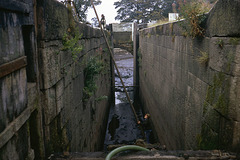
Lock 13
| |
|
Lock 13 at Marple proved to be the very devil of a job to clear of mud when the Peak Forest Canal Society set about it with barrow hoist and men with shovels. Each time we started work something would break. The pump would stop working or the hoist failed, or some other disaster would befall the job. Instead of a weekend it took several weeks before it was finally emptied of that black mud. This photo was taken at the beginning of the Lock 13 saga in September 1972.

Building the power station
| |
|
Concrete batching plant and blondin system in use during the construction of the Ardnacrusha hydroelectric scheme on the Shannon. The project was run by Siemens and during construction, 5,000 men were employed, 65 miles of railway, including a line up from Limerick, were built, four major bridges were constructed and nine rivers and four streams were diverted. Postcard view c1928.

West Offaly Power Station
| |
|
Peat fired power station of the Irish Electricity Supply Board at Shannonbridge on the River Shannon. This 150 megawatt West Offaly station is supplied with around 1 million tons of peat annually by Bord na Mona.
The old station which stood adjacent was demolished in 2008/9.

Chatterley ironworks, Harecastle
| |
|
The Chatterley Iron Company was established in 1865 and soon developed three blast furnaces opposite the Ravensdale Forge near Harecastle on the Trent and Mersey Canal in North Staffordshire. A vertical blowing engine by Adamson of Manchester was erected in 1868 in this building. The venture was not very successful and went into voluntary liquidation in 1879. The company continued to trade under supervision for a few years before final winding up in 1889. Subsequently in the ownership of Chatterley Whitfield Collieries Ltd the last furnace was blown out in 1900.
The empty blowing engine house stood derelict until the 1980's when it was demolished during the construction of a new road. Another fascinating relic lost to progress.

Goyt Mill
| |
|
Goyt Mill at Hawk Green, Marple, was erected in 1905 to the design of Stott & Sons and housed 80,080 mule and 45,000 ring spindles. Today it is divided into a range of industrial units and the office rangeseen in the foreground is given over to selling petfood and animal supplies.

East Buxton Lime Works
| |
|
The East Buxton Lime Works was opened in 1880 adjacent to the Midland Railway west of Millers Dale Station. The two kilns were cut into the solid rock and it was only in the 1920's that the concrete buttresses were added. The kilns were served by a narrow gauge tramway from the adjacent quarry. Production ended here in 1944.

Passenger on Nancha Bank
| |
|
Morning northbound passenger service charging the 1 in 30 gradient of Nancha Bank. This was the only train that I saw on this line without a banker. With 11 coaches behind, QJ 2823 slipped almost to a stand on the final ascent, but superb driving saw the train successfully cross the summit at walking pace.

Winding - in all directions!
| |
|
I have installed a new scanner and am astonished at the improvement achieved in scannning old negatives. This one is from a 1982 trip to the woods not far from Silverdale Colliery in North Staffordshire. There were several private mines around Bank Top, one of which boasted this fine winding house working drifts in three directions. All gone now.

Sick parade
| |
|
Line-up of Edwardian steam locomotives awaiting repair behind the shed at Malakwal. The line commences with a spare tender, followed by a Standard Goods Superheated (SGS) 0-6-0, then a Standard Passenger Superheated (SPS) 4-4-0, then another SGS and another SPS. All British made and, sadly, probably never to run again.
