

tarboat's photos

AstraZeneca Panorama
| |
|
On my wanderings about the hills around Macclesfield I looked back on the Hurdsfield side of town and was struck by just how big the AstraZeneca pharmaceutical plant has now become. As the largest employer in the town it has a major impact on the local economy and it would be a disaster if production were to be moved elsewhere.
Hurdsfield Church can be seen, looking rather small, at the lower left, and Woodford Airfield and the soon to be closed BAE factory is in the background. The Macclesfield Canal runs behind the Leylandii on the far right.
This needs to be viewed large .
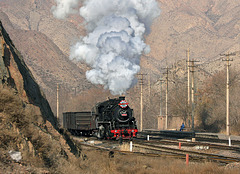
Shunting the siding at Liugongli
| |
|
|
The pickup goods is alive and well on the Baiyin Mining Railway. This particular afternoon SY 1581 was busy moving wagons into a siding off the main line where they were being emptied of sacks containing some sort of mineral.

Talk o' th' Hill Colliery
| |
|
Another one from the tarchives.
The North Staffordshire Coal & Iron Company leased this colliery from Ralph Sneyd in the 1860s in conjunction with a short-lived ironworks (1862-73). Later run by the Talke o' th' Hill Colliery Company, in 1920 it was acquired by Deeside steelmakers John Summers & Sons Limited who also owned the Shelton Iron & Steel Co Ltd. Closure came in March 1928 with over 1000 people made unemployed.
The photograph was taken from on top of the bunkers associated with the battery of 70 Simon Carves bye-product coke ovens on the site. These replaced a several ranges of beehive coke ovens around 1900. There were two shafts here with the upcast (No.2) just out of view on the left. The downcast shaft (No.1) was 384 yards deep to the Bullhurst seam. The buildings in front of the chimney on the right were used to repair railway wagons and locomotives.
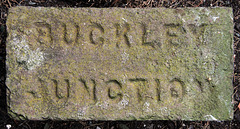
Buckley Junction
| |
|
Buckley Junction brickworks was established by John Jones and Henry Lamb in 1911 when they took on a lease of the site and set about working the clay. In 1919 Frederick Phelp Jones acquired the business and renamed it the Buckley Junction Metallic Brick Co Ltd. The company used the trade marks 'Jacobean' and City' for some of their facing brick products. In 1956 after the company became bankrupt the works were acquired by the Castle Firebrick Co, but this only lasted for three years before complete closure.

Jacobean
| |
|
Buckley Junction brickworks was established by John Jones and Henry Lamb in 1911 when they took on a lease of the site and set about working the clay. In 1919 Frederick Phelp Jones acquired the business and renamed it the Buckley Junction Metallic Brick Co Ltd. The company used the trade marks 'Jacobean' and City' for some of their facing brick products. In 1956 after the company became bankrupt the works were acquired by the Castle Firebrick Co, but this only lasted for three years before complete closure.
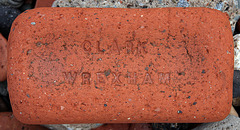
Clark Wrexham
| |
|
The Wilderness Brickworks at Gresford was established by Edward Stanley Lea in 1885 and soon after he was joined in partnership by Russell and James Rea and Charles William Massey, all from Liverpool.In 1888 they formed Clark & Rea Ltd and became known for producing quality pinky red and buff bricks. In 1903 Stuart Clark became the sole proprietor of the company which was then operating 8 round kilns for red bricks and 7 square kilns for blues. It appears that the works was never profitable and the Clark family lost money for a number of years. It closed by 1924 and was dismantled in 1926.

Clark & Rea Ltd
| |
|
The Wilderness Brickworks at Gresford was established by Edward Stanley Lea in 1885 and soon after he was joined in partnership by Russell and James Rea and Charles William Massey, all from Liverpool.In 1888 they formed Clark & Rea Ltd and became known for producing quality pinky red and buff bricks. In 1903 Stuart Clark became the sole proprietor of the company which was then operating 8 round kilns for red bricks and 7 square kilns for blues. It appears that the works was never profitable and the Clark family lost money for a number of years. It closed by 1924 and was dismantled in 1926.

QJ at work
| |
|
QJ 6487 goes about its daily work on a freight heading east at Huan He Junction on the outskirts of Shenyang. This afternoon saw a never ending procession of freights on this busy line.

Sandhole Colliery demolition
| |
|
Another view from the 1964 demolition of Sandhole Colliery. The concrete headgear over No.2 Pit dated from 1935. No.1 Pit headgear is to the right and the remains of the No.3 Pit headgear and winding drum are centre and in front of the chimney.
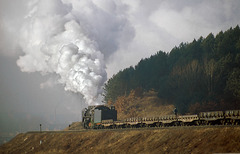
The Nancha banker
| |
|
Another thrash up the bank for QJ 2590 on the back of a train of empty flat wagons at the start of the 257km branch to Wuyiling. Trains were banked up from Liushu on the other side of the hill too and this meant that the banking locos had to work uphill tender first out of Nancha. The steepness of the climb is evident from the height already gained in less than 2km from the level of Nancha town in the background. This was a great place to spend time watching the endless procession of freights over the bank, and it was easily possible to run over to the other side to photograph the southbound trains coming up as well.

Brown Coal
Portarlington power station
| |
|
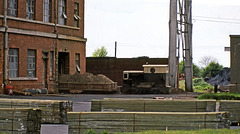
All was quiet when I called at the Portarlington peat-fired power station and the Ruston diesel was standing with a wagon loaded with boiler ash ready for a Monday morning trip to the tip on the worked out bog. Thanks to Ted McAvoy for help with the explanation.
The Edwardian railway
| |
|
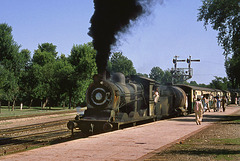
SGS (Standard Goods Superheated) 0-6-0 2471 at the head of a passenger service in Malakwal Station. Not quite Edwardian, the locomotive was built at some time between 1914 and 1923. The lack of coal in Pakistan meant that oil firing was the rule and this is confirmed by the black plume rising from the chimney.
No.7 Air Pit
| |
|
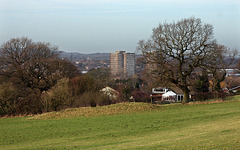
Coal mining took place on the Common very close to the town of Macclesfield. Eighteenth century workings included the Fence Colliery at Higherfence, the site of the main winding shaft of which was destroyed when Wades built a service reservoir there. Local coal owner, and proprietor of the nearby Roe Wood Colliery, George Needham reopened the workings when he sank the new Throstles Nest Pit above Commonside Farm in the mid nineteenth century. This included clearing and shoring up the old road underground leading to the No.7 Air Pit by one Jackson. By 1884 Needham had relinquished the colliery and it was under of control of William Mellor, the owner of the 'White Shop' engineering works at Rainow and also the collieries at Hough Hole and Lymer Clough, although all were shown as 'standing' at that time.
This is the No.7 Air Pit of Fence/Throstles Nest Collieries as it now lies; a small mound of spoil at the edge of a field overlooking the town.

My introduction to Irish Railways
| |
|
My first visit to the Irish Republic came in May 1982 and having travelled overnight from Holyhead to Dun Laoghaire it was a case of catching the train which turned out to comprise a motley collection of coaches and a generator van hauled by this C class BoBo. Seen here on arrival at Dublin Connolly this locomotive was one of a batch supplied by Metropolitan Vickers in 1956 from their Dukinfield works. Originally powered by a Crossley ESTV8, the engine proved to be unreliable and they were eventually replaced with General Motors power units by CIÉ at Inchicore Works, Dublin.

Sandhole Colliery No.1 Shaft
| |
|
I started scanning some slides from the Tarchives today and found a box of colliery images. This pit was actually called Bridgewater Colliery but was always referred to as Sandhole. It was sunk in 1865 and eventually became an important part of the Manchester Collieries Ltd empire. High costs associated with geological problems led to closure in 1962 and the colliery was demolished in 1964 apart from the washery that continued to operate until 1968. This view is during the demolition process.
Evening Star
| |
|
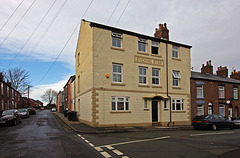
Former Evening Star, James Street, Macclesfield. This used to be quite a homely little boozer but unfortunately most of the people who used it became elderly and/or died and the younger generation don't go for quiet back street pubs. I remember it serving Marstons Ale, but it was originally a Smith's house having been acquired for their Crown Brewery tied estate in 1910.
Eddisbury Hill
| |
|
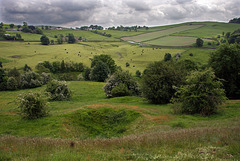
The land on the slope of Ecton Hill in Rainow and Commonside in Macclesfield is riddled with old coal workings. On the far side of the Buxton New Road is Eddisbury Hill on which can be clearly seen the remains of the spoil mound of Brocklehurst's Eddisbury Hill Colliery which operated after the First World War and was abandoned in 1925.
The workings in the foreground are much older and date from some time after the enclosure of the Rainow Wastes in the 1620s. At that time Laurence Hooley (Hulley) of the One House, who already had coal under his land, was granted additional acreage on Eddisbury. These pits are both small and numerous and do not appear to have been worked with a horse gin. I reckon they employed a simple hand windlass (locally known as a 'Pit Turn' ) to raise the baskets of coal. They were largely worked out by the end of the eighteenth century.
As an aside, I have searched the OS maps of the Macclesfield area for mention of Ecton Hill and cannot find the name on any of them.
