

tarboat's photos

Hongshila colliery
| |
|
Two drifts, screens and an incline up onto the waste tips. A typical Chinese small coal mine at Hongshila in the Nanpiao District.

Afternoon passenger to Linghe
| |
|
The afternoon passenger services on the Nanpiao Coal Railway carry schoolchildren and shoppers from Huangjia onto the two branches to Linghe and Sanjiazi. This is the Linghe train, whilst the locomotive for the Sanjiazi service can be seen backing onto the coaches in the station at Xiamiaozi where it has picked up passengers who started at Huangjia on the first train. It's all dieselised now

Holebottom Colliery
| |
|
|
Holebottom Colliery was situated on Moss Street (now named Fairbottom Street) in Oldham. In 1854 the colliery was operated by Lees, Jones and Co, and this continued until 1878
The photograph shows Fairbottom Street in the middle of the 19th century. The base of the colliery chimney stack was later covered up by the front stalls of the Kings Cinema, which was built in 1911. The pit shaft is also now under buildings. The large building in the background, is the back of the Theatre Royal on Horsedge Street. The Coliseum, which was built in 1887 would appear later on the extreme right of this view.
In 1856 the pit was part of a valuation of the assets of Lees, Jones and Company. the equipment was listed as:
One pair headstocks, pulleys, capstan and cages
One 24 horse, condensing engine with pumping gear complete
One 20 horse, H.P. winding engine, with winding gear complete
One hemp and one wire rope
Two boilers fitted up complete
One boiler house and chimney
One wire capstan rope
Smith shop and store rooms
1305 pairs of rails with iron sleepers
69 3-basket wagons
2 houses at Holebottom
In August 1876 the rotary beam engine at Holebottom was giving 17 strokes/minute and the pumps working 6 strokes/minute. The shaft was 177 yards deep to the Lower Bent seam, passing through five other seams on the way
Operation passed to Jones and Company in 1878 but legal disputes and geological problems led to closure around 1880.

Robinsons
| |
|
|
The centre of Oldham seems to be full of architecture like this. Clearly the first quarter of the twentieth century saw a lot of redevelopment. This pub stands on the corner of Union Street and Peter Street and was built by Robinson's Brewery in 1923 as the Grey Horse. Although no longer owned by Robinson's it is still in business as a music venue under the name of The Castle. The coloured glass in the leaded windows is wonderful, and the little details such as the hop motifs in the terracotta add a lot to the overall effect.

Donchang crossing
| |
|
Empty spoil train at the crossing just outside the Donchang Colliery yard on the Chengzihe system at Jixi.

Freight to Fuli
| |
|
The Hegang Mining Railway offered the choice of steam and electric trains when I was there in 2005 and 2006 This freight movement caught me be surprise as I was walking back after photographing the afternoon steam passenger service as it came from the Fuli mine. The locomotive is a 1981 product of the LEW Hennigsdorf Works in Germany.
The Trading Post
| |
|
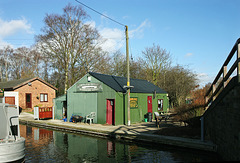
Eddie and Edith Burgess ran Constellation Cruises from the Nelson Arm at Higher Poynton for many years. After Eddie died the buildings slowly became more decrepit and eventually Edith sold the business and retired. The site is now the base of Braidbar boats who fit out narrowboat shells and the only survivor from earlier times is the former chandlery building that has metamorphosed into the ' Trading Post '. Chandlery is still available but you can also have a pump-out, buy diesel, or walkers can buy a cup of tea and something to eat along with a waterway magazine or two.
The Macclesfield Canal runs on the far side of the towpath bridge on the right and the water in view is on the private canal arm constructed for the use of Lord Vernon's Collieries when the canal was built and opened in 1831. It is only a couple of boats long and terminates alongside the modern bungalow seen on the left.
The Nelson Pit was situated somewhere near the birch tree and coal would be brought up the shaft and tipped straight into boats for shipment to the mills of Bollington, Marple and beyond. After winding of coal here ended in 1870 a stationary steam engine was installed to haul coal tubs up a tramroad from the Anson Pit. Loaded tubs destined for the canal were also brought to the Anson Pit on standard gauge railway wagons from the Park Pits some distance away. I believe that he last coal was shipped out from here in the early 1930s.
Being a long-established connection to the main canal means that British Waterways cannot demand an annual connection fee from Braidbar Boats, neither can they insist that any boat in the arm has to have a licence. This is a significant commercial advantage to the business.

Ilfeld viaduct
| |
|
|
|
Just a bit of early morning glint as a load of standard gauge wagons on narrow gauge transporters are hauled across the Ilfeld viaduct on the Harzquerbahn.
James Swinnerton, Macclesfield Courier invoice 184…
| |
|
|
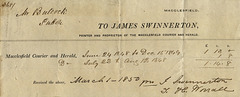
The Macclesfield Express newspaper is celebrating its bicentenary in 2011 and has just published a facsimile of the first edition of the Macclesfield Courier from which it has evolved over the years. In my collection of local ephemera are a number of invoices issued by James Swinnerton who was proprietor of the paper in the 1840s and 50s when it was published as the Macclesfield Courier and Herald. This example was sent to Mr Thomas Bullock of Sutton, a local silk manufacturer, invoicing him for his subscription to the paper. For eighteen months from June 1848 to December 1849 the cost was 33 shillings which is 22 shillings per annum. Today the paper costs 57p which is just slightly more than you would have paid for 6 months of issues in 1848!
Pretoria Pit explosion - Report to the Miners' Fed…
| |
|
Another document from the Tarchives
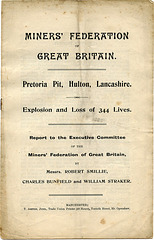
The explosion at Pretoria Pit occurred on 21st December 1910 and was the second worst mining accident in England, and the third worst in Britain. The recent centenary of this tragic event has recently been marked by the publication of an excellent book by Alan Davies .
The document in my collection is a report by three representatives of the Miners' Federation of Great Britain who were deputed by that body to act as its representatives at the inquest into the deaths, and subsequent public inquiry into the explosion. Their report reflects the findings of the inquiry and makes a number of comments regarding the operation and supervision of the colliery and concludes in calling for alterations to the relevant Mines' Act.
The document came into my possession from the boardroom of the Poynton Co-operative Society shortly before the building was demolished. I was given a selection of records relating to the Co-operative Society in Poynton and also the Poynton Collieries branch of the Lancashire and Cheshire Miners' Federation that at one time met there. I presume that every branch was sent a copy of the report.
Shaft on Ecton Hill
| |
|
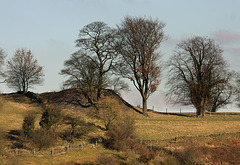
On of the Hulley pits is still evident on the top of the bank above Eddisburygate. The workings that produced this spoil heap were probably active in the late eighteenth or early nineteenth century. The Little Smut and Sweet seams are closest to the surface here.
Gas and Electric
| |
|
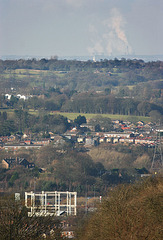
A different view of Macclesfield from the Buxton Road adjacent to Eddisbury Hill whilst I was looking at the remains of the Macclesfield coal industry. Fiddler's Ferry power station was busy that day.

Knowle Farm limekiln Mellor
| |
|
A most surprising discovery by Mellor Archaeological Trust was this limekiln on the top of a hill in Mellor. There was no sign on the surface and nothing on old maps and plans. It was the application of geophysical survey techniques that pointed to something interesting in the field and subsequent excavation yielded this fine eighteenth century? kiln. The pot and access passage for drawing the kiln have survived well.

Blakelow Colliery 3
| |
|
Coal mining on the southern side of Macclesfield Common was concentrated around Blakelow via a number of shafts to the north-east of the current boundary of Macclesfield Golf Club. The Macclesfield Copper Company leased the Blakelow workings in the later eighteenth century and was extracting the coal from the two Holcombe Brook Seams using pillar and stall workings drained by a sough driven from lower down the hill towards Macclesfield town. The seams were thin and sometimes less than 2ft thick, but the quality was good enough to make it worthwhile extracting them.
The mound just above the frosted grass is the spoil heap and site of the third shaft at the colliery. There are sign of the loading bank in the sunken lane behind. The cart road back to the copper works is seen running steeply uphill at the right side and then turning left to pass Higher Blakelow Farm on its way to Lower Blakelow. It must have been hard work for the horses to surmount this bank, but once past Higher Blakelow it was all downhill. I am told that there is a fourth shaft, but this has now disappeared under the adjacent golf course.

Belgrave No.3 Mill
| |
|
The electrically powered No.3 Belgrave Mill at Hathershaw was built to the design of F W Dixon in 1910. Production ceased in 1960 and later use included a clothing factory until 1976 and then flock manufacture. It is currently occupied by a company manufacturing foam and fibre fillings for cushions etc.

Another adit
| |
|
This one took a bit of finding as there was a lot of snow around and falling on the day I was there. Having eventually found the entrance it was clear that there had been a fall a short way in. However, that is surmountable and further coal mining excitement lurks beyond!

Making chimneypots
| |
|
I had a trip out today and found a wide range of traditional chimneypots being made in round downdraught kilns. :-)
Two chimneys
| |
|
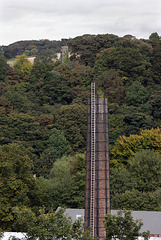
This one has been hanging around in my pending box since the Bollington Flickrmeet in 2008! A look from Chancery Lane over the valley to the brick chimney at Lower Mills and then on to the derelict stone chimney of the Oak Bank Print Works.
