

tarboat's photos

Thermphos Widnes
| |
|
Thermphos International is one of the world’s largest producers of phosphorus, phosphoric acid, phosphates, phosphonates and phosphorus derivatives. The company supplies material for pharmaceuticals, hygiene, industrial and household cleaning, food and feed additives. beverages, flame retardants, crop protection etc.
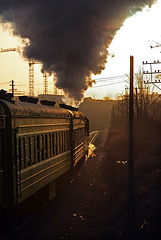
Evening glow
| |
|
SY 1581 heads the afternoon passenger service from the Sanyelian smelter towards Baiyin City.
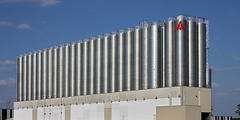
BP Ineos Westerlo
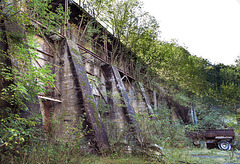
Cocking Limeworks
| |
|
Cocking limeworks stands on land owned by the Cowdray estate and had kilns in use at least as far back as 1861 and ten years later there are three kilns shown on the 1:2500 OS map. In 1921 the works was leased to Frederick Searle and later his brother Eli who went into partnership with Robert Dunning. Dunning and Searle built six new coal-fired flare kilns in 1926 and made further developments including an aerial ropeway, an overhead crane and the conversion of existing draw kilns to flare kilns in order to produce cleaner lime for the sand-lime brick industry at Midhurst. In 1938 the works, now consisting of two batteries of kilns, was expanded further and production of agricultural grade lime began at the behest of the Ministry of Agriculture. The final operator was Dudman Chalk & Lime Ltd who ceased operations in 1999 and the site is now derelict.
The north bank of four flare kilns has been largely demolished whilst the eight draw kilns comprising the south bank are largely intact. Kiln 1 appears to have been erected as late as 1958 whilst kiln 8 was originally used for drying chalk.
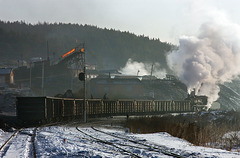
Taiping Mine
| |
|
Another industrial line that has now seen the end of steam operations is the Lishu section of the Jixi Coal Railway. In happier times a train is seen being loaded at the Taiping Mine. It is standing on what was, until a couple of years earlier, the branch up to Sijing Cokeworks and Qikeng Colliery. The men standing in the wagons are levelling the load with shovels.
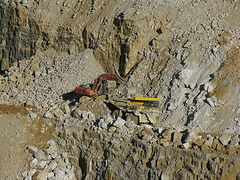
Digging
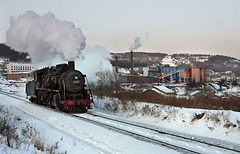
Leaving Pingang Mine
| |
|
As the light fades on a winter afternoon, SY 1018 heads away from the Pingang Colliery on the Lishu system of the Jixi Coal Railway.

Unknown species - Myanmar
| |
|
I spotted this little dragonfly at the side of the path in north-eastern Myanmar, but I have no idea what species it is. All suggestions gratefully accepted.

Bullock cart at the crossing
| |
|
The boy with the cart laden with grain in sacks has to wait whilst the train clears the crossing just east of the yard at Namtu on the Burma Mines Railway.
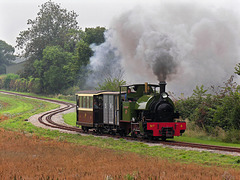
Trangkil No.4
| |
|
Trangkil No.4 is a Tattoo class Hunslet built in 1971 many years after the company had last built a steam locomotive. After service at the Trangkil Sugar Factory, Java, Indonesia the locomotive was repatriated to the Statfold Barn Railway where it is seen here at an open day.
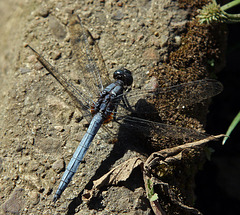
Orthetrum Glaucum
| |
|
The Blue Marsh Hawk ( Orthetrum glaucum ) is a common river dweller found across much of Asia. This male was resting at the roadside in north-east Myanmar.

The moment it all went wrong
| |
|
The Bagnall 2-6-2 was thrashing up the bank through this gorge above Namtu when suddenly, just as I took this shot, disaster struck. The front right coupling rod broke in two and one end dug into the ballast and bent the crank pin. Luckily the loco did not derail and the staff on hand rapidly dismantled the offending parts in order that the train could creep backwards down to the depot about two miles away. When I returned to Namtu that evening the locomotive had already been repaired and a replacement rod fitted!
The signal lady
| |
|
The lady guardian of the signal that protects the runaway siding above Lopah watches a train of ore hoppers heading up to Tiger Camp on the Burma Mines Railway. The locomotive is a rare surviving product of Stoke-on-Trent builders Kerr Stuart, having been completed in1914.

Heading for Wallah Gorge
| |
|
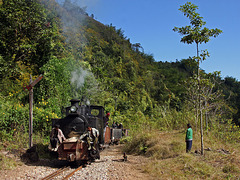
1927 built Bagnall 2-6-2 No.42 heads a short freight towards Wallah Gorge as it crosses the river above Namtu on the Burma Mines Railway.

Darjeeling 19
| |
|
Memories of an open day at Statfold Barn when Adrian Shooter's Darjeeling B Class loco No.19 was one of the attractions. The train is running on dual gauge track but the notice by the points warns that the branch is only 2ft gauge and that trains on the 2ft 6ins gauge should STOP!
Drydock
| |
|
|
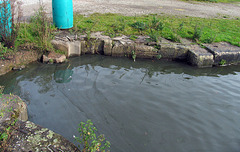
At Buxton Road Wharf on the Macclesfield Canal are some interesting remains that indicate that at one time a lock gate was installed here. Unlike those at Bosley, this gate was a single item of a full seven feet plus in width as can be seen from the recess seen here. At the left of the recess is the quoin and the cut-off remains of the iron straps that held the gate collar. These straps are of an identical design to the few remaining old style straps still in use on the gates at Bosley. At the far left was reason for the gate as this is the entrance to the drydock that the Macclesfield Canal Company built here in the 1830s.
The dock is not shown on any of the maps and plans that I have consulted and must have been taken out of use after only a short life. There is, however, a reference in the proceedings of the Macclesfield Canal Committee.
Dry Dock at Buxton Road Wharf:
Meeting on 10th July 1834 at the Canal Office, Macclesfield.
Mr Hall having laid before the Committee a letter from J P Swanwick & Co. containing an offer to rent a part of the Company’s Wharf north of the Buxton Road, including the partly formed dock at £20 per annum provided the Company complete the said dock, each party to be at liberty on giving 6 months notice; the subject was considered, the rent offered was thought too low, and some difficulties appeared to present themselves with respect to the present lime shed, and the ingress and egress to and from the wharf and also as to the waste of water that might occur if the dock was used to repair unless under proper control; the mode of completing the dock was also discussed. It was thought unnecessary to go to the expense of ashlar coping or of puddling round the dock and that a rubble wall would be sufficient. It was therefore ordered that Mr Watts be requested to undertake the arrangement with Messrs J P Swanwick & Co. with the understanding as to 6 months notice and the letting of water to be under Mr Hall’s control and the rent must be more than £20 per annum, and that he be empowered to arrange with Mr Hall and Mr Nicholls as to the completion of the dock and the expenses attendant thereon.
I wonder if the cheap construction and consequent water loss made it more trouble than it was worth? There is no further mention in subsequent Committee minutes.
Huanan express
| |
|
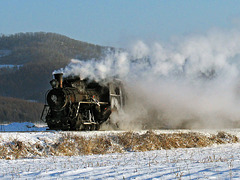
The little C2 class 0-8-0 tender locomotives that graced so many narrow gauge lines in China were capable of sounding just like their grown-up main line cousins when worked hard and heard from a distance. In this case the train was running downhill, so no sounds of thrash, but C2 011 arriving at Tuoyaozi on the Huanan Coal Railway certainly gave the visual impression of being on an express.
Ganister mining
| |
|
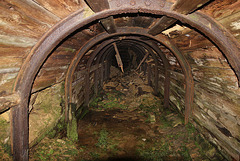
This abandoned adit was used for the extraction of ganister and fireclay for use in the refractory industry. It has collapsed a short way into the hillside.
