

tarboat's photos

Corrugated church
| |
|
Church of the Good Shepherd, Drury, Buckley, Flintshire. A nineteenth century mission church which is still in use.
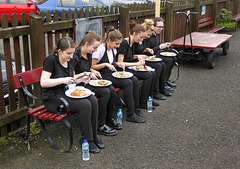
Sunday lunch
| |
|
We went for a Sunday Lunch trip on the East Lancashire Railway and very good it was. The Hughes Crab that was hauling the train was handled gently so as not to spill our drinks! Before setting off the train catering staff grabbed their own lunch before a busy time serving two coaches of diners and then afternoon teas on a later run.
Exposed
| |
|
|
|
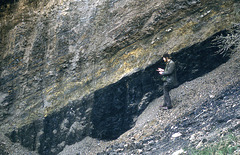
A coal seam exposed in a quarried face at Apedale. A very much younger Tarboat gives scale to the scene.
Branch line
| |
|
|
|
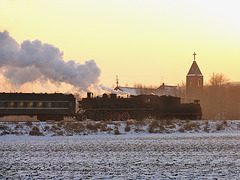
SY 1772 arrives at Wangqian on one of the branches of the Tiefa Coal Railway with a local passenger service.
Turning pillars
| |
|
|
Cornfield Colliery was operated by The Exors of John Hargreaves but closed in February 1897 after a dispute over mining rights under Gawthorpe Hall although it was retained for pumping in connection with Habergham Colliery. The shaft collapsed, taking the pumping equipment with it, in March 1933. The pit was connected by a chain ginney to a landsale wharf in Padiham. This line continued to run after the closure of Cornfield Pit as it had by that time been connected by an extension to Habergham Colliery which finally closed in 1941 due to labour shortages.
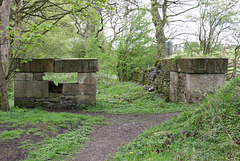
Turning the direction of tubs on a chain hauled line was quite a complicated business involving the detaching of the tubs from the haulage chain before the change of direction and their reattachment afterwards. The operation was supposed to be automatic but there are many tales of problems which often necessitated a man being placed at the turn to supervise the operation. This image shows the remains of the turning block close to Grove Lane to the east of Padiham. The substantial construction reflects the heavy loads and hard use to which it was put.
Threlkeld
| |
|
|
|
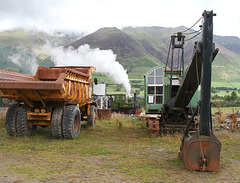
A visit to Threlkeld Quarry is a must for anyone interested in old excavators and quarry equipment. The quarry railway is an added bonus.
Winmarleigh Street
| |
|
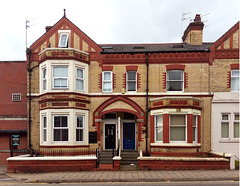
On a visit to Warrington I spotted these houses in Winmarleigh Street. This is a particularly effective use of polychromatic brickwork and the decorative red bricks over the bays and below the guttering add a lot to the final effect too.
Generation
| |
|
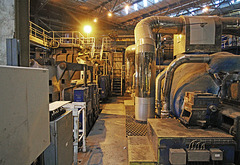
At the end of one of the the turbine/generator rows at Drax power station.
High Pressure Turbine on the right,the large silver pipes carry super heated steam, meet in the middle then pas over the turbine. On the left are the Steam Governor Valves ,which govern the amount of steam, and stop the Turbine from overspeeding. The Turbine will be turning at 3000RPM.
Entrance
Bob platform
| |
|
|
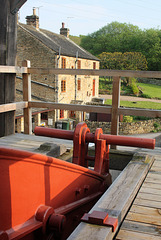
Bob platform and end of the beam on the Elsecar pumping engine of 1795. This is the only Newcomen engine in the world that survives in its original enginehouse. It was subject to a major conservation project which was completed in 2014 and the engine can now be seen moving using hydraulic drive. The cylinder base was badly cracked after the engine was run in the 1950s with steam of too high a pressure and significant quantities of water in the bottom of the cylinder.

J Duckett & Son Ltd
| |
|
|
James Duckett, the founder of this firm, was born in December, 1825, the son of John and Jenny, his father was mployed as a cotton spinner. After working in a cotton mill and he became a stonemason with his brother and by 1851 was employing 30 men. In the 1859 he turned his attention to brick manufacture and by 1871 was a brick manufacturer and stone merchant employing 25 men. As the business prospered, he turned his attention to the manufacture of sanitary ware. It was this side of the business that was to prove most successful, and the works developed into the firm James Duckett and Son, Sanitary Pipe Manufacturers on Blannel Street in Burnley with a large claypit close to Burnley Barracks Station. His son Alfred later became involved with the business, as did his grandson, George.
Initially James Duckett manufactured bricks using a large Hoffmann kiln at what was originally known as the Mitre Works where in 1870 he was advertising Dressed and Common Bricks, Field and Draining Tiles. In 1892 this is shown on the OS map as a brick and tile works but by 1912 James Duckett & Son Ltd was operating a Sanitary Ware Works with five circular downdraught kilns on the site. The Hoffmann kiln was abandoned and eventually demolished as brickmaking ceased and the works then manufactured a wide range of salt glazed urinal slabs & stalls, closet pans, wash basins, sinks & channel pipes which were sold all over Britain, Europe & South America. The Hepworth Iron Company acquired Ducketts in 1961 but production continued until the early 1970s.
This trademark is on the water tank above the Duckett urinals in the Ship Inn in Macclesfield.
Aggregates production
| |
|
|
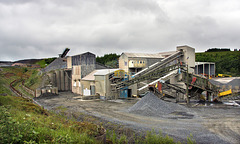
Crushing and grading plant at the Cemex operated Shap Blue Quarry.
The ‘blue’ quarried granite rock is used exclusively for hardcore purposes, and as aggregate for tarmacadam and concrete plants. This stone is found to be superior to other chippings use in road making, because it does not break easily and therefore does not require replacing so frequently.
Almost there
| |
|
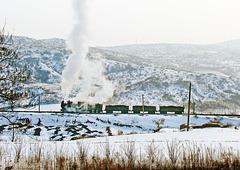
Wreathed in escaping steam a C2 class locomotive drags three wagons of coal on the approach to the sidings at Xianyang on the Yinghao Coal Railway. The brakesman hanging on at the rear was looking frozen.
Rotary
| |
|
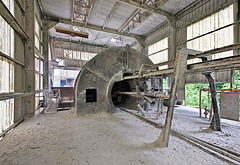
Disused rotary cement kiln in the limestone quarrying area around Ampsin near Liège in Belgium.
Waiting for the end
| |
|
|
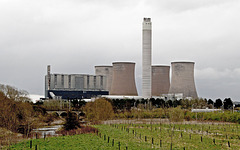
Rugeley power station in April 2016, just before closure. It was sleeping on this particular day.

Comestibles
| |
|
|
Muslim night market down the back lanes of Xian. The kebab stall was in full production.
Steaming at Threlkeld
| |
|
|
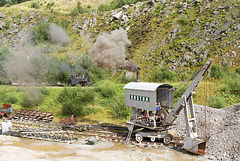
Joffre class Kerr Stuart 3014 climbs the bank up to the quarry at Threlkeld whilst in the foreground the 1909 Ruston proctor steam navvy lays a smokescreen.
Another push
| |
|
|
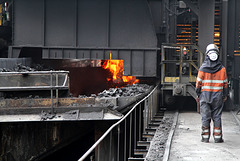
Coke being pushed from an oven into the coke car at Monckton coke works at Royston. All gone now.
