

tarboat's photos
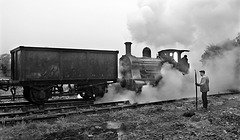
Shunting
| |
|
|
Shunting at Chasewater Heaths with Kerr Stuart 3063 built in 1918. This little well tank gave us a great photoshoot even if it was dark, wet and misty the whole time.
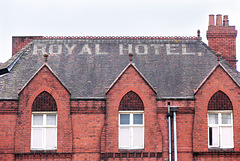
Royal Hotel
| |
|
|
Ghost sign close to the station in Crewe. The brickwork around the window bays is an unusual feature too.
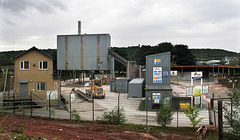
Asphalt
| |
|
Small industrial units are often ephemeral and ignored by photographers which I think is a great shame. This is the Cemex asphalt plant on Harewood Street in Tunstall.
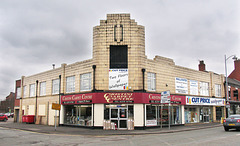
Two floors of wallpaper
| |
|
Carpet centre on Mill Street in Crewe. The cream terracotta faience is unusual for the area. The building has a date of 1937 at the bottom of the black central rectangle. I wonder whether it was shops when built?
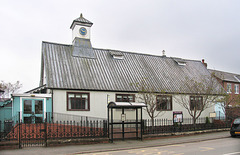
Kenyon Hall
| |
|
The Kenyon Hall was built on land donated by Lord Kenyon to the village of Holt with money raised by the Primrose League, a Conservative Association. Officially opened in 1892 by the Duchess of Westminster it was used as a meeting place and reading room. In 1935 the hall was placed under the control of Holt Town Trust and on 12th March 1940 it was registered as a charity.
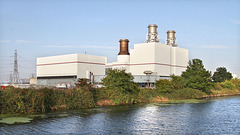
Keadby Power Station
| |
|
Keadby 1 in North Lincolnshire was built in 1996 and is operated by Scottish and Southern Energy. It has a generation capacity of 735MW. This combined cycle gas-fired power station was mothballed in 2013 due to adverse market conditions and brought back on line in November 2015.
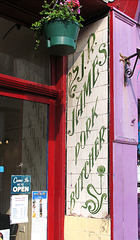
Pork Butcher
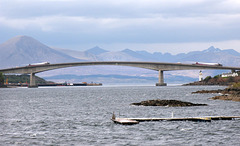
Blades on the bridge
| |
|
|
Whilst waiting for the train at Kyle of Lochalsh we were surprised to see three windmill blades being transported across the Skye Bridge away from the Island. I would love to know where they were coming from and where they were going. I can only surmise that these had been taken from an existing structure and replaced by new ones.

Sound of Sleat
| |
|
|
It was a lovely sunny afternoon when we crossed the Sound of Sleat from Mallaig to Armadale, This is the view looking north-west when about half way across. The next day all the crossings were cancelled due to the wind.
A stitch of seven images using Photoshop.
Kelvin Marine Engines
| |
|
|
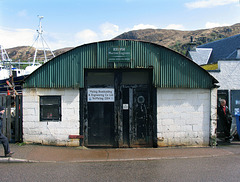
The premises of the Mallaig Boatbuilding & Engineering Co Ltd sport an excellent enamel sign advertising the engine of choice for Scottish fishermen. Kelvin engines continue in production as part of the British Polar Engines Group and are based in Glasgow.
Isolation Hospital
| |
|
|
|
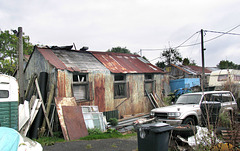
The corrugated iron buildings are the remains of the isolation hospital that was on the land at Turnwater Meadow adjacent to the junction of the Melton Mowbray Navigation with the River Soar Navigation.
White Bay Power Station
| |
|
|
|
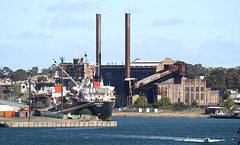
To satisfy the power requirements for the expansion of the Sydney tram and rail network, the New South Wales Government Railways began the first phase of work on The White Bay Power Station in 1912. The plant, constructed in the Federation Anglo-Dutch architectural style, was fully operational from 1917 but two further phases of development, 1923-1928 and 1945-1948, saw the station expand even further. It remained under the control of the department until 1953 when the newly created Electricity Commission of NSW took over. Ownership moved to Pacific Power when NSW electricity was deregulated in 1995.
In later years the generation capacity comprised 186 MW made up of three Australian General Electric turbines with British Thomson-Houston alternators which ran at 1,500 rpm, with a continuous rating of 22 MW, they were numbered 6, 7 and 8. Steam was supplied by 9 Babcock
and Wilcox CTM chain grate boilers. Each boiler produced 80,000 lbs/hour at a pressure of 275 psi and a temperature of 640 deg F. In 1928, a single 20 MW unit supplied by Parsons was brought into use (no.9, In addition a 50 MW, 50 cycle turbo-alternator from Parsons was commissioned in 1951 (no. 1), followed by a second identical unit in 1955 (no. 2). These two sets were erected on the original 'A' station site.
Units 6 to 9 were decommissioned in 1975 and removed, whereafter only the 50 MW Parsons units remained. Thenceforth, the remaining units saw intermittent use; their last intensive use was during power shortages in 1982. The entire power station was closed permanently on 25 December 1983.
The buildings are on the heritage list with some of the generating machinery still in situ.
Kettell's Restaurant
| |
|
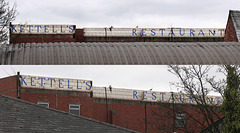
High above the streets of Crewe is this signing advertising a long defunct restaurant. In more recent times the building housed the Steam nightclub but is now derelict. I would love to know more about Kettell's but have so far found no information.

Stuck
| |
|
|
The tanker narrowboat is well and truly stuck at Bridge 86 on the Huddersfield Narrow Canal due to a combination of rubbish in the cut and low water levels. Use of block and tackle and the application of a number of passing walkers to pull on the rope soon had things moving again.
Drum house
| |
|
|
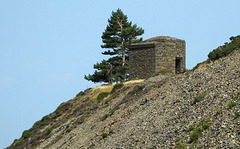
The Conwy stone quarries are easily visible from the A55 a short distance west of the tunnel under the estuary. A microgranite was worked here during the nineteenth century under a number of quarry owners. A series of inclines connected at least four levels with the mill and loading bunkers on a siding off the Chester and Holyhead Railway. Closure came at some point between 1936 and 1945 after an agreement was reached to supply the North Wales Granite Co Ltd with stone from Penmaenmawr. The quarry is now sometimes used by climbers and the five incline brake drum houses stand empty, staring out onto the Irish Sea. This is the remains of the drum house at the top level of the quarry.
Chasewater minerals
| |
|
|
|
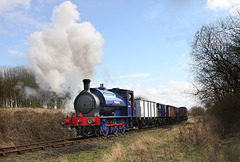
Hunslet 3738 of 1953 running as Holly Bank No.3 with a rake of mineral wagons on the Chasewater Railway. This former colliery line provides an authentic location for photo charters such as this.
Patten Arms Hotel
| |
|
|
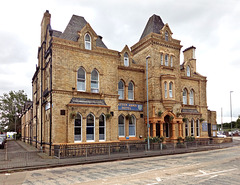
The Patten Arms is situated across the road from Warrington Bank Quay Station and is named after local industrialist Thomas Patten who was instrumental in the development of copper smelting in the town. The use of cream brick is unusual in an area where red brick predominates The manufacturer of the bricks was probably one of those in the St Helens area. The resulting building is certainly eye-catching and impressive.

Ingleton quarry
| |
|
Processing plant at the Hanson quarry at Ingleton which extracts greywacke sandstone for aggregate.
