


Nederland: kastelen en buitenplaatsen

Folder: Nederland - the Netherlands
Foto's van Nederlandse kastelen, landhuizen, havezathe's en buitenplaatsen.

Nederland - Bunnik, Huis Rhijnauwen
| |
|
|
|
Around the year 1200, Rhijnauwen Castle (a real fortress with a moat and a drawbridge) stood on the site of Huis Rhijnauwen (Manor Rhijnauwen). The castle was destroyed by the French in 1672. The current building was built around 1830. In 1919, the estate was purchased by the municipality of Utrecht from its last private owner.
Huis Rhijnauwen - located on the right bank of the river Kromme Rijn - has been used as a youth hostel since 1933, making it the oldest in the Netherlands.
Nederland - Vaassen, Kasteel Cannenburch
| |
|
|
|
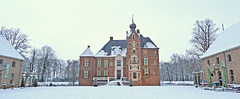
Kasteel Cannenburch (Cannenburch Castle) was built in 1543 by a well known Dutch field marshal, Maarten van Rossum (also Marten van Rossem). He constructed a country house - in the style of the Dutch Renaissance - on the spot of a medieval castle.
Van Rossum died in 1555 and his nephew, Hendrik van Isendoorn, inherited the castle and it remained in the family for more than 300 years. In 1882, however, it was acquired by Eduard Baron van Lynden by purchase. In 1905, it came into the possession of Mrs. Frida Cleve-Mollard from Berlin, whose husband Richard Cleve was the last private resident of the castle. Over the years, the castle has been altered and extended many times and it became also a stone entrance bridge.
Since the 1950’s Kasteel Cannenburch and surrounding park are owned and managed by the Stichting Geldersch Landschap en Geldersche Kasteelen , a Dutch heritage foundation.
Nowadays the castle is is a Dutch national monument.
Nederland - Warnsveld, Huis Welgelegen
| |
|
|
|
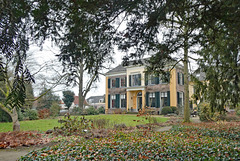
A farmstead with a horse mill stood on the location of the current Huis Welgelegen as early as 1571. From 1650 to 1832, it was used as an inn. It was conveniently situatred on one of the access roads to the nearby city of Zutphen.
In 1832, the complex was converted into a country estate. The former inn was connected to a newly built mansion in the classicist style. The English landscape-style garden also dates from this period. The house subsequently served as a residence for various owners, but has also had other functions. From 1870 to 1897, for example, it was used as a boarding school for girls.
The garden was given the name Overtuin and was enriched with flower beds and fruit trees. The garden is home to unusual trees and is known for the stinzenplanten (historical bulbs growing for centuries as wildflowers) that bloom abundantly in the spring.
Since 1986, Huis Welgelegen has been owned by the Stichting Warnsveldse Monumenten Today Febryuary 2026), it houses a private residential care centre.

Nederland - Apeldoorn, Het Oude Loo
| |
|
|
|
Kasteel Het Oude Loo (Castle Het Oude Loo) is dating back to the early 15th century when it was a farm, which later was fortified. When it came into the possession of the Bentinck family the moated castle as we see it today was built and enlarged between 1538 and 1540. In those days it was used as a hunting lodge by Karel, Duke of Gelre.
In 1684 Prince Willem III van Oranje, Stadtholder of Holland and Zeeland acquired the castle. He also used it as a hunting lodge. Soon the castle became too small for his hunting parties and he built Paleis Het Loo in 1686-88.
In 1795, when the French occupied Holland, the castle was used as a military hospital and it fell into neglect. In 1806 Napoleon Bonaparte appointed his brother Louis Napoleon as King of The Netherlands. Louis resided in the castle during summers. He filled up the moat around the castle.
In 1904 Queen Wilhelmina of the Netherlands ordered the restoration of the castle. This was done by the famous Dutch architect Cuypers. In the 1950's and 1960's other restoration works were carried out. Since 1968 the castle has been owned by the Dutch state. In 1973 it became a national heritage site.
Kasteel Het Oude Loo is nowadays used by the Dutch royal family as country house and guest residence. The castle itself is not open for the public, but the surrounding fenced garden/park can be visited during April and May.

Nederland - Baarn, Kasteel Groeneveld
| |
|
|
|
Kasteel Groeneveld in Baarn is an 18th-century country estate and one of the finest examples of a country house from that era. Since the 17th century, regents and merchants from Dutch cities came to their country houses to enjoy the good life.
The ‘castle’ was built in 1703 by Marcus Mamuchet and is considered being one of the finest examples of a country house from the Rococo style period. It was built in the tradition of 17th- and 18th-century estates that were intended as summer houses for wealthy city dwellers, mainly from Amsterdam. Groeneveld was probably built on the foundations of a farmstead. Initially, the house consisted only of the central part of the main building and the two outbuildings: coach house and orangery. The side wings date from around 1760.
Kasteel Groeneveld was privately owned until 1940. Nowadays it is owned and managed by
Staatsbosbeheer (a Dutch governmental organization for forestry and the management of nature reserves).
Jump to top
RSS feed- Latest items - Subscribe to the latest items added to this album
- ipernity © 2007-2026
- Help & Contact
|
Club news
|
About ipernity
|
History |
ipernity Club & Prices |
Guide of good conduct
Donate | Group guidelines | Privacy policy | Terms of use | Statutes | In memoria -
Facebook
X
