


Nederland: kastelen en buitenplaatsen

Folder: Nederland - the Netherlands
Foto's van Nederlandse kastelen, landhuizen, havezathe's en buitenplaatsen.
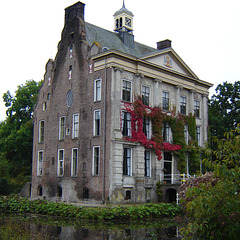
Nederland - Loenen, Kasteel ter Horst
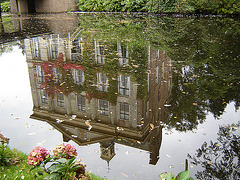
Nederland - Loenen, Kasteel ter Horst
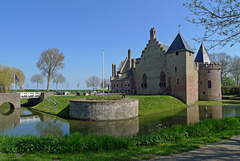
Nederland - Medemblik, Kasteel Radboud
| |
|
|
|
Kasteel Radboud (Radboud Castle) - also knwon as Kasteel Medemblik - is located between the harbour of Medemblik and the IJsselmeer . At the end of the 13th century, Count Floris V of Holland ordered the construction of a series of castles to control the Westfrisian population. Radboud Castle is the only one remaining of those castles. When exactly it was built is unknown, but the castle was completed before the so called St. Lucia's Flood in December 1287.
From old pictures and archeological research it is known that Radboud Castle must have been a strong castle. Nowadays only two residential wings, two square and one round tower are still standing.
In the 14th and 15th century the counts of Holland installed guardians at the castle. Radboud Castle has never been connected to nobility but has been primarily used as a prison. The people of Medemblik used it also as a refuge. The defensive function of the castle was reduced with the building of walls around the city of Medemblik at the end of the 16th century and due to both dismantling and lack of maintenance there was attrition of the castle buildings.
From 1848 the demolition of the castle buildings started. In 1889 the remains of the castle were transferred to the state and a thorough restoration followed. From 1897 till 1934 the castle was used as a courthouse. From 1964 to 1965 further restorations were done with a more historical and architectural correctness and some of the previous renovations were removed
The name Radboud has been derived from the popular assumption that the castle was built on the place where in the 8th century a castle from the Frisian king Radboud had been standing.
Nowadays Kasteel Radboud houses a museum, while on the ground flore there is a café/restaurant.
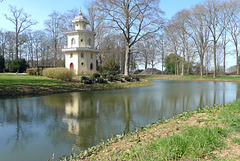
Nederland - Megchelen, Huis Landfort
| |
|
|
|
Huis Landfort (Country Hous Landfort) is located on a location near the German border along the river “Oude IJssel”. The official history of Landfort begins in 1434, when the estate was first mentioned in a document. It was then called “Lanckvoort”, most probably because there was a ford in the river.
Landfort looked different in the past compared to the present. In former times it consisted of a square building with four corner towers. Around the house there was a moat with a bridge that led to the entrance door. This was the shape of the house until 1823-25. In those years the house became its current, elongated form. At the same time, the surrounding park was landscaped. In the romantic park there is a separate building: a pigeon tower in Moorish style.
During World War II the mansion was severely damaged. In 1970 the family who inhabited the estate was forced to sell it. Geldersch Landschap & Kasteelen , a foundation for the protection of nature and landscape in the province of Gelderland, became the new owner. The estate is still owned and managed by the foundation, but the house is sold and will be - after the current restoration - privately inhabited.
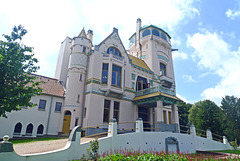
Nederland - Molenhoek, Jachtslot Mookerheide
| |
|
|
|
Jachtslot Mookerheide (Hunting lodge Mookerheide) was commissioned by the wealthy Nijmegen banker Jan J. Luden van Heumen and designed on the highest point of the Mookerheide estate. The lodge was designed by two architects from Nijmegen in a very richly and exuberantly decorated Jugendstil style.
In June 1940, the Germans seized this beautiful hunting lodge and turned it into the country retreat for the feared Waffen SS. Himmler himself is said to have visited on a couple of occasions. In September 1944, the hunting lodge and its estate were taken over by the Americans as a temporary prisoner-of-war camp.
For 30 years, the main building was a hotel-restaurant. In 1985 Jachtslot Mookerheide and the estate are owned by Natuurmonumenten (a society for preservation of nature monuments in the Netherlands) and recently have been restored. Since 2001 it is designated a protected national Dutch monument.
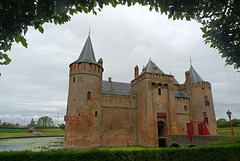
Nederland - Muiden, Muiderslot
| |
|
|
|
Kasteel Muiderslot (Muiden Castle) is a moated castle, which is dating back to the year of 1285. Count Floris V commissioned the construction of this stone fortress. It is one of the oldest and best preserved castles in the Netherlands. It is also very well known (by foreigners) due to its location near Amsterdam.
Soon after its construction - in 1296 - the castle was destroyed by Bishop Willem van Mechelen. In 1380 a new castle was built on the ruins of the old one. Muiderslot has been a court building, a prison and the official residence of castle wardens. One of the most famous of these wardens was the author and poet, P.C. Hooft. He lived at the castle from 1609 to 1674. During this period, the Muiderslot was an important center for science and art and the meeting place for a group of prominent citizens known as the Muiderkring .
At the end of the 19th century Muiderslot was completely dilapidated and even came close to being demolished. Fortunately that never happened because King Willem I got involved. The castle was renovated thoroughly by the famous Dutch architect Pierre Cuypers. In 1878 the castle became a national museum, one of the first in the Netherlands.
The castle is part of the so called Stelling van Amsterdam (Defence Line of Amsterdam), a ring of fortifications around the city. Since 1996 it is a UNESCO World Heritage Site.
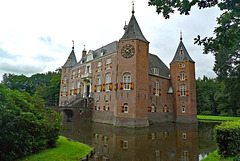
Nederland - Nederhorst den Berg, Kasteel Nederhors…
| |
|
|
|
In the 13th century, Kasteel Nederhorst (Castle Nederhorst) was no more than a simple moated tower. These structures were usually not intended for permanent residence but were purely defensive. As with many other of these donjons, a residential wing was added later, after which the complex grew into a castle.
The castle - formerly known as Horst op de Berg - was founded around the year of 1260. From 1301 to 1560 the castle was owned by the Van der Horst family. Another important owner was Godard van Reede. He undertook many activities, such as having the Reevaart canal dug, which enabled visitors to reach the castle by boat. He also gave the castle its present appearance around 1635.The house acquired the character of a country estate. In winter, the elite lived in the city, but in summer they moved to the country estates.
Nederhorst remained a country estate with some grandeur until the Napoleonic era. It then came into the possession of the Freule De Warin, who lived at Nederhorst during the summer for most of the 19th century. In the early 20th century Kasteel Nederhorst came into the possession of the Van Lynden family. After a renovation, the castle became suitable for permanent residence.
After the World War II the house was neglected, fell into disrepair and was finally uninhabitable. In 1959, the building in this dilapidated state was bought by Jan Lourens Jonker. He restored the castle to its former glory. On 10 January 1971, when the restoration of the castle was practically finished, a big fire broke out. With the help of additional funding by state, provincial and local governments, renovation could start again and was completed in 1973.
Today the Kasteel Nederhorst hosts a private company. The park and the driveway (with a wrought iron entrance gate from 1730 between stone pillars in Louis XIV style) are free accessible.
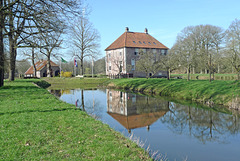
Nederland - Neede, Havezathe de Kamp
| |
|
|
|
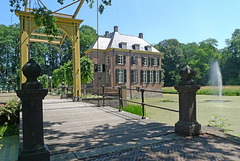
Over the past centuries Havezathe de Kamp (havezathe = manor or fortified (farm) house) has been rebuilt and renovated several times. In 1782 the stepped gables disappeared and in 1871 the canal was filled in and “De Kamp” lost its castle-like appearance.
“Huis De Camp” - as it was originally called - was probably built in the 13th century. In 1469 Johan Van Barmentloo was the first resident whose name we know. In 1553 the house came into the hands of the Gansneb family called Tengnagel. Several generations continued to live there for almost two hundred years. In 1636, Otto Gansneb had Havezathe de Kamp raised and rebuilt into the building as it looks today. The manor was sold in 1741 and subsequently had various owners.
In 1977 the house came into the possession of the municipality of Neede (later Berkelland). Between 1983 and 1989 the manor was restored, the canal was dug out again and the coach house was rebuilt. In 2014, “De Kamp” came into the possession of private owners
After the re-excavation of the moat and the most recent alterations and renovations, Havezathe de Kamp has regained its authentic appearance. Nowadays it is used for business/private meetings and events.
Nederland - Kasteel Neerijnen
| |
|
|
|
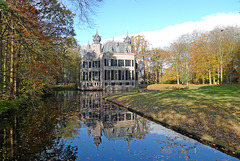
The first Kasteel Neerijnen (Castle Neerijnen) was probably built around 1350 and was originally called Klingelenburg . It was the first noble house in Neerijnen. The inhabitants of the castle carried the name “De Cock van Neerijnen”. The present castle was built around 1600 on the foundations of the older one. It was radically rebuilt in the 18th century and was extended in the late 19th century. Together with the Kasteel Waardenburg (PiP4) built in 1265, it forms one estate. From 1700 onwards both castles have always had the same owners.
After the “De Cock” family, the estate was owned by various noble families. At the end of 1827, the estate came into the hands of “Frederik Willem Floris Theodorus baron van Pallandt”. This family owned the estate until 1971. On May 6 of that year the last baroness of “Pallandt van Neerijnen en Waardenburg” died. Three years later the estate came into the hands of the Stichting Gelders Landschap & Kasteelen , a foundation for the protection of nature and landscape in the province of Gelderland. From 1980 to 2019, Kasteel Neerijnen was in use as the town hall of the former municipality of Neerijnen.
The castle garden - situated between the castle and the reformed church of Neerijnen - had been seriously neglected for a long time. Since 1996 this garden has been renovated and maintained by volunteers, taking into account the original layout. The garden consists of several parts, including a herb garden, vegetable garden, flower garden and a rose garden.
Nederland - Oegstgeest, Kasteel Oud-Poelgeest
| |
|
|
|
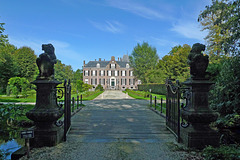
The country estate Oud-Poelgeest (officially Kasteel Oud-Poelgeest) was built in 1668 in the Dutch Neoclassical style on the foundations of the medieval castle Alkemade. This castle was destroyed by Spanish troops in 1574.
The well-known humanist and physician Herman Boerhaave lived here between 1724 and 1738. He grew plants at Oud-Poelgeest for which there was no room in the botanical garden of Leiden University.
In the 19th century, four towers were built on the square house - making it look more like a castle - along with the coach house. The grounds also contain a gardener's house, a neo-Gothic chapel and a well dating from 1550. These building and the surrounding park are protected as a Dutch national monument.
Today, the coach house is a hotel-restaurant. The castle is used as a conference centre
Nederland - Olst, Groot Hoenlo
| |
|
|
|
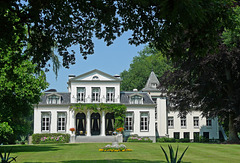
Landgoed Hoenlo (Hoenlo Estate) covers 145 hectares with the functions agriculture, forestry and nature. The main building of the estate is the manor Groot Hoenlo .
The name Hoenlo was first mentioned in 1230. In 1368, a havezate (manorial farm) was built at this location. The present manor house was probably originally built in the 18th century as an extension of an older building.
In 1802 the Groot Hoenlo came into the possession of the Teding van Berkhout family. In the period 1895-1907, a series of renovations were carried out and the original house was almost completely replaced and received its present appearance and interior.
Until 1950, Hoenlo was still one of the largest estates in the province of Overijssel with five country houses, more than 750 hectares of land and 25 tenant farms. After that it disintegrated. In 1985, Groot Hoenlo was divided into several appartments.
Groot Hoenlo became well-known because Harry Mulisch - one of the greatest Dutch writers - lived in the house for some time.
Nederland - Friesland, Huize Oranjewoud
| |
|
|
|
In 1664 the Frisian Nassau’s bought some heathland east of Heerenveen known as ‘t Wold’. The ‘village’ became its name 'Oranjewoud' ('Orange Forest' – Orange is the colour of the Dutch royal family) in the year of 1676, when Albertina Agnes, Prinses van Oranje Nassau, after the death of her husband Willem Frederik van Nassau - Stadtholder of Frisia - bought an existing country estate.
Early 18th century her daughter-in-law Henriëtte Amalia van Anhalt-Dessau modernized the manor by (landscape) architect Marot (well known for the construction of Palace Het Loo nearby Apeldoorn). Marot designed two new wings for Oranjewoud, but the central building was never built. The architect also planned the gardens and park around the manor. During the French occupation, both wings were demolished and the property was sold. Two estates were built where the Stadtholder's country house had once stood: Oranjewoud at the site of the old castle and Oranjestein where the home of the steward had been.
Various generations of the Oranje-Nassau family spent their summer at Oranjewoud.
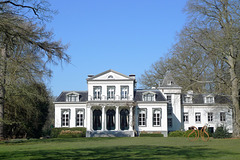
White plastered Huize Oranjewoud - built 1834 on the place of the former (royal) Palace Oranjewoud - is surrounded by a beautiful garden and a moat. It is private owned and it can not be visited. Opposite of the house is the entrance to the so called ‘Overtuin’ - see note - a lovely garden/park in English style.
Nederland - Huize Oranjewoud
| |
|
|
|
In 1664 the Frisian Nassau’s bought some heathland east of Heerenveen known as ‘t Wold . The ‘village’ became its name Oranjewoud (Orange Forest - Orange is the colour of the Dutch royal family) in the year of 1676, when Albertina Agnes, Prinses van Oranje Nassau, after the death of her husband Willem Frederik van Nassau - Stadtholder of Frisia - bought an existing country estate.
Early 18th century her daughter-in-law Henriëtte Amalia van Anhalt-Dessau modernized the manor by (landscape) architect Marot (well known for the construction of Palace Het Loo nearby Apeldoorn). Marot designed two new wings for Oranjewoud, but the central building was never built. The architect also planned the gardens and park around the manor. During the French occupation, both wings were demolished and the property was sold.
Two estates were built where the Stadtholder's country house had once stood: Oranjewoud at the site of the old castle and Oranjestein where the home of the estate manager had lived. Various generations of the Oranje-Nassau family spent their summer at Oranjewoud. It remained in the possession of the Oranje-Nassau family for a long time. The last time a family member showed up was in 1791. Not long after, the summer residence was demolished.
In 1823, the jonkheer De Blocq van Scheltinga bought the land and had the current country house built on the old foundations. White plastered Huize Oranjewoud (Country House Oranjewoud) is surrounded by a beautiful garden and a moat. The estate remained in the family until 1953.
Huize Oranjewoud is private owned and is used and rented to companies for meetings of all kinds.
Nederland - Oranjewoud, Huize Oranjestein
| |
|
|
|
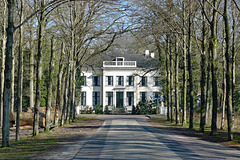
Huize Oranjestein (Country House Oranjestein) was built on the site where, around the 18th century, the residence of the estate manager of Landgoed Oranjewoud (Country Estate Oranjewoud) stood. The estate belonged to the Van Nassau-Dietz family.
Oranjestein was bought in 1820 by the merchant Pieter Cats. The property was thoroughly rebuilt by the new owner and was completed two years later. More alterations followed; a final thorough renovation took place in 2008/2009, whereby the house retained its original 19th century atmosphere.
The Oranjestein estate is still privately owned. Access to the estate/park is restricted to a number of Sundays in the summer. Since 2003, the Oranjestein estate is a national Dutch monument.
Nederland - Overveen, Elswout
| |
|
|
|
Dutch economy reached a peak in the Golden Age. To escape the foul stench of the city in the summer, wealthy Amsterdam merchants invested in luxurious country estates with park-like gardens in the forested inner dunes. Thanks to a system of barge-canals and rivers, they could travel from Amsterdam to their estates in just a few hours. The area west of Haarlem (Kennemerland) became the cradle of these country estates.
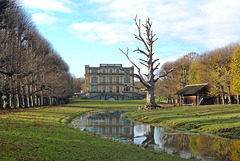
Buitenplaats (summer residence) Elswout was founded in the middle of the 17th century by Carel du Moulin, but the Amsterdammer Gabriel Marcelis completed the first construction of Elswout. Over the centuries, many great architects worked on the ever-changing architecture.
The oldest buildings on Elswout date from the 17th century. The construction of the Grote Huis (Big House) on the Elswout Estate already started in 1884. When the façades and the terraces were completed, the client Willem Borski jr. died and construction came to a standstill. Although the building was given various functions after his death, it remained unfinished.
After being occupied by the Germans during World War II the building was in bad shape. It later functioned for different purposes like schools. Elswout estate and the house became property of the municipality in 1958 and the Dutch State Forestry Commission in 1970. Over the years they could not find a proper function for the building and decided to have a competition for the rebuilding and renovation of the estates building. A private company decided to take up the challenge. After thorough search and research the original plans from around 1814 were found. Restoring the building’s interior and exterior according to those plans started in 2004 and realizing a new high end office function for the building.
Elswout also offers one of the most beautiful and watery country estates along the inner dune edge of Zuid-Kennemerland National Park. This 85-hectare national monument has a rich plant and animal life and is dotted with several special follies. Because of the special flora and fauna, Elswout (and the rest of National Park Zuid- Kennemerland) have a Natura 2000 status and the area is part of the European protected nature network.
The Elswout house has never been open to the public, so it can only be admired from the outside. The garden can be visited and access is free.
Nederland - Overveen, Duinlust
| |
|
|
|
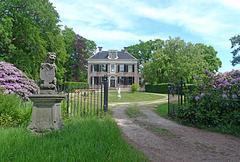
Duinlust is one of the many so called buitenplaatsen (summer residences) west of the city of Haarlem along the inner dunes. Wealthy merchants from Amsterdam built here their mansions.
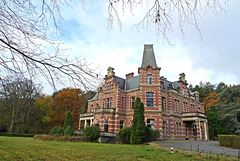
In 1783 a first house was built. After it was old in 1810 the new owner founded the Duinlust country estate and built a white house built in Empire style. There was also an orangerie, which still exists. In 1828 the house was sold again to Johanna Jacoba van de Velde, who also was the owner of the nearby Elswout ountry estate . After her death, the country estate goes to her son Willem Borski, a well-known Amsterdam banker. It became the summer residence of his eldest daughter Johanna Jacoba. After Willem Borski's death in 1881, she inherited the estate. Johanna Jacoba had a new house built by architect Constantijn Muysken in 1881. It is designed in neo-renaissance style.
During the World War II, Dutch troops were stationed there, later it was confiscated by the German occupiers. During the last weeks of the war it was used by Canadians and the Homeland Forces. The house was in poor condition and as of November 1, 1947, the government rented the country estate and restored Duinlust.
The CIOS (the first school for sports leaders) was located in the house from 1948 to 2001.
Nowadays the mansion is used for events. The surrounding park is a nature reserve managed by Staatsbosbeheer (a Dutch government organization for forestry and the management of nature reserves).
Nederland - Paterswolde, Huis Vennebroek
| |
|
|
|
Not much is known about the origins of Huis Vennebroek (Manor Vennebroek). From 1689 to 1747 the house had the so-called right of havezate (manor or fortified house). In 1768 the manor was mentioned in an advertisement in a local newspaper. In 1848, Jonkheer Hooft van Iddekinge rebuilt the house extensively, retaining a large part of the basement and the ground floor.
In 1912 the estate was bought by P.A. Camphuis, a merchant from Groningen. He was also the owner of the adjacent Friesche Veen estate; Vennebroek and Friesche Veen have formed a unit ever since. Camphuis restored the house, but did not stay there long. The manor remained in the family for a long time; the wife of his eldest son lived there until her death in 1994.
Around 1985 the house and the estates became the property of Natuurmonumenten (Society for preservation of nature monuments in the Netherlands). Since 2014 the house has been privately owned and inhabited again.
Huis Vennebroek is surrounded by a horseshoe-shaped moat. The estate has many old beeches and chestnuts; the oldest is more than 300 years. In the autumn the estate is known for its many species of mushrooms.
Nederland - Poederoyen, Slot Loevestein
| |
|
|
|
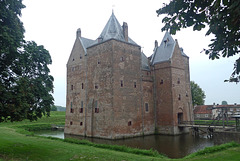
Slot Loevestein (Loevestein Castle), or officially Museum Slot Loevestein , is one of the most well-known castles of the Netherlands. The castle was built by the knight Dirk Loef of Horne (hence "Loef's stein" (stone) house) between 1357 and 1368. Around 1575 it was expanded to a larger fortress surrounded by earthen fortifications with two (later three) stone bastions, two moats, an arsenal, and barracks for a commander and soldiers. The castle was also integrated into the Hollandic Water Line.
From 1614 on Slot Loevestein was used as a state prison. In 1619 a famous Dutch jurist, humanist, lawyer and poet “Hugo de Groot”, was imprisoned in the castle together with his wife and daughter to serve a life term sentence. In 1621 however he managed to escape from the castle by hiding in a big wooden bookcase, which was being brought out of the castle.
In the 19th century the castle was incorporated into a new and enlarged earthwork fortress, which made the castle an important stronghold in the New Dutch Waterline (a line of defensive works using water throughout the western part of Holland) and is part of this 200-kilometer long UNESCO World heritage Site. During all these works the bailey of the castle was torn down, the sole remnant is the round tower which was used as a powder magazine. Loevestein Castle lost its military function in 1952.
Nowadays Slot Loevestein is used as a medieval museum and function centre.
Jump to top
RSS feed- Latest items - Subscribe to the latest items added to this album
- ipernity © 2007-2026
- Help & Contact
|
Club news
|
About ipernity
|
History |
ipernity Club & Prices |
Guide of good conduct
Donate | Group guidelines | Privacy policy | Terms of use | Statutes | In memoria -
Facebook
X
