

Arches in the cathedral
Fonte battesimale
Crib near the San Nicola church
coloured balconies
yard with plants
Basilica di San Nicola with marriage
San Nicola interior
San Nicola-Ciborio
Portal
Bell of San Nicola
Rickshaws tricycles
Belvedere Tre Archi
San Domenico Church
Piazza Vittorio Veneto
Sasso Barisano- panorama
Dettaglio del Sasso barisano
Piastrelle sotto i Tre Archi
Al Calderaio- Nicola Morelli 1982
Palazzo e Arco del Sedile
Salita Castelvecchio-Verso la Cattedrale
Complesso di Sant'Agostino
Facade of the Cathedral
Belltower of the Cathedral
Cattedrale di San Sabino
Pottery-Ceramiche
Little lane
Castello Normanno Svevo
Palazzo Mincuzzi
Fontana Monumentale Piazza Aldo Moro- Bari
Piazza del Popolo -A lion from the central fountai…
Paris -Défense -The thumb by César Baldaccini
Tivoli- Fountain in Piazza Trento-Igor Mitoraj-GAP…
Legro paese dipinto - Riso amaro
Io e Ilda nei giardini del Municipio di Orta
Ristorante bar Edera in the little street
Street lamp in the old street
Old street
bike and flowers
Garden at the island
Street lamp on the way of silence
Street lamp at the island
Listen to the silence
A boat like our
With the boat around the San Giulio island
Sport around the San Giulio island
Location
Lat, Lng:
You can copy the above to your favourite mapping app.
Address: unknown
You can copy the above to your favourite mapping app.
Address: unknown
See also...
Keywords
Authorizations, license
-
Visible by: Everyone -
All rights reserved
-
247 visits
Cathedral interior
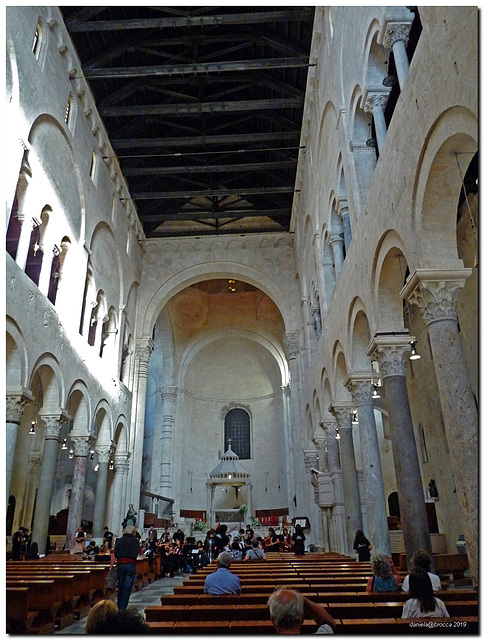

Uno dei più fulgidi esempi di architettura romanico pugliese a Bari. Sorta fra il XII e il XIII secolo sulle rovine del Duomo bizantino distrutto dal normanno Guglielmo il Malo, la Cattedrale presenta una facciata in luminosa pietra calcarea, ornata da archetti, lesene e un rosone dalla ghiera istoriata. Da ammirare le testate del transetto, con rosoni e bifore, la trulla (antico battistero convertito in sacrestia) e il campanile dall’alta cuspide. L’interno a tre navate, spogliato dagli stucchi barocchi all’inizio del Novecento, appare solenne e armonioso, sobriamente decorato da elementi scolpiti nel calcare a vista.
Il 21 giugno, giorno del solstizio d’estate, nella cattedrale si osserva un fenomeno insolito: intorno alle 17, i raggi solari che penetrano dai 18 spicchi del rosone della facciata vanno a combaciare perfettamente con i petali della rosa che orna il pavimento della navata.
Sotto il transetto si trova la cripta, con l’icona della Vergine Odegitria, cui la chiesa era dedicata anticamente, le reliquie di San Sabino e Santa Colomba. Accanto alla cripta si estende il succorpo, un ambiente dalla storia stratificata decorato da mosaici e affreschi, dove elementi dell’antica chiesa bizantina coesistono con rovine romane.
---------------------------------------------------------------------
One of the most shining examples of Apulian Romanesque architecture in Bari. Built between the twelfth and thirteenth centuries on the ruins of the Byzantine cathedral destroyed by the Norman William the Bad, the cathedral has a bright limestone facade, adorned with arches, pilasters and a rose window with a historiated lintel. To admire the heads of the transept, with rose windows and mullioned windows, the trulla (ancient baptistery converted into a sacristy) and the bell tower with its high spire. The three-nave interior, stripped of its baroque stuccoes at the beginning of the twentieth century, appears solemn and harmonious, soberly decorated with elements carved in exposed limestone.
On 21 June, the day of the summer solstice, there is an unusual phenomenon in the cathedral: around 5 p.m., the sun's rays that penetrate the 18 segments of the rose window on the facade perfectly match the petals of the rose that adorns the floor of the nave.
Under the transept is the crypt, with the icon of the Virgin Odegitria, to whom the church was dedicated in ancient times, the relics of St. Sabine and St. Dove. Next to the crypt there is the succorpo, an environment with a layered history decorated with mosaics and frescoes, where elements of the ancient Byzantine church coexist with Roman ruins.
Translated with www.deepl.com/Translator
Translate into English
Il 21 giugno, giorno del solstizio d’estate, nella cattedrale si osserva un fenomeno insolito: intorno alle 17, i raggi solari che penetrano dai 18 spicchi del rosone della facciata vanno a combaciare perfettamente con i petali della rosa che orna il pavimento della navata.
Sotto il transetto si trova la cripta, con l’icona della Vergine Odegitria, cui la chiesa era dedicata anticamente, le reliquie di San Sabino e Santa Colomba. Accanto alla cripta si estende il succorpo, un ambiente dalla storia stratificata decorato da mosaici e affreschi, dove elementi dell’antica chiesa bizantina coesistono con rovine romane.
---------------------------------------------------------------------
One of the most shining examples of Apulian Romanesque architecture in Bari. Built between the twelfth and thirteenth centuries on the ruins of the Byzantine cathedral destroyed by the Norman William the Bad, the cathedral has a bright limestone facade, adorned with arches, pilasters and a rose window with a historiated lintel. To admire the heads of the transept, with rose windows and mullioned windows, the trulla (ancient baptistery converted into a sacristy) and the bell tower with its high spire. The three-nave interior, stripped of its baroque stuccoes at the beginning of the twentieth century, appears solemn and harmonious, soberly decorated with elements carved in exposed limestone.
On 21 June, the day of the summer solstice, there is an unusual phenomenon in the cathedral: around 5 p.m., the sun's rays that penetrate the 18 segments of the rose window on the facade perfectly match the petals of the rose that adorns the floor of the nave.
Under the transept is the crypt, with the icon of the Virgin Odegitria, to whom the church was dedicated in ancient times, the relics of St. Sabine and St. Dove. Next to the crypt there is the succorpo, an environment with a layered history decorated with mosaics and frescoes, where elements of the ancient Byzantine church coexist with Roman ruins.
Translated with www.deepl.com/Translator
©UdoSm, Erhard Bernstein, Jean-luc Drouin, Gudrun have particularly liked this photo
- Keyboard shortcuts:
Jump to top
RSS feed- Latest comments - Subscribe to the comment feeds of this photo
- ipernity © 2007-2026
- Help & Contact
|
Club news
|
About ipernity
|
History |
ipernity Club & Prices |
Guide of good conduct
Donate | Group guidelines | Privacy policy | Terms of use | Statutes | In memoria -
Facebook
X

Daniela Brocca club has replied to Gudrun clubDaniela Brocca club has replied to Herb Riddle clubDaniela Brocca club has replied to ©UdoSmSign-in to write a comment.