

cammino's photos with the keyword: Universität Würzburg
Insekten Highlights 2021 (2): Blaue Holzbiene - In…
| 30 Jan 2022 |
|
|
|
Bitte vergrößern - Please enlarge
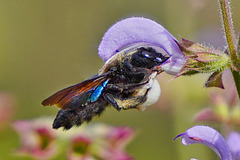
Dieses auffällige Insekt wird manchmal wegen seiner Größe (20 - 28 mm) und dem lauten Brummen mit einer Hummel verwechselt. Tatsächlich handelt es sich aber um die größte bei uns vorkommenden Biene, nämlich die Blaue Holzbiene (Xylocopa violacea) , die übrigens nicht angriffslustig ist (aber natürlich auch stechen kann) und solitär lebt (Einsiedlerbiene).
Die Blaue Holzbiene sah ich als junger Student in den 70er Jahren am Untermain zum ersten Mal, später dann mit Familie häufig in Kroatien und mittlerweile immer wieder auch bei uns in Deutschland in warmen Biotopen. Das Verbreitungsgebiet dieser Insektenart verschiebt sich offenbar vom Süden immer mehr nach Norden als Folge der Klimaveränderung. Informationen zur Lebensweise findet man hier: de.wikipedia.org/wiki/Gro%C3%9Fe_Holzbiene
Zum Bild: Die Holzbiene drängt sich nach der Landung auf dieser Salbeiblüte möglichst tief in die Blüte, um den Nektar optimal saugen zu können. Dabei drückt sie auf einen Mechanismus, so dass die Staubbeutel aus der Oberlippe herausgedrückt werden und Pollen auf dem Rücken der Biene aufgetragen werden (siehe Notiz). Bei einer anderen Salbeiblüte, bei der der Stempel aus der Oberlippe herausragt, wird dann bei der Landung der Pollen auf dem Rücken der Biene auf die Narbe übertragen, die Blüte ist bestäubt.
This conspicuous insect is sometimes mistaken for a bumblebee because of its size (20-28mm) and loud buzzing noise. In fact, it is the largest of our bees, namely the blue carpenter bee (Xylocopa violacea) , which by the way is not aggressive (but can of course also sting) and lives solitarily (hermit bee).
I saw the blue carpenter bee for the first time as a young student in the 1970s on the Lower river Main, later then often with my family in Croatia and now again and again in Germany in warm biotopes. The range of this insect species is apparently shifting more and more from the south to the north as a result of climate change. Informations on the lifestyle can be found here: de.wikipedia.org/wiki/Gro %C3%9Fe_Carpenter Bee
About the picture: After landing on this sage flower, the carpenter bee pushes itself as deeply as possible into the flower in order to be able to suck the nectar optimally. She presses on a mechanism so that the anthers are pushed out of the upper lip and pollen is applied to the back of the bee (see note). In another sage flower, where the pistil protrudes from the upper lip, the pollen is then transferred to the stigma upon landing on the bee's back, the flower is pollinated.
Die Gespensterblume - The Ghost Flower
| 21 Apr 2021 |
|
|
|
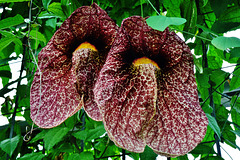
Die aus Südamerika stammende Aristolochia gigantea hat ungewöhnlich große Blüten (etwa so groß wie ein DIN A4-Blatt) mit gelbem Auge. Noch ungewöhnlicher ist aber die Art der Bestäubung: Insekten werden durch den etwas eigenartigen Geruch der großen Blüten angezogen, in das gelbe Auge gelockt und in ein kleines "Säckchen" geführt. Durch die herumkrabbelnden Insekten wird Pollen aufgewirbelt, der den oben sitzenden Stempel bestäubt. Die Insekten werden nicht verdaut und können sich leicht befreien.
Die Aufnahme entstand im Botanischen Garten der Universität Würzburg.
www.florakoala.de/Aristolochia-gigantea-Gespensterblum
www.botanik.kit.edu/garten/english/1185.php
Aristolochia gigantea , which comes from South America, has unusually large flowers (about the size of an A4 sheet) with a yellow eye. Even more unusual, however, is the method of pollination: insects are attracted by the somewhat peculiar smell of the large flowers, lured into the yellow eye and guided into a small "bag". The insects crawling around stir up pollen which pollinates the pistil sitting on top. The insects are not digested and can easily free themselves.
The photo was taken in the Botanical Garden of the University of Würzburg.
Jump to top
RSS feed- cammino's latest photos with "Universität Würzburg" - Photos
- ipernity © 2007-2026
- Help & Contact
|
Club news
|
About ipernity
|
History |
ipernity Club & Prices |
Guide of good conduct
Donate | Group guidelines | Privacy policy | Terms of use | Statutes | In memoria -
Facebook
X
