

Xata's photos
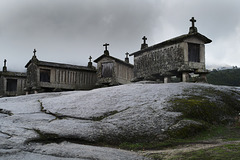
Soajo, Espigueiros L1005489
| |
|
Set on the periphery of the beautiful Peneda-Gerês National Park in Portugal is the traditional village of Soajo. Its quaint houses and small church create a charming picture, but it is best known for its impressive espigueiros: granite granaries built above the ground.
Espigueiros means “spikes,” and these granaries are supported on granite slabs from the Peneda mountains. They were built off the ground to protect food crops from rats and other rodents, and were used by the whole community.
The oldest espigueiros date back to 1782, and the whole cluster was constructed between the 18th and 19th centuries. Of the 24 that remain today, some are still used today to store grain, especially corn.
Source: www.atlasobscura.com/places/espigueiros-do-soajo
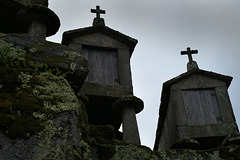
Soajo, Espigueiros L1005498
| |
|
Set on the periphery of the beautiful Peneda-Gerês National Park in Portugal is the traditional village of Soajo. Its quaint houses and small church create a charming picture, but it is best known for its impressive espigueiros: granite granaries built above the ground.
Espigueiros means “spikes,” and these granaries are supported on granite slabs from the Peneda mountains. They were built off the ground to protect food crops from rats and other rodents, and were used by the whole community.
The oldest espigueiros date back to 1782, and the whole cluster was constructed between the 18th and 19th centuries. Of the 24 that remain today, some are still used today to store grain, especially corn.
Source: www.atlasobscura.com/places/espigueiros-do-soajo
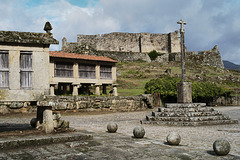
Lindoso, Espigueiros L1005456
| |
|
|
youtu.be/9qHCSuAb6uQ
The Lindoso Granaries date back from the 18th and 19th centuries. Contrary to what was often written by some that present them as an expression of community life, they are private and adjusted in its structure and volume to the possessions of each family. By having a look at the type of granary, also called “canastro”, one could guess to which house they would belong. However, due to several divisions this became quite difficult. In the past they were a privileged place for thieves, especially at times of cereal crisis. Their location, in a high place, did not obey to a community programme of corn distribution, but to the need of cereals’ ventilation and surveillance.
This daily surveillance of the cereals, of the vineyards, of the flour in mills and eventually also of fruit trees was carried out by policemen in a rotation scheme and / or by owners of houses that had vineyards, under the local authorities orders: president of the parish council, the janitor, etc.
The existence of sanctions and the surveillance system – evidence the lack of trust and confidence and also the idea that poor would steal/ rob the wealthiest – and this also conveyed the idea that there was a certain interest among the inhabitants. Only when deprivation and starvation were eliminated, and all the houses had a vineyard, did this surveillance system disappeared as it had no reason to exist.
Source: www.center.pt/imprensactr/estudo_187.pdf

Lindoso, Espigueiros L1005457
| |
|
youtu.be/9qHCSuAb6uQ
The Lindoso Granaries date back from the 18th and 19th centuries. Contrary to what was often written by some that present them as an expression of community life, they are private and adjusted in its structure and volume to the possessions of each family. By having a look at the type of granary, also called “canastro”, one could guess to which house they would belong. However, due to several divisions this became quite difficult. In the past they were a privileged place for thieves, especially at times of cereal crisis. Their location, in a high place, did not obey to a community programme of corn distribution, but to the need of cereals’ ventilation and surveillance.
This daily surveillance of the cereals, of the vineyards, of the flour in mills and eventually also of fruit trees was carried out by policemen in a rotation scheme and / or by owners of houses that had vineyards, under the local authorities orders: president of the parish council, the janitor, etc.
The existence of sanctions and the surveillance system – evidence the lack of trust and confidence and also the idea that poor would steal/ rob the wealthiest – and this also conveyed the idea that there was a certain interest among the inhabitants. Only when deprivation and starvation were eliminated, and all the houses had a vineyard, did this surveillance system disappeared as it had no reason to exist.
Source: www.center.pt/imprensactr/estudo_187.pdf

Lindoso, Espigueiros L1005460
| |
|
youtu.be/9qHCSuAb6uQ
The Lindoso Granaries date back from the 18th and 19th centuries. Contrary to what was often written by some that present them as an expression of community life, they are private and adjusted in its structure and volume to the possessions of each family. By having a look at the type of granary, also called “canastro”, one could guess to which house they would belong. However, due to several divisions this became quite difficult. In the past they were a privileged place for thieves, especially at times of cereal crisis. Their location, in a high place, did not obey to a community programme of corn distribution, but to the need of cereals’ ventilation and surveillance.
This daily surveillance of the cereals, of the vineyards, of the flour in mills and eventually also of fruit trees was carried out by policemen in a rotation scheme and / or by owners of houses that had vineyards, under the local authorities orders: president of the parish council, the janitor, etc.
The existence of sanctions and the surveillance system – evidence the lack of trust and confidence and also the idea that poor would steal/ rob the wealthiest – and this also conveyed the idea that there was a certain interest among the inhabitants. Only when deprivation and starvation were eliminated, and all the houses had a vineyard, did this surveillance system disappeared as it had no reason to exist.
Source: www.center.pt/imprensactr/estudo_187.pdf

Lindoso, Espigueiros L1005467
| |
|
youtu.be/9qHCSuAb6uQ
The Lindoso Granaries date back from the 18th and 19th centuries. Contrary to what was often written by some that present them as an expression of community life, they are private and adjusted in its structure and volume to the possessions of each family. By having a look at the type of granary, also called “canastro”, one could guess to which house they would belong. However, due to several divisions this became quite difficult. In the past they were a privileged place for thieves, especially at times of cereal crisis. Their location, in a high place, did not obey to a community programme of corn distribution, but to the need of cereals’ ventilation and surveillance.
This daily surveillance of the cereals, of the vineyards, of the flour in mills and eventually also of fruit trees was carried out by policemen in a rotation scheme and / or by owners of houses that had vineyards, under the local authorities orders: president of the parish council, the janitor, etc.
The existence of sanctions and the surveillance system – evidence the lack of trust and confidence and also the idea that poor would steal/ rob the wealthiest – and this also conveyed the idea that there was a certain interest among the inhabitants. Only when deprivation and starvation were eliminated, and all the houses had a vineyard, did this surveillance system disappeared as it had no reason to exist.
Source: www.center.pt/imprensactr/estudo_187.pdf
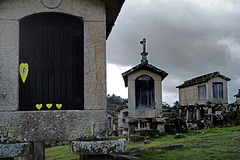
Lindoso, Espigueiros L1005468
| |
|
youtu.be/9qHCSuAb6uQ
The Lindoso Granaries date back from the 18th and 19th centuries. Contrary to what was often written by some that present them as an expression of community life, they are private and adjusted in its structure and volume to the possessions of each family. By having a look at the type of granary, also called “canastro”, one could guess to which house they would belong. However, due to several divisions this became quite difficult. In the past they were a privileged place for thieves, especially at times of cereal crisis. Their location, in a high place, did not obey to a community programme of corn distribution, but to the need of cereals’ ventilation and surveillance.
This daily surveillance of the cereals, of the vineyards, of the flour in mills and eventually also of fruit trees was carried out by policemen in a rotation scheme and / or by owners of houses that had vineyards, under the local authorities orders: president of the parish council, the janitor, etc.
The existence of sanctions and the surveillance system – evidence the lack of trust and confidence and also the idea that poor would steal/ rob the wealthiest – and this also conveyed the idea that there was a certain interest among the inhabitants. Only when deprivation and starvation were eliminated, and all the houses had a vineyard, did this surveillance system disappeared as it had no reason to exist.
Source: www.center.pt/imprensactr/estudo_187.pdf
Borgarvirki Fortress, View
| |
|
|
|
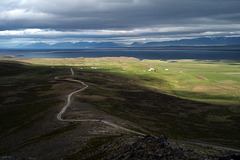
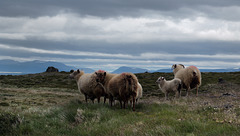
Borgarvirki - the Citadel is a columnar basalt fortress and a volcanic plug on Vatnsnes peninsula in northwest Iceland. It is 10-15 m high and 177 meters above sea-level. It might have been used as an old Viking fortress, at least some legends claim that it was, but we don't know this for sure.
Source: guidetoiceland.is/connect-with-locals/regina/borgvirki-fortress-in-north-west-iceland

Pousada Mosteiro de Amares L1005592

Pousada Mosteiro de Amares L1005600

Pousada Mosteiro de Amares L1005682

Pousada Mosteiro de Amares
Borgarvirki, Icelandic Lambs
| |
|
|
|
Carrasqueira, Cais palafítico L1005409
| |
|
|
|
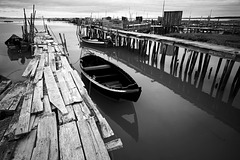
Historical Harbour (Porto Palafítico da Carrasqueira). For over two centuries, the harbour built in traditional wooden stakes has served as anchorage for local boats. Over the wharf, stand small buildings which support the fishermen. This palafitte harbour, unique in Europe, lies a small fishing village, Carrasqueira on the left bank of the River Sado.
Source: en.wikivoyage.org/wiki/Comporta
Carrasqueira, Cais palafítico
| |
|
|
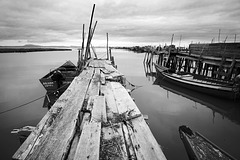
Historical Harbour (Porto Palafítico da Carrasqueira). For over two centuries, the harbour built in traditional wooden stakes has served as anchorage for local boats. Over the wharf, stand small buildings which support the fishermen. This palafitte harbour, unique in Europe, lies a small fishing village, Carrasqueira on the left bank of the River Sado.
Source: en.wikivoyage.org/wiki/Comporta
Carrasqueira, Cais palafítico L1005428
| |
|
|
|
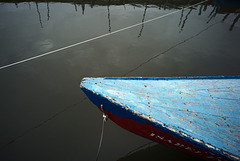
Historical Harbour (Porto Palafítico da Carrasqueira). For over two centuries, the harbour built in traditional wooden stakes has served as anchorage for local boats. Over the wharf, stand small buildings which support the fishermen. This palafitte harbour, unique in Europe, lies a small fishing village, Carrasqueira on the left bank of the River Sado.
Source: en.wikivoyage.org/wiki/Comporta
Carrasqueira, Cais palafítico L1005429
| |
|
|
|
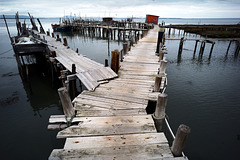
Historical Harbour (Porto Palafítico da Carrasqueira). For over two centuries, the harbour built in traditional wooden stakes has served as anchorage for local boats. Over the wharf, stand small buildings which support the fishermen. This palafitte harbour, unique in Europe, lies a small fishing village, Carrasqueira on the left bank of the River Sado.
Source: en.wikivoyage.org/wiki/Comporta
Carrasqueira, Cais palafítico L1005435
| |
|
|
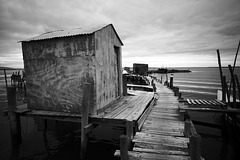
Historical Harbour (Porto Palafítico da Carrasqueira). For over two centuries, the harbour built in traditional wooden stakes has served as anchorage for local boats. Over the wharf, stand small buildings which support the fishermen. This palafitte harbour, unique in Europe, lies a small fishing village, Carrasqueira on the left bank of the River Sado.
Source: en.wikivoyage.org/wiki/Comporta
