

Xata's photos
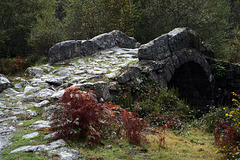
Serra da Peneda, Lamas de Mouro
| |
|
|
|

Serra da Peneda, Senhora da Peneda , Vaca
| |
|
|
Barrosã cattle breed is native of Portugal. It is known mainly for its big distinctive horns, which can grow well over 100 cm in length. Ancestral inhabitants of the highest lands of northern Portugal, these animals graze freely on traditional pastures and marshes in conditions that are ideal for their welfare. The cattle enjoy a purity of nature that is characteristic of these places, contributing greatly to preservation and biodiversity of the landscape as well as to the rural economic sustainability.
Source: www.fondazioneslowfood.com/en/ark-of-taste-slow-food/barrosa-cattle
Wolves are their natural ennemy and can attack an isolated cow. It is one of the problems the breeders have. To protect them they use Castro Laboreiro dogs, a local dog breed.
www.dogbreedinfo.com/castrolaboreiro.htm

Serra da Peneda, Senhora da Peneda L1005531
| |
|
|
Sanctuary of Senhora da Peneda
An enormous crag (the Meadinhas rock) dominates the site with its 300 metres of sheer height. In the pure air of the altitude, the Santuário de Peneda gives a holy feel to the mountain, creating a religious atmosphere.
Every year, in the first week of September, several hundred pilgrims from all over the region and from neighbouring Galicia flock to this place of pilgrimage. The dedication to Nossa Senhora das Neves (Our Lady of the Snows) originates from the Middle Ages, spreading the legend of her apparition at this site, where a small chapel has been built. The present Sanctuary, built in the nineteenth century, is topped by a church with a monumental flight of steps. At the front, there is a series of terraces and steps, lined on both sides by twenty little chapels comprising episodes in the life of Jesus, that go down the valley and finish in a square with an image of the Angel Gabriel on top of a column and a portico with a sculpture at the top representing Nossa Senhora da Encarnação.
Source: www.visitportugal.com/en/NR/exeres/C541CE73-8AEE-4FF8-9590-AD53D1EA44F9

Serra da Peneda, Senhora da Peneda L1005542
| |
|
|
Sanctuary of Senhora da Peneda
An enormous crag (the Meadinhas rock) dominates the site with its 300 metres of sheer height. In the pure air of the altitude, the Santuário de Peneda gives a holy feel to the mountain, creating a religious atmosphere.
Every year, in the first week of September, several hundred pilgrims from all over the region and from neighbouring Galicia flock to this place of pilgrimage. The dedication to Nossa Senhora das Neves (Our Lady of the Snows) originates from the Middle Ages, spreading the legend of her apparition at this site, where a small chapel has been built. The present Sanctuary, built in the nineteenth century, is topped by a church with a monumental flight of steps. At the front, there is a series of terraces and steps, lined on both sides by twenty little chapels comprising episodes in the life of Jesus, that go down the valley and finish in a square with an image of the Angel Gabriel on top of a column and a portico with a sculpture at the top representing Nossa Senhora da Encarnação.
Source: www.visitportugal.com/en/NR/exeres/C541CE73-8AEE-4FF8-9590-AD53D1EA44F9

Serra da Peneda, Senhora da Peneda L1005543
| |
|
|
Sanctuary of Senhora da Peneda
An enormous crag (the Meadinhas rock) dominates the site with its 300 metres of sheer height. In the pure air of the altitude, the Santuário de Peneda gives a holy feel to the mountain, creating a religious atmosphere.
Every year, in the first week of September, several hundred pilgrims from all over the region and from neighbouring Galicia flock to this place of pilgrimage. The dedication to Nossa Senhora das Neves (Our Lady of the Snows) originates from the Middle Ages, spreading the legend of her apparition at this site, where a small chapel has been built. The present Sanctuary, built in the nineteenth century, is topped by a church with a monumental flight of steps. At the front, there is a series of terraces and steps, lined on both sides by twenty little chapels comprising episodes in the life of Jesus, that go down the valley and finish in a square with an image of the Angel Gabriel on top of a column and a portico with a sculpture at the top representing Nossa Senhora da Encarnação.
Source: www.visitportugal.com/en/NR/exeres/C541CE73-8AEE-4FF8-9590-AD53D1EA44F9

Serra da Peneda, Senhora da Peneda L1005550
| |
|
|
Sanctuary of Senhora da Peneda
An enormous crag (the Meadinhas rock) dominates the site with its 300 metres of sheer height. In the pure air of the altitude, the Santuário de Peneda gives a holy feel to the mountain, creating a religious atmosphere.
Every year, in the first week of September, several hundred pilgrims from all over the region and from neighbouring Galicia flock to this place of pilgrimage. The dedication to Nossa Senhora das Neves (Our Lady of the Snows) originates from the Middle Ages, spreading the legend of her apparition at this site, where a small chapel has been built. The present Sanctuary, built in the nineteenth century, is topped by a church with a monumental flight of steps. At the front, there is a series of terraces and steps, lined on both sides by twenty little chapels comprising episodes in the life of Jesus, that go down the valley and finish in a square with an image of the Angel Gabriel on top of a column and a portico with a sculpture at the top representing Nossa Senhora da Encarnação.
Source: www.visitportugal.com/en/NR/exeres/C541CE73-8AEE-4FF8-9590-AD53D1EA44F9
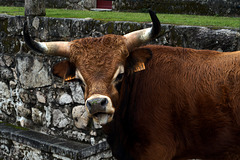
Serra da Peneda, Senhora da Peneda, Vaca L1005535
| |
|
|
|
Barrosã cattle breed is native of Portugal. It is known mainly for its big distinctive horns, which can grow well over 100 cm in length. Ancestral inhabitants of the highest lands of northern Portugal, these animals graze freely on traditional pastures and marshes in conditions that are ideal for their welfare. The cattle enjoy a purity of nature that is characteristic of these places, contributing greatly to preservation and biodiversity of the landscape as well as to the rural economic sustainability.
Source: www.fondazioneslowfood.com/en/ark-of-taste-slow-food/barrosa-cattle
Wolves are their natural ennemy and can attack an isolated cow. It is one of the problems the breeders have. To protect them they use Castro Laboreiro dogs, a local dog breed.
www.dogbreedinfo.com/castrolaboreiro.htm
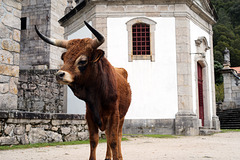
Serra da Peneda, Senhora da Peneda, Vaca L1005538
| |
|
|
|
Barrosã cattle breed is native of Portugal. It is known mainly for its big distinctive horns, which can grow well over 100 cm in length. Ancestral inhabitants of the highest lands of northern Portugal, these animals graze freely on traditional pastures and marshes in conditions that are ideal for their welfare. The cattle enjoy a purity of nature that is characteristic of these places, contributing greatly to preservation and biodiversity of the landscape as well as to the rural economic sustainability.
Source: www.fondazioneslowfood.com/en/ark-of-taste-slow-food/barrosa-cattle
Wolves are their natural ennemy and can attack an isolated cow. It is one of the problems the breeders have. To protect them they use Castro Laboreiro dogs, a local dog breed.
www.dogbreedinfo.com/castrolaboreiro.htm
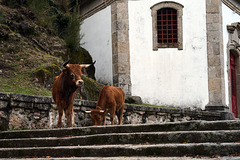
Serra da Peneda, Senhora da Peneda, Vacas L1005545
| |
|
|
|
Barrosã cattle breed is native of Portugal. It is known mainly for its big distinctive horns, which can grow well over 100 cm in length. Ancestral inhabitants of the highest lands of northern Portugal, these animals graze freely on traditional pastures and marshes in conditions that are ideal for their welfare. The cattle enjoy a purity of nature that is characteristic of these places, contributing greatly to preservation and biodiversity of the landscape as well as to the rural economic sustainability.
Source: www.fondazioneslowfood.com/en/ark-of-taste-slow-food/barrosa-cattle
Wolves are their natural ennemy and can attack an isolated cow. It is one of the problems the breeders have. To protect them they use Castro Laboreiro dogs, a local dog breed.
www.dogbreedinfo.com/castrolaboreiro.htm
Serra da Peneda, Vaca L1005518
| |
|
|
|
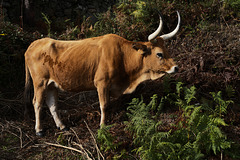
Barrosã cattle breed is native of Portugal. It is known mainly for its big distinctive horns, which can grow well over 100 cm in length. Ancestral inhabitants of the highest lands of northern Portugal, these animals graze freely on traditional pastures and marshes in conditions that are ideal for their welfare. The cattle enjoy a purity of nature that is characteristic of these places, contributing greatly to preservation and biodiversity of the landscape as well as to the rural economic sustainability.
Source: www.fondazioneslowfood.com/en/ark-of-taste-slow-food/barrosa-cattle
Wolves are their natural ennemy and can attack an isolated cow. It is one of the problems the breeders have. To protect them they use Castro Laboreiro dogs, a local dog breed.
www.dogbreedinfo.com/castrolaboreiro.htm

Reykjavik, Colours
| |
|
|
|
Soajo, Espigueiros L1005472
| |
|
|
|
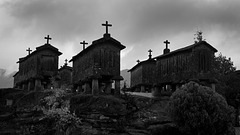
Set on the periphery of the beautiful Peneda-Gerês National Park in Portugal is the traditional village of Soajo. Its quaint houses and small church create a charming picture, but it is best known for its impressive espigueiros: granite granaries built above the ground.
Espigueiros means “spikes,” and these granaries are supported on granite slabs from the Peneda mountains. They were built off the ground to protect food crops from rats and other rodents, and were used by the whole community.
The oldest espigueiros date back to 1782, and the whole cluster was constructed between the 18th and 19th centuries. Of the 24 that remain today, some are still used today to store grain, especially corn.
Source: www.atlasobscura.com/places/espigueiros-do-soajo
Soajo, Espigueiros L1005473
| |
|
|
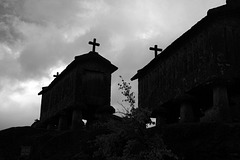
Set on the periphery of the beautiful Peneda-Gerês National Park in Portugal is the traditional village of Soajo. Its quaint houses and small church create a charming picture, but it is best known for its impressive espigueiros: granite granaries built above the ground.
Espigueiros means “spikes,” and these granaries are supported on granite slabs from the Peneda mountains. They were built off the ground to protect food crops from rats and other rodents, and were used by the whole community.
The oldest espigueiros date back to 1782, and the whole cluster was constructed between the 18th and 19th centuries. Of the 24 that remain today, some are still used today to store grain, especially corn.
Source: www.atlasobscura.com/places/espigueiros-do-soajo
Soajo, Espigueiros L1005476
| |
|
|
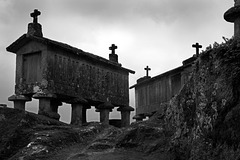
Set on the periphery of the beautiful Peneda-Gerês National Park in Portugal is the traditional village of Soajo. Its quaint houses and small church create a charming picture, but it is best known for its impressive espigueiros: granite granaries built above the ground.
Espigueiros means “spikes,” and these granaries are supported on granite slabs from the Peneda mountains. They were built off the ground to protect food crops from rats and other rodents, and were used by the whole community.
The oldest espigueiros date back to 1782, and the whole cluster was constructed between the 18th and 19th centuries. Of the 24 that remain today, some are still used today to store grain, especially corn.
Source: www.atlasobscura.com/places/espigueiros-do-soajo
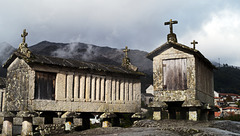
Soajo, Espigueiros L1005481
| |
|
Set on the periphery of the beautiful Peneda-Gerês National Park in Portugal is the traditional village of Soajo. Its quaint houses and small church create a charming picture, but it is best known for its impressive espigueiros: granite granaries built above the ground.
Espigueiros means “spikes,” and these granaries are supported on granite slabs from the Peneda mountains. They were built off the ground to protect food crops from rats and other rodents, and were used by the whole community.
The oldest espigueiros date back to 1782, and the whole cluster was constructed between the 18th and 19th centuries. Of the 24 that remain today, some are still used today to store grain, especially corn.
Source: www.atlasobscura.com/places/espigueiros-do-soajo
Soajo, Espigueiros L1005483
| |
|
Set on the periphery of the beautiful Peneda-Gerês National Park in Portugal is the traditional village of Soajo. Its quaint houses and small church create a charming picture, but it is best known for its impressive espigueiros: granite granaries built above the ground.
Espigueiros means “spikes,” and these granaries are supported on granite slabs from the Peneda mountains. They were built off the ground to protect food crops from rats and other rodents, and were used by the whole community.
The oldest espigueiros date back to 1782, and the whole cluster was constructed between the 18th and 19th centuries. Of the 24 that remain today, some are still used today to store grain, especially corn.
Source: www.atlasobscura.com/places/espigueiros-do-soajo
Soajo, Espigueiros L1005485
| |
|
Set on the periphery of the beautiful Peneda-Gerês National Park in Portugal is the traditional village of Soajo. Its quaint houses and small church create a charming picture, but it is best known for its impressive espigueiros: granite granaries built above the ground.
Espigueiros means “spikes,” and these granaries are supported on granite slabs from the Peneda mountains. They were built off the ground to protect food crops from rats and other rodents, and were used by the whole community.
The oldest espigueiros date back to 1782, and the whole cluster was constructed between the 18th and 19th centuries. Of the 24 that remain today, some are still used today to store grain, especially corn.
Source: www.atlasobscura.com/places/espigueiros-do-soajo
Soajo, Espigueiros L1005487
| |
|
Set on the periphery of the beautiful Peneda-Gerês National Park in Portugal is the traditional village of Soajo. Its quaint houses and small church create a charming picture, but it is best known for its impressive espigueiros: granite granaries built above the ground.
Espigueiros means “spikes,” and these granaries are supported on granite slabs from the Peneda mountains. They were built off the ground to protect food crops from rats and other rodents, and were used by the whole community.
The oldest espigueiros date back to 1782, and the whole cluster was constructed between the 18th and 19th centuries. Of the 24 that remain today, some are still used today to store grain, especially corn.
Source: www.atlasobscura.com/places/espigueiros-do-soajo
