

Ned's photos
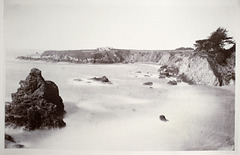
Duncan's Landing Salt
| |
|
|
|
Salt print from calotype.
Calotype had a few spots touched up on back w/ soft pencil.
Lana Aquarelle, 2% alaea salt, 0.5% CA, 0.8% gelatine.
Sensitized with 12% AgNO3, 6% CA.
Bright overcast at start, partly sunny after first 1/2 hour.
1h 25m toward N sky with paper diffusor.
10m facing E away from sun, no diffusor.
2m direct 4PM sun.
Toning:
2ml 0.2% gold chloride + 2ml 2% ammonium thiocyanate in about 80ml DH2O. 12 minutes.
Followed by:
0.2g borax + 1ml 0.2% gold chloride in about 80ml water, 10 minutes
Hard to get the tone right on this digi-snap. It is a little more neutral, but also a tiny bit more toward dark purple in the water. It also looks sharper with more "pop".
Printed 27 February 2016
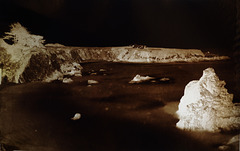
Duncan's Landing
| |
|
|
|
Duncan's Landing on the Sonoma Coast in California. The rock point in the distance is locally known as "Death Rock" because large waves occasionally wash over it and many fishermen have been swept off. Now the cliffs are fenced off with warning signs, but fishermen still occasionally take the risk until the park ranger chases them off.
Greenlaw's process.
7x11 Eastman View No. 2, un-cataloged Wollensak lens.
LV 15, but it is hard to judge UV at the coast. I treated it as LV 16: F/45 12 minutes.
Developed in 1.4g gallic in 200 ml DH2O
No image visible at start.
Added 2 eyedroppers of aceto-nitrate of silver ( ~0.75ml each )
Image appeared more slowly than usual.
At 38 minutes, added another 1/2 eyedropper, which did speed things up but not too much and still under good control.
Done at 50 minutes.
Dried for 3 days under a heavy book between several changes of blotter paper.
I think the calotype was slightly underexposed, but it looks fine and I hope it will print well. If I like the way it comes out, it may start a series of seaside calotypes.
This is a poor reproduction. I had to put it into a printfile sleeve because it was curling. The trees on the clifftop are perfectly crisp and full of detail. But you can get an idea what it looks like.
After making this, I read Dr. Mansell's The calotype on the sea-shore with great interest. Perhaps I will try to follow his instructions while making my own "calotype on the sea-shore" series.
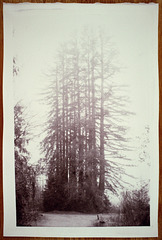
Redwoods in Fog
| |
|
|
|
Gold toned salt print made from a calotype.
Printed 7 February 2016
This "fairy ring" of redwood trees is probably on the same ground a prehistoric giant once stood upon. At Riverfront Regional Park near the Russian River in Sonoma County, California.
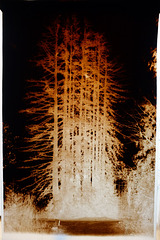
Isle of Redwoods
| |
|
|
|
This "fairy ring" of redwood trees is probably on the same ground a prehistoric giant once stood upon. At Riverfront Regional Park near the Russian River in Sonoma County, California.
Greenlaw's process.
7x11 Eastman No. 2, un-cataloged Wollensak lens.
My first successful calotype with this camera!
LV ~12, heavy fog. 25m @ f/16
Developed in 1.4g gallic acid in 200ml DH2O.
No visible image at start.
No image after 5 minutes in gallic.
Added 2 eyedroppers aceto-nitrate of silver, developed 45 more minutes, until shadow detail apparent and could not see shadow of fingers moving behind the sky.
Hope to make a print tomorrow.
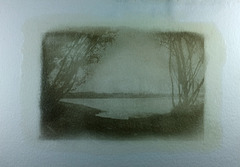
Lake Benoist
| |
|
|
|
At Riverfront regional park Another non-toxic oil print made from a pinhole paper negative. I liked the last results better but the process worked well on this one. I'm still trying to figure out how to do this!
I'm not exactly sure when I made this photo... it was another from a box I've never scanned or printed before. Looks like it was made with my "red rooster" coffee can camera :)
Inked 20 January 2016
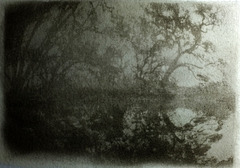
Laguna de Santa Rosa
| |
|
|
|
Still working on the non-toxic oil prints. This is an oilprint using AFC instead of bichromate. I'm having mixed luck, but having fun trying to make it work.
It was made from a pinhole paper negative. I've never printed or scanned this negative before, I think it is from February 2015 "red rooster" coffee can pinhole camera.
Printed / inked 17 January 2016
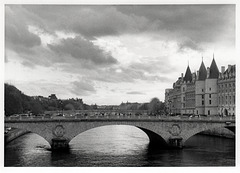
Around the World
| |
|
|
|
This negative is traveling around the world to be printed by different people. It came to me from Germany, next stop is Greece. I think it was in Paris too :).
Printed 9 January 2016.
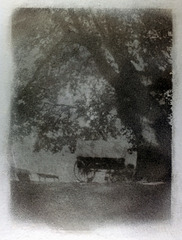
oak and cart
| |
|
|
|
at Sutter's Fort in Sacramento, California. Pinhole paper negative from Oct. 2012.
This is an oil pigment print made using AFC instead of bichromate. I've been working at this process for a few weeks and this is the first partially "successful" one. It is inked like a bromoil print.
The process is non-toxic. There are still a few "kinks" to work out.
Spring Lake
| |
|
|
|
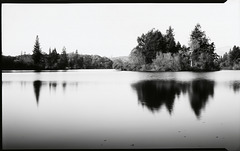
Met up with a nice fellow from APUG yesterday and tried out a new tripod for my camera at Spring Lake, near Santa Rosa, California.
This is a paper negative exposed for salt printing... I made a salt print from it today but it had an odd defect I've never seen before, so I'll try again another day. Meanwhile here's an inverted scan.

Ragle Ranch Oak
Ragle oak forest
| |
|
|
|
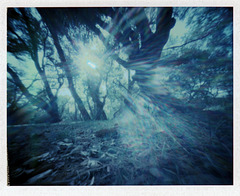
The sun moved during the ~15m exposure.
There was a photographer at the park photographing a couple and their baby, and for about 5 minutes they all were in this view. I can't see them, but I have an almost subliminal sense that I can tell they were there....
paper sky 3
| |
|
|
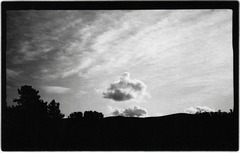
New contact print of an old paper negative.
Negative from Oct. 2012, printed Oct 2015.
I'm going to start making more of these again.
paper sky 2
| |
|
|
|
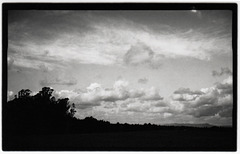
New contact print of an old paper negative.
Negative from Oct. 2012, printed Oct 2015.
I'm going to start making more of these again.

paper sky 1
| |
|
|
New contact print of an old paper negative.
Negative from Oct. 2012, printed Oct 2015.
I'm going to start making more of these again.

New Toy
| |
|
|
I was excited to find this original contact printing frame for Kodak postcard film and paper. It was made for printing 122 format film on Kodak postcard paper.
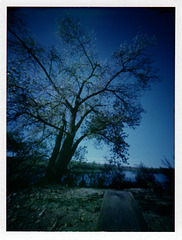
Riverfront
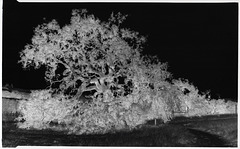
Valley oak negative
| |
|
|
Valley oak at Crane Creek regional park in Sonoma County, California.
Paper negative. Sometimes I like the negative better than the positive...
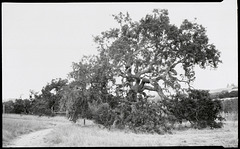
Valley oak
| |
|
|
|
Valley Oak at Crane Creek regional park in Sonoma County California.
The mid-afternoon light was flat, and I think I will come back and photograph this tree from the other side.
Something I never noticed before, but makes sense if you think about it: as I walked around the park, I noticed that for every tree, if I stood where you could see the trunk and branches then I was looking into the sun. Of course the leaves grow and spread out more on the side of the tree that faces the afternoon sun!
