

LaurieAnnie's photos

Amuletic Stone with a Protective Spell Invoking Is…
| |
|
Title: Amuletic stone with a protective spell against scorpions
Period: Third Intermediate Period–Late Period
Date: ca. 1070–332 BCE
Medium: Limestone
Dimensions: H. 8 × W. 10.6 × D. 3 cm (3 1/8 × 4 3/16 × 1 3/16 in.)
Credit Line: Dodge Fund, 1947
Object No.: 47.105.5
Scorpions were part of everyday life in ancient Egypt. Their nature is to hide during the day and come out at night, habits that would have worried people. Ancient Egyptians therefore sought ways to prevent scorpion stings and treat them when they failed to avoid these venomous arachnids. Protection could come from eating a scorpion, drinking liquid poured over an image like a healing stela, or just recording a spell on a stone, as seen here.
Text from: www.metmuseum.org/exhibitions/divine-egypt/exhibition-objects

Ostracon with Seth Holding a Hieroglyph with an An…
| |
|

Ostracon with Seth Holding a Hieroglyph with an An…
| |
|

Head from the Statue of a Cobra Likely the Goddess…
| |
|

Head from the Statue of a Cobra Likely the Goddess…
| |
|

Faience Statuette of a Hippo Goddess in the Metrop…
| |
|

Faience Statuette of a Hippo Goddess in the Metrop…
| |
|

Statue of Horus as a Falcon Protecting King Nectan…
| |
|
Title: Statue of Horus as a falcon protecting King Nectanebo II
Period: Late Period
Date: 360–343 BCE
Medium: Metagraywacke
Dimensions: H. 72 × W. 20 × D. 46.5 cm, 55.3 kg (28 3/8 × 7 7/8 × 18 5/16 in., 122 lb.)
Credit Line: Rogers Fund, 1934
Object No.: 34.2.1
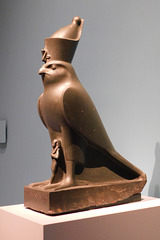
Standing protectively over a miniature image of King Nectanebo II, the falcon Horus wears a double crown and uraeus, or rearing cobra, signifying his role as the mythological king of a united Egypt. Nectanebo II’s Egyptian name, Nakhthorhebyt ("Horus of Hebyt is Strong"), references a specific form of Horus associated with the site Hebyt (present-day Behbeit el-Hagar) in the Nile Delta. The statue therefore speaks to Horus’s importance as both a state-level and a local deity.
Text from: www.metmuseum.org/exhibitions/divine-egypt/exhibition-objects
Statue of Horus as a Falcon Protecting King Nectan…
| |
|
Title: Statue of Horus as a falcon protecting King Nectanebo II
Period: Late Period
Date: 360–343 BCE
Medium: Metagraywacke
Dimensions: H. 72 × W. 20 × D. 46.5 cm, 55.3 kg (28 3/8 × 7 7/8 × 18 5/16 in., 122 lb.)
Credit Line: Rogers Fund, 1934
Object No.: 34.2.1
Standing protectively over a miniature image of King Nectanebo II, the falcon Horus wears a double crown and uraeus, or rearing cobra, signifying his role as the mythological king of a united Egypt. Nectanebo II’s Egyptian name, Nakhthorhebyt ("Horus of Hebyt is Strong"), references a specific form of Horus associated with the site Hebyt (present-day Behbeit el-Hagar) in the Nile Delta. The statue therefore speaks to Horus’s importance as both a state-level and a local deity.
Text from: www.metmuseum.org/exhibitions/divine-egypt/exhibition-objects

Statue of Horus as a Falcon Protecting King Nectan…
| |
|
Title: Statue of Horus as a falcon protecting King Nectanebo II
Period: Late Period
Date: 360–343 BCE
Medium: Metagraywacke
Dimensions: H. 72 × W. 20 × D. 46.5 cm, 55.3 kg (28 3/8 × 7 7/8 × 18 5/16 in., 122 lb.)
Credit Line: Rogers Fund, 1934
Object No.: 34.2.1
Standing protectively over a miniature image of King Nectanebo II, the falcon Horus wears a double crown and uraeus, or rearing cobra, signifying his role as the mythological king of a united Egypt. Nectanebo II’s Egyptian name, Nakhthorhebyt ("Horus of Hebyt is Strong"), references a specific form of Horus associated with the site Hebyt (present-day Behbeit el-Hagar) in the Nile Delta. The statue therefore speaks to Horus’s importance as both a state-level and a local deity.
Text from: www.metmuseum.org/exhibitions/divine-egypt/exhibition-objects

Statue of Horus as a Falcon Protecting King Nectan…
| |
|
Title: Statue of Horus as a falcon protecting King Nectanebo II
Period: Late Period
Date: 360–343 BCE
Medium: Metagraywacke
Dimensions: H. 72 × W. 20 × D. 46.5 cm, 55.3 kg (28 3/8 × 7 7/8 × 18 5/16 in., 122 lb.)
Credit Line: Rogers Fund, 1934
Object No.: 34.2.1
Standing protectively over a miniature image of King Nectanebo II, the falcon Horus wears a double crown and uraeus, or rearing cobra, signifying his role as the mythological king of a united Egypt. Nectanebo II’s Egyptian name, Nakhthorhebyt ("Horus of Hebyt is Strong"), references a specific form of Horus associated with the site Hebyt (present-day Behbeit el-Hagar) in the Nile Delta. The statue therefore speaks to Horus’s importance as both a state-level and a local deity.
Text from: www.metmuseum.org/exhibitions/divine-egypt/exhibition-objects

Column with Hathor-Emblem Capital in the Metropoli…
| |
|

Column with Hathor-Emblem Capital in the Metropoli…
| |
|

Bust of a Dignitary Re-inscribed with Divine Figur…
| |
|

Bust of a Dignitary Re-inscribed with Divine Figur…
| |
|

Detail of a Statuette of Kary Carrying a Standard…
Detail of a Statuette of Kary Carrying a Standard…

