

LaurieAnnie's photos

Cleopatra's Chair by Chase-Riboud in the Metropoli…

Detail of He Who Floods the Nile by Karon Davis in…
| |
|
Title: He Who Floods the Nile
Artist: Karon Davis
Date: 2019
Medium: Plaster cloth, wire, glass eyes, artist’s hair weave, brass beads, gold leaf, black glitter, raw
frankincense, wood, and prayers
Dimensions: 85 × 32 1/2 × 32 1/2 in. (215.9 × 82.6 × 82.6 cm)
Credit Line: Private collection, London
Object No.: RCE.224
Text from: www.metmuseum.org/exhibitions/flight-into-egypt-black-artists-and-ancient-egypt-1876-now/exhibition-objects

Detail of He Who Floods the Nile by Karon Davis in…
| |
|
Title: He Who Floods the Nile
Artist: Karon Davis
Date: 2019
Medium: Plaster cloth, wire, glass eyes, artist’s hair weave, brass beads, gold leaf, black glitter, raw
frankincense, wood, and prayers
Dimensions: 85 × 32 1/2 × 32 1/2 in. (215.9 × 82.6 × 82.6 cm)
Credit Line: Private collection, London
Object No.: RCE.224
Text from: www.metmuseum.org/exhibitions/flight-into-egypt-black-artists-and-ancient-egypt-1876-now/exhibition-objects

He Who Floods the Nile by Karon Davis in the Metro…
| |
|
Title: He Who Floods the Nile
Artist: Karon Davis
Date: 2019
Medium: Plaster cloth, wire, glass eyes, artist’s hair weave, brass beads, gold leaf, black glitter, raw
frankincense, wood, and prayers
Dimensions: 85 × 32 1/2 × 32 1/2 in. (215.9 × 82.6 × 82.6 cm)
Credit Line: Private collection, London
Object No.: RCE.224
Text from: www.metmuseum.org/exhibitions/flight-into-egypt-black-artists-and-ancient-egypt-1876-now/exhibition-objects

He Who Floods the Nile by Karon Davis in the Metro…
| |
|
Title: He Who Floods the Nile
Artist: Karon Davis
Date: 2019
Medium: Plaster cloth, wire, glass eyes, artist’s hair weave, brass beads, gold leaf, black glitter, raw
frankincense, wood, and prayers
Dimensions: 85 × 32 1/2 × 32 1/2 in. (215.9 × 82.6 × 82.6 cm)
Credit Line: Private collection, London
Object No.: RCE.224
Text from: www.metmuseum.org/exhibitions/flight-into-egypt-black-artists-and-ancient-egypt-1876-now/exhibition-objects

He Who Floods the Nile by Karon Davis in the Metro…
| |
|
Title: He Who Floods the Nile
Artist: Karon Davis
Date: 2019
Medium: Plaster cloth, wire, glass eyes, artist’s hair weave, brass beads, gold leaf, black glitter, raw
frankincense, wood, and prayers
Dimensions: 85 × 32 1/2 × 32 1/2 in. (215.9 × 82.6 × 82.6 cm)
Credit Line: Private collection, London
Object No.: RCE.224
Text from: www.metmuseum.org/exhibitions/flight-into-egypt-black-artists-and-ancient-egypt-1876-now/exhibition-objects

Aegis with the Head of a Goddess in the Metropolit…
| |
|
Title: Aegis with the head of a goddess
Period: Third Intermediate Period–Late Period
Date: ca. 924–600 BCE
Medium: Cupreous metal; stone, paint
Dimensions: H. 22.5 × W. 18 cm (8 7/8 × 7 1/16 in.)
Credit Line: Rogers Fund, 1948
Object No.: 48.73
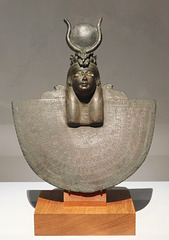
An Egyptian aegis consists of the head of an important deity above a stylized broad collar (wesekh). This example wears a vulture headdress capped by a ring of rearing cobras. Aegises first appeared during the reign of Hatshepsut, Egypt’s longest-ruling female pharaoh, decorating the sacred barque of Amun. The two loops on the aegis indicate that it was originally attached to a keyhole-shaped counterweight typical of ritual menit necklaces, which were shaken by women to make music in ceremonies.
Text from: www.metmuseum.org/exhibitions/divine-egypt/exhibition-objects
Aegis with the Head of a Goddess in the Metropolit…
| |
|
Title: Aegis with the head of a goddess
Period: Third Intermediate Period–Late Period
Date: ca. 924–600 BCE
Medium: Cupreous metal; stone, paint
Dimensions: H. 22.5 × W. 18 cm (8 7/8 × 7 1/16 in.)
Credit Line: Rogers Fund, 1948
Object No.: 48.73
An Egyptian aegis consists of the head of an important deity above a stylized broad collar (wesekh). This example wears a vulture headdress capped by a ring of rearing cobras. Aegises first appeared during the reign of Hatshepsut, Egypt’s longest-ruling female pharaoh, decorating the sacred barque of Amun. The two loops on the aegis indicate that it was originally attached to a keyhole-shaped counterweight typical of ritual menit necklaces, which were shaken by women to make music in ceremonies.
Text from: www.metmuseum.org/exhibitions/divine-egypt/exhibition-objects
Tile with Seated Tatenen in the Metropolitan Museu…
| |
|
Title: Tile with seated Tatenen (or Ptah-Tatenen)
Period: New Kingdom, Ramesside Period
Dynasty: Dynasty 19
Reign: likely reign of Ramesses II
Date: ca. 1279–1213 BCE
Geography: From Egypt; Probably from Eastern Delta, Tell el-Yahudiya
Medium: Faience
Dimensions: H. 12 × W. 10.2 × D. 2.5 cm (4 3/4 × 4 × 1 in.)
Credit Line: Gift of Joseph W. Drexel, 1889
Object Number: 89.2.649
Curatorial Department: Egyptian Art
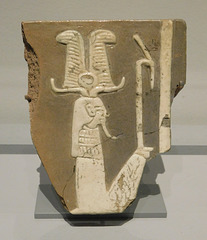
During the Ramesside Period, Ptah was frequently combined with another creator deity, Tatenen ("Rising Land," likely a reference to the first mound of earth). Tatenen typically wears a distinctive crown with two wide spiral ram horns, two curled ostrich feathers, and a sun disk. The merged deity Ptah-Tatenen has this same crown and retains none of Ptah’s usual attributes. Therefore, this tile could represent Tatenen alone or Ptah-Tatenen.
Text from: www.metmuseum.org/exhibitions/divine-egypt/exhibition-objects

Tile with Seated Tatenen in the Metropolitan Museu…
| |
|
Title: Tile with seated Tatenen (or Ptah-Tatenen)
Period: New Kingdom, Ramesside Period
Dynasty: Dynasty 19
Reign: likely reign of Ramesses II
Date: ca. 1279–1213 BCE
Geography: From Egypt; Probably from Eastern Delta, Tell el-Yahudiya
Medium: Faience
Dimensions: H. 12 × W. 10.2 × D. 2.5 cm (4 3/4 × 4 × 1 in.)
Credit Line: Gift of Joseph W. Drexel, 1889
Object Number: 89.2.649
Curatorial Department: Egyptian Art
During the Ramesside Period, Ptah was frequently combined with another creator deity, Tatenen ("Rising Land," likely a reference to the first mound of earth). Tatenen typically wears a distinctive crown with two wide spiral ram horns, two curled ostrich feathers, and a sun disk. The merged deity Ptah-Tatenen has this same crown and retains none of Ptah’s usual attributes. Therefore, this tile could represent Tatenen alone or Ptah-Tatenen.
Text from: www.metmuseum.org/exhibitions/divine-egypt/exhibition-objects

Statuette of the Apis Bull in the Metropolitan Mus…
| |
|

Statuette of the Apis Bull in the Metropolitan Mus…
| |
|

Head and Shoulder Statue of a Vulture, Likely the…
| |
|
On loan to The Met
Title: Head and shoulder from a statue of a vulture
Period: Napatan Period
Date: ca. 690–664 BCE
Medium: Granite gneiss
Dimensions: 41.5 × 27 × 50 cm, 49 kg (16 5/16 × 10 5/8 × 19 11/16 in., 108 lb.)
Other (Head): 10 1/4 in. (26 cm)
Credit Line: The Ashmolean Museum, University of Oxford. Allocated by the Oxford Expedition to Nubia from excavations at Sanam Abu Dom, 1922.
Object No.: DE.113
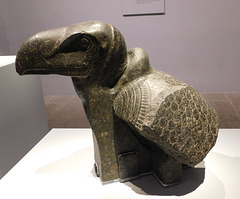
This fragment probably depicts the goddess of Upper Egypt, Nekhbet, in her vulture manifestation. The presence of Nekhbet and her Lower Egyptian counterpart Wadjet (likely represented in the adjacent cobra statue fragment) reinforced a king’s divine right to rule. Although both deities are Egyptian, aspects of the fragments suggest that they come from statues made in Nubia. Napatan rulers used gneiss for state-commissioned art, and details of the vulture—in particular the thick beak, heavy neck ridge, and broad collar—have no parallel in known Egyptian depictions of Nekhbet.
Text from: www.metmuseum.org/exhibitions/divine-egypt/exhibition-objects
Head and Shoulder Statue of a Vulture, Likely the…
| |
|
On loan to The Met
Title: Head and shoulder from a statue of a vulture
Period: Napatan Period
Date: ca. 690–664 BCE
Medium: Granite gneiss
Dimensions: 41.5 × 27 × 50 cm, 49 kg (16 5/16 × 10 5/8 × 19 11/16 in., 108 lb.)
Other (Head): 10 1/4 in. (26 cm)
Credit Line: The Ashmolean Museum, University of Oxford. Allocated by the Oxford Expedition to Nubia from excavations at Sanam Abu Dom, 1922.
Object No.: DE.113
This fragment probably depicts the goddess of Upper Egypt, Nekhbet, in her vulture manifestation. The presence of Nekhbet and her Lower Egyptian counterpart Wadjet (likely represented in the adjacent cobra statue fragment) reinforced a king’s divine right to rule. Although both deities are Egyptian, aspects of the fragments suggest that they come from statues made in Nubia. Napatan rulers used gneiss for state-commissioned art, and details of the vulture—in particular the thick beak, heavy neck ridge, and broad collar—have no parallel in known Egyptian depictions of Nekhbet.
Text from: www.metmuseum.org/exhibitions/divine-egypt/exhibition-objects

Head and Shoulder Statue of a Vulture, Likely the…
| |
|
On loan to The Met
Title: Head and shoulder from a statue of a vulture
Period: Napatan Period
Date: ca. 690–664 BCE
Medium: Granite gneiss
Dimensions: 41.5 × 27 × 50 cm, 49 kg (16 5/16 × 10 5/8 × 19 11/16 in., 108 lb.)
Other (Head): 10 1/4 in. (26 cm)
Credit Line: The Ashmolean Museum, University of Oxford. Allocated by the Oxford Expedition to Nubia from excavations at Sanam Abu Dom, 1922.
Object No.: DE.113
This fragment probably depicts the goddess of Upper Egypt, Nekhbet, in her vulture manifestation. The presence of Nekhbet and her Lower Egyptian counterpart Wadjet (likely represented in the adjacent cobra statue fragment) reinforced a king’s divine right to rule. Although both deities are Egyptian, aspects of the fragments suggest that they come from statues made in Nubia. Napatan rulers used gneiss for state-commissioned art, and details of the vulture—in particular the thick beak, heavy neck ridge, and broad collar—have no parallel in known Egyptian depictions of Nekhbet.
Text from: www.metmuseum.org/exhibitions/divine-egypt/exhibition-objects

Head and Shoulder Statue of a Vulture, Likely the…
| |
|
On loan to The Met
Title: Head and shoulder from a statue of a vulture
Period: Napatan Period
Date: ca. 690–664 BCE
Medium: Granite gneiss
Dimensions: 41.5 × 27 × 50 cm, 49 kg (16 5/16 × 10 5/8 × 19 11/16 in., 108 lb.)
Other (Head): 10 1/4 in. (26 cm)
Credit Line: The Ashmolean Museum, University of Oxford. Allocated by the Oxford Expedition to Nubia from excavations at Sanam Abu Dom, 1922.
Object No.: DE.113
This fragment probably depicts the goddess of Upper Egypt, Nekhbet, in her vulture manifestation. The presence of Nekhbet and her Lower Egyptian counterpart Wadjet (likely represented in the adjacent cobra statue fragment) reinforced a king’s divine right to rule. Although both deities are Egyptian, aspects of the fragments suggest that they come from statues made in Nubia. Napatan rulers used gneiss for state-commissioned art, and details of the vulture—in particular the thick beak, heavy neck ridge, and broad collar—have no parallel in known Egyptian depictions of Nekhbet.
Text from: www.metmuseum.org/exhibitions/divine-egypt/exhibition-objects

Head and Shoulder Statue of a Vulture, Likely the…
| |
|
On loan to The Met
Title: Head and shoulder from a statue of a vulture
Period: Napatan Period
Date: ca. 690–664 BCE
Medium: Granite gneiss
Dimensions: 41.5 × 27 × 50 cm, 49 kg (16 5/16 × 10 5/8 × 19 11/16 in., 108 lb.)
Other (Head): 10 1/4 in. (26 cm)
Credit Line: The Ashmolean Museum, University of Oxford. Allocated by the Oxford Expedition to Nubia from excavations at Sanam Abu Dom, 1922.
Object No.: DE.113
This fragment probably depicts the goddess of Upper Egypt, Nekhbet, in her vulture manifestation. The presence of Nekhbet and her Lower Egyptian counterpart Wadjet (likely represented in the adjacent cobra statue fragment) reinforced a king’s divine right to rule. Although both deities are Egyptian, aspects of the fragments suggest that they come from statues made in Nubia. Napatan rulers used gneiss for state-commissioned art, and details of the vulture—in particular the thick beak, heavy neck ridge, and broad collar—have no parallel in known Egyptian depictions of Nekhbet.
Text from: www.metmuseum.org/exhibitions/divine-egypt/exhibition-objects

Amuletic Stone with a Protective Spell Invoking Is…
| |
|
Title: Amuletic stone with a protective spell against scorpions
Period: Third Intermediate Period–Late Period
Date: ca. 1070–332 BCE
Medium: Limestone
Dimensions: H. 8 × W. 10.6 × D. 3 cm (3 1/8 × 4 3/16 × 1 3/16 in.)
Credit Line: Dodge Fund, 1947
Object No.: 47.105.5
Scorpions were part of everyday life in ancient Egypt. Their nature is to hide during the day and come out at night, habits that would have worried people. Ancient Egyptians therefore sought ways to prevent scorpion stings and treat them when they failed to avoid these venomous arachnids. Protection could come from eating a scorpion, drinking liquid poured over an image like a healing stela, or just recording a spell on a stone, as seen here.
Text from: www.metmuseum.org/exhibitions/divine-egypt/exhibition-objects
