


Planets

Folder: Astronomy

Venus and Mercury conjunction
| |
|
|
|
It is not very spectacular but I got no better ones. It was more cloud watching than planet watching.

Venus und Merkur am Abendhimmel
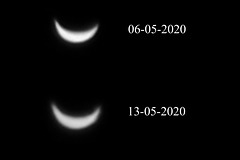
Sichel der Venus
| |
|
|
|
Der Sichel (kann man nur mit einem Teleskop sehen) wird die kommende Tage grösser und schmaler werden bis die Venus Richtung Sonne steht. Dann sehen wir (also nicht) die von der Sonne nicht beleuchteter Hälfte der Venus. Am 22. Mai steht Venus nahe Merkur, die Chance Merkur mal zu sehen.
Fasen der Venus.
www.lehrer-online.de/unterricht/sekundarstufen/naturwissenschaften/astronomie/unterrichtseinheit/seite/ue/venus-beobachtung-der-phasen-unseres-nachbarn/entstehung-der-venusphasen
Der erwähnte Merkurtransit Mercury transit part 2 (view on black)
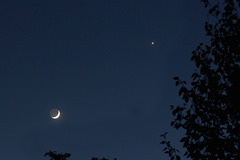
Moon and Venus (view on black)
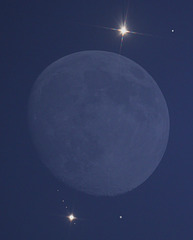
Venus and Jupiter (plus moons)
| |
|
|
|
and the Moon as reference. To the right of the overexposed planet images you see the real apparent sizes of the planets
Canon 700D attached to Newton telescope, f=750 mm, D=15 cm
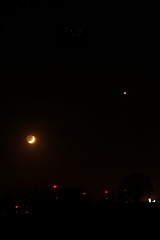
Moon and Venus (view on black)
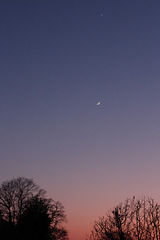
Moon and Venus
| |
|
|
|
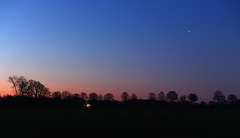
Half an hour later
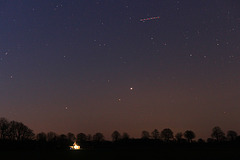
Jupiter-Saturn conjunction alert
| |
|
|
|
23-3-2020 5:00 Jupiter, Mars and Saturn rising above the south-eastern horizon and a rarity these days, a plane in the sky.
And now, at the end of this year Jupiter and Saturn, get very close together (a so called conjunction). The distance between them on the sky is at the moment already less than the size of a full moon. You can see them in the early evening (~18h) in the south west, however, close to the horizon. Saturn appears much fainter than Jupiter. Hope the weather is fine.
Jupiter and Saturn have a conjunction every 20 years, but they are not all the same. This year it will be the closest since 1623. The next very close one will be in 2080. So if you want to see a good one you have to try this year !!!!!
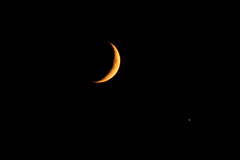
Moon and Jupiter close together
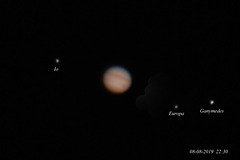
Jupiter (view on black)
| |
|
|
|

Jupiter (view on black)
| |
|
|
|
Jupiter's picture is a combination of 16 exposures (see EXIF). Added is a seperate picture of the moons (T= 4 sec.)
Jupiter is visible near the horizon, not very favourable for making pictures but...
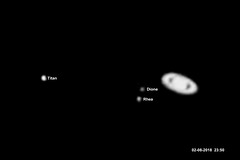
Saturn and moons
| |
|
|
|
Used two exposures. The moons are too bright compared to the brightnes of Saturn
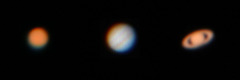
Mars, Jupiter and Saturn
| |
|
|
|
Every evening/night visible. Aperent sizes are to scale. Pictures taken and treated in the same way (except exposure time)
the red (top) and blue (bottom) colours are an artifact due to the earth atmosphere
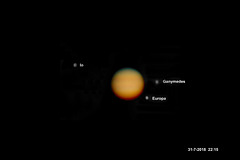
Jupiter and his moons
| |
|
|
|
Used two exposures. The moons are too bright compared to Jupiter. The two cloud bands are visible. The colours at the north (blue) and southpole (red) are artifacts
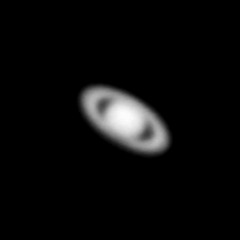
Saturn
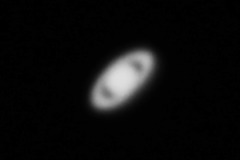
Saturn
| |
|
|
|
The blury view is caused by turbulence in the earth atmosphere (Saturn does not rise very high above the horizon) and the relatively long exposure of T=1/5 s. Combined 6 exposures. Projection with 14 mm eyepiece
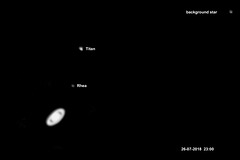
Saturn
| |
|
|
The ring of Saturn and the moon Titan were discovered by Christiaan Huygens (1665), the moon Rhea by Cassini (~1680)
Jump to top
RSS feed- Latest items - Subscribe to the latest items added to this album
- ipernity © 2007-2026
- Help & Contact
|
Club news
|
About ipernity
|
History |
ipernity Club & Prices |
Guide of good conduct
Donate | Group guidelines | Privacy policy | Terms of use | Statutes | In memoria -
Facebook
X
