

John Sheldon's photos

08 May 2018
3 favorites
2 comments
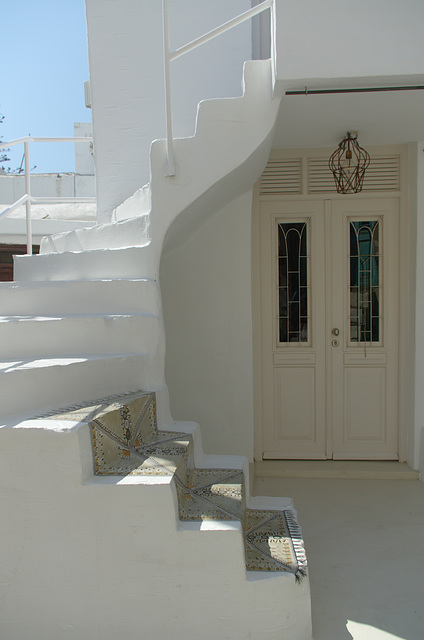
Hot stairs and a cool doorway at Naoussa
A dwelling in the maze of narrow, winding streets in the village of Naoussa, to the north of the island of Paros in the Cyclades.
08 May 2018
2 favorites
2 comments
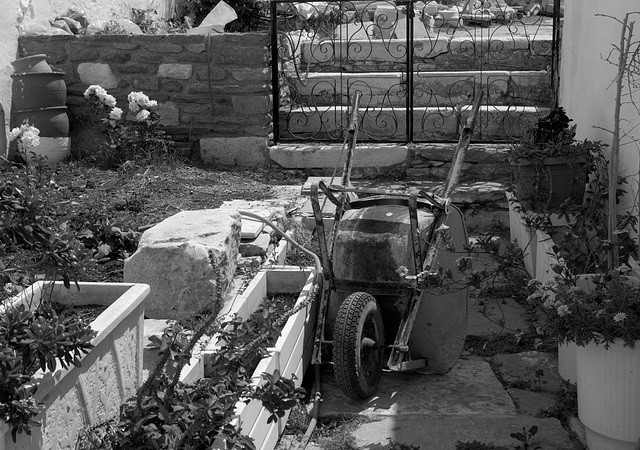
Garden work in progress at Parikia
Garden 'work in progress' at the church of Panagia Ekatontapiliani in Parikia, Paros.

08 May 2018
Ancient cruciform font at Panagia Ekatontapiliani in Parikia
Parikia is the main town in the island of Paros in the Cyclades. The church in which this ancient font is preserved is one of the most important Christian monuments in Greece.
The original church was constructed in the 4th century A.D. Many reformations were performed through centuries and today the church is a complex of Paleochristian, Byzantine and post-Byzantine elements. The name Ekatontapiliani means 'the Church with the hundred doors'. According to tradition, the church has 99 doors and a secret door will open when the church of Hagia Sofia in Constantinople becomes Orthodox Christian again.
The ancient Baptistery in which the cruciform font is situated dates back to the 4th century. It is said to be the most ancient and the best preserved baptistery of the orthodox Christian East. It was, obviously, designed for the use of adults wishing to be baptised as Christians.
08 May 2018
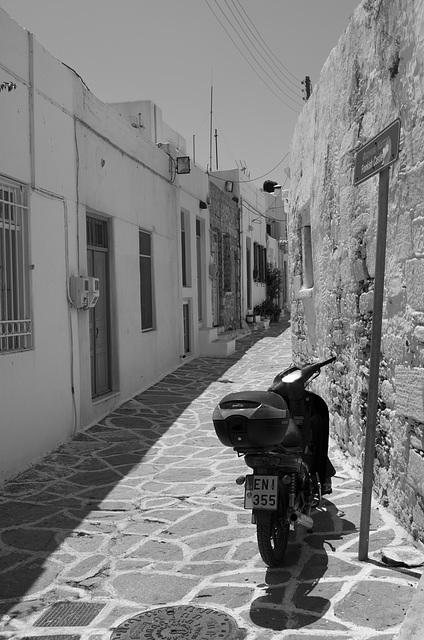
Narrow street with motor bike, Parikia
Parikia is the main town in the island of Paros in the Cyclades. The older part of the town consists of many narrow, winding streets.
09 May 2018
5 favorites
4 comments
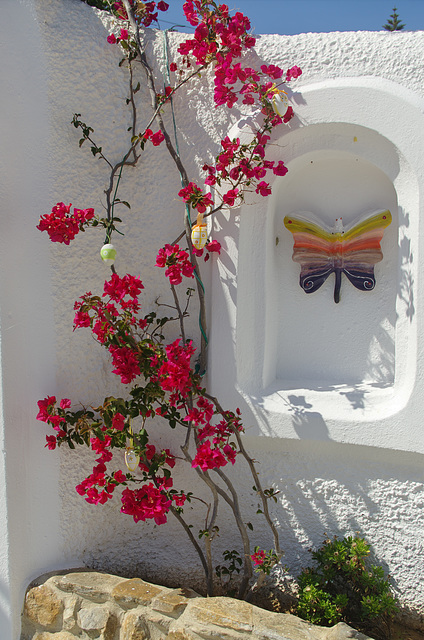
Colourful garden niche at Alyki
Alyki is a village on the southern tip of Paros, an island in the Cyclades. This wall niche was probably intended to hold a religious image or icon. There are many such niches in this part of the world, and most of them still serve their original purpose.
09 May 2018
3 favorites
3 comments
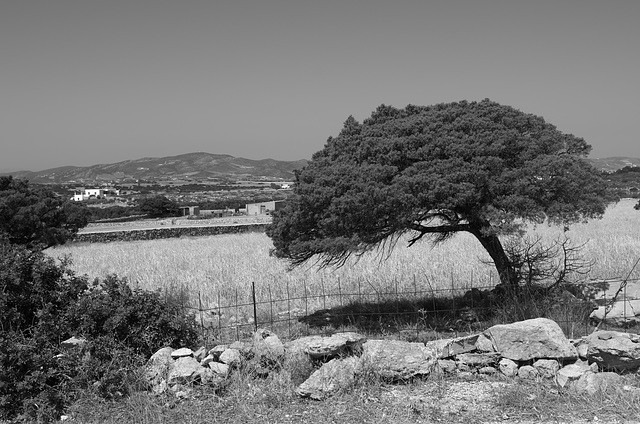
Windswept tree at Alyki
Alyki is a village on the southern tip of Paros, an island in the Cyclades. The ground is dry, and water is precious. There are strong winds from the sea which help to keep the temperatures down. These may however have a drying effect on the crops wich can be seen in the field beyond the tree.

09 May 2018
1 favorite
1 comment
Sea defences at Paros
Picture taken from the coast at Alyki, a village on the southern tip of Paros, an island in the Cyclades.

09 May 2018
1 favorite
Houses and scrubland at Alyki
Alyki is a village on the southern tip of Paros, an island in the Cyclades. The ground is dry, and water is precious. The majority of the buildings are white, which presumably helps to keep the internal temperatures down. Photographers have to be aware of 'dynamic range' issues.
10 May 2018
5 favorites
2 comments
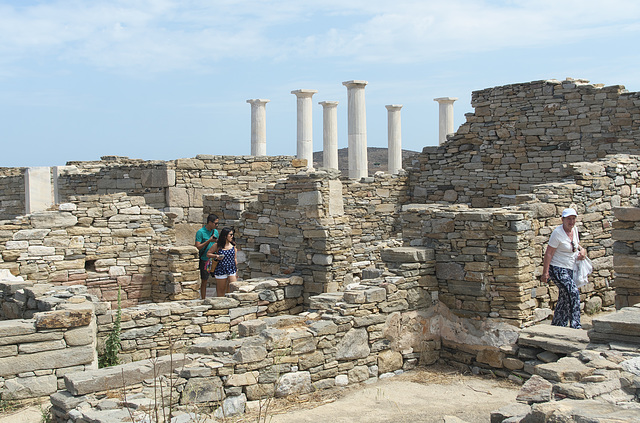
Tourists amongst the ruins at Delos
The island of Delos, near the centre of the Cyclades archipelago, is one of the most important mythological, historical, and archaeological sites in Greece. The island is dry with poor soil and it would have been of no interest to anyone had it not been for its position as a holy sanctuary. When Greek mythology formulated the story of Apollo and Artemis in the first millennium BCE Delos was made their birthplace, although the island had been a holy site long before that.
In the Homeric Hymn to Delian Apollo the Titaness Leto says: "Delos, if you would be willing to be the abode of my son Phoebus Apollo and make him a rich temple – for no other will touch you, as you will find: and I think you will never be rich in oxen and sheep, nor bear vintage nor yet produce plants abundantly. But if you have the temple of far-shooting Apollo, all men will bring you hecatombs and gather here, and incessant savour of rich sacrifice will always arise, and you will feed those who dwell in you from the hand of strangers; for truly your own soil is not rich."
In later times the island became a very important and wealthy trading centre and surprisingly well populated given its scant natural resources; but by the 1st century BCE trade routes had changed and the island became uninhabited. It is still uninhabited today apart from visiting archaeologists and researchers - and of course tourists.
