

Esther's favorite photos
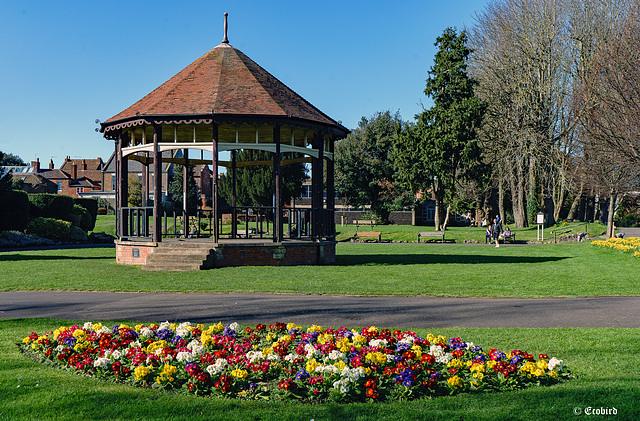

Bandstand (PiP)
Captured at Blake Gardens, Bridgwater, Somerset. The old bandstand sadly sees little use these days and is in need of repair and decoration. It used to be so nice to sit here and listen to bands playing whilst enjoying the sunshine and gardens.
The PiP is of the flower bed with walkway through the park on the left of the picture. On the other side of the wall is the River Parrett.
I have added a song by Aha. Here is ' The Banstand'
www.youtube.com/watch?v=kvy4h-DXFZ0
and the bandstand needs fixing so here is 'Fix You' and a live performance by Coldplay and Ed Sheeran
www.youtube.com/watch?v=n9aL0otZalc

At Last (PiP) HFF!
At last we are seeing the restoration of the Birnbeck Pier starting to take shape. I have long lamented the neglected state of this lovely old pier that holds so many memories for me.
Built between 1864 and 1867 this grand old Victorian lady was the only British seaside pier to link an island with the mainland.
In 1881 a lifeboat station was added with a boathouse built in 1889
Over the years the pier has seen steam ships taking visitors to Cardiff, Ilfracombe and Lundy Island and I can still remember taking a trip on the Waverley from the end of this pier when I was a child. There was a tramway carrying baggage from the steam ships.
Birnbeck island has also housed amusements and a beer cellar. A new pavilion and fire station were built following a fire but in 1902 but a year later severe gales damaged the pier. Then in 1933 the Grand Pier opened in Weston resulting in the loss of the amusements business.
After a spell being run by the Admiralty during the second world war it was sold and steam ships continued to use the pier up until 1972. It was later sold, changing hands a number of times but plans to restore it never amounted to anything.
The pier closed to the public in 1994. The lifeboat crew continued to use it and a walkway was built along the pier but it later became too unsafe for them.
This year has finally seen the start of the restoration work and the PiP shows the state of disrepair before work started.
At Last - listen here to Etta James
www.youtube.com/watch?v=cZag0E32is0

Nederland - Bolsward, stadhuis
The stadhuis (city hall) of Bolsward is one of the most beautiful buildings of the province of Friesland. The richly decorated building was built between 1614 and 1617 in a Frisian mannerism style (late Renaissance).
Once the municipality of Bolsward became included in the municipality of Súdwest-Fryslân in 2011, the city hall lost its traditional function. The building nowadays has a new function as museum and cultural center.

Nederland - Baarn, Kasteel Groeneveld
Kasteel Groeneveld in Baarn is an 18th-century country estate and one of the finest examples of a country house from that era. Since the 17th century, regents and merchants from Dutch cities came to their country houses to enjoy the good life.
The ‘castle’ was built in 1703 by Marcus Mamuchet and is considered being one of the finest examples of a country house from the Rococo style period. It was built in the tradition of 17th- and 18th-century estates that were intended as summer houses for wealthy city dwellers, mainly from Amsterdam. Groeneveld was probably built on the foundations of a farmstead. Initially, the house consisted only of the central part of the main building and the two outbuildings: coach house and orangery. The side wings date from around 1760.
Kasteel Groeneveld was privately owned until 1940. Nowadays it is owned and managed by
Staatsbosbeheer (a Dutch governmental organization for forestry and the management of nature reserves).

By Günter Klaus
28 favorites
Die geflügelte männliche Rossameise (Camponotus) am Blatt :)) The winged male carpenter ant (Camponotus) on the leaf :)) La fourmi charpentière mâle ailée (Camponotus) sur la feuille :))
Die männliche Rossameisen sind mit etwa 8 bis 12 mm deutlich kleiner als die imposanten Königinnen (bis zu 18 mm),Typisch für Rossameisen ist der glatte, gleichmäßig stark gewölbte Rücken und das einzelne Schuppenglied zwischen dem mittleren Körperabschnitt und dem Hinterleib. Im Vergleich zu den Königinnen ist ihr Kopf oft verhältnismäßig kleiner und die Augen (inklusive dreier Punktaugen auf der Stirn) sind für den Hochzeitsflug stark ausgeprägt.Die Männchen haben im Staat keine Aufgaben wie Nestbau, Nahrungssuche oder Brutpflege. Ihre einzige biologische Aufgabe besteht darin, die Jungköniginnen zu begatten :))
Pip1-5: Nahaufnahmen der Ameise
Male carpenter ants, at about 8 to 12 mm, are significantly smaller than the imposing queens (up to 18 mm). Typical characteristics of carpenter ants include their smooth, evenly arched backs and the single scale segment between the thorax and abdomen. Compared to the queens, their heads are often relatively smaller, and their eyes (including three simple eyes on the forehead) are strongly developed for the nuptial flight. Males have no roles in the colony such as nest building, foraging, or brood care. Their sole biological function is to mate with the young queens. :))
Pip1-5: Close-up photos of the ant
Les mâles des fourmis charpentières, mesurant environ 8 à 12 mm, sont nettement plus petits que les imposantes reines (jusqu'à 18 mm). Les fourmis charpentières se caractérisent par un dos lisse et régulièrement arqué, ainsi que par un unique segment d'écailles entre le thorax et l'abdomen. Comparée à celle des reines, leur tête est souvent relativement plus petite et leurs yeux (dont trois ocelles simples sur le front) sont fortement développés pour le vol nuptial. Les mâles n'ont aucun rôle dans la colonie : construction du nid, recherche de nourriture ou soins aux jeunes. Leur unique fonction biologique est de s'accoupler avec les jeunes reines. :))
Pip1-5 : Photos en gros plan de la fourmi

By Günter Klaus
32 favorites
Die Wiesenschaumzikade (Philaenus spumarius) hat sich in Pose gebracht :)) The meadow spittlebug (Philaenus spumarius) has struck a pose :)) La cicadelle écumeuse des prés (Philaenus spumarius) a pris la pose :))
Die Zikade Sie gehören zu den besten Springern im Tierreich.Bei Gefahr können sie schlagartig bis zu 70 Zentimeter hoch schnellen. Rechnet man das auf ihre Körpergröße von gerade einmal 5 bis 7 Millimetern um, ist das eine enorme Leistung,sie ernähren sich von Pflanzensaft,sie sind völlig harmlos für den Menschen, extrem anpassungsfähig und praktisch überall auf Wiesen, in Gärten und an Wegrändern zu finden :))
Pip1-5: Nahaufnahmen der Zikade
Cicadas are among the best jumpers in the animal kingdom. When threatened, they can suddenly leap up to 70 centimeters into the air. Considering their body size of just 5 to 7 millimeters, that's an enormous feat. They feed on plant sap, are completely harmless to humans, extremely adaptable, and can be found practically everywhere – in meadows, gardens, and along roadsides. :))
Pip1-5: Close-up photos of the cicada
Les cigales comptent parmi les meilleurs sauteurs du règne animal. Menacées, elles peuvent bondir soudainement jusqu'à 70 centimètres de hauteur. Compte tenu de leur taille (5 à 7 millimètres seulement), c'est un exploit remarquable. Elles se nourrissent de sève, sont totalement inoffensives pour l'homme, extrêmement adaptables et se rencontrent pratiquement partout : dans les prairies, les jardins et au bord des routes. :))
Pip1-5 : Gros plans de cigales

By Günter Klaus
22 favorites
Die Galle auf einen Fichtenzweig :)) The gall on a spruce branch :)) La galle sur une branche d'épicéa :))
Ich beobachte ja immer die Natur auf meiner Naturrunde,was normal nicht zu einen Naturobjekt passt,wie hier diese rötliche "Ananasgalle",die ich aud diesen Zweig entdeckte!Sie wird von einer winzigen Fichtengalllaus verursacht,im Frühjahr saugt eine weibliche Laus an den jungen Knospen der Fichte. Durch ihren Speichel gibt sie chemische Stoffe ab, die das Pflanzengewebe manipulieren. Anstatt normaler Nadeln bildet die Fichte an dieser Stelle diese verdickte, gekammerte Wucherung. Die Nadelbasen schwellen an und schließen sich zusammen. In den kleinen Kammern im Inneren dieser Galle wachsen gut geschützt die Larven der Laus heran und saugen am Pflanzensaft.Im Frühsommer ist sie noch grün-rötlich und saftig. Sobald die Larven im Spätsommer (meist ab August) ausgewachsen sind, trocknet die Galle aus, die Kammern öffnen sich wie kleine Klappen und die geflügelten Läuse fliegen aus. Zurück bleibt genau das, was du fotografiert hast: Eine leere, braune "Skelett-Galle", die oft noch monatelang am Zweig hängen bleibt,für die Fichte ist sie aber harmlos in kleinen Mengen!
Pip1-4: Nahaufnahmen dieser Galle am Zweig
I always observe nature on my walks, which isn't usually appropriate for a natural object, like this reddish "pineapple gall" I discovered on this branch! It's caused by a tiny spruce gall aphid. In spring, a female aphid sucks sap from the young buds of the spruce tree. Through her saliva, she releases chemical substances that manipulate the plant tissue. Instead of normal needles, the spruce develops this thickened, chambered growth at that spot. The bases of the needles swell and close together. Well-protected in the small chambers inside this gall, the aphid larvae develop and suck the plant sap. In early summer, it's still greenish-red and succulent. As soon as the larvae are fully grown in late summer (usually from August onwards), the gall dries out, the chambers open like small flaps, and the winged aphids fly out. What remains is exactly what you photographed: an empty, brown "skeletal gall" that often stays on the branch for months. However, it's harmless to the spruce tree in small quantities!
Pip 1-4: Close-ups of this gall on the branch
Lors de mes promenades, j'observe toujours la nature, ce qui n'est pas toujours approprié pour un objet naturel, comme cette galle rougeâtre en forme d'ananas que j'ai découverte sur cette branche ! Elle est causée par un minuscule puceron gallicole de l'épicéa. Au printemps, la femelle se nourrit de la sève des jeunes bourgeons de l'épicéa. Sa salive libère des substances chimiques qui modifient les tissus de la plante. Au lieu d'aiguilles normales, l'épicéa développe à cet endroit une excroissance épaisse et cloisonnée. La base des aiguilles gonfle et se resserre. Bien protégées dans les petites loges à l'intérieur de la galle, les larves du puceron se développent et se nourrissent de la sève. Au début de l'été, la galle est encore rouge verdâtre et charnue. Dès que les larves ont atteint leur taille adulte à la fin de l'été (généralement à partir d'août), la galle sèche, les loges s'ouvrent comme de petits clapets et les pucerons ailés s'envolent. Ce qui reste, c'est exactement ce que vous avez photographié : une galle squelettique brune et vide qui persiste souvent plusieurs mois sur la branche. Cependant, en petite quantité, elle est inoffensive pour l'épicéa !
Photos 1 à 4 : Gros plans de cette galle sur la branche

By Kayleigh
16 favorites
The Luxury of Time |
Sunday Breakfast | Would You Date Yourself? :-)))))
Every Town Has a Professional Idiot | Blues Masterpiece
☆☆☆
Jump to top
RSS feed- Latest favorites - Subscribe to the favorite docs of Esther
- ipernity © 2007-2026
- Help & Contact
|
Club news
|
About ipernity
|
History |
ipernity Club & Prices |
Guide of good conduct
Donate | Group guidelines | Privacy policy | Terms of use | Statutes | In memoria -
Facebook
X
