

Esther's favorite photos


57 favorites
Mexican Sunflower
Photographed at my workplace in the Bronx, this Mexican sunflower (Tithonia rotundifolia) offered a simple reminder that beauty can be found everywhere, if one looks. Native to Mexico and Central America, the species has been widely cultivated as an ornamental far beyond its native range.
The flower’s journey into gardens around the world also reflects a broader history of plants crossing borders through horticulture, collecting, and exchange. In much the same way, human travel and cultural exchange, when guided by curiosity, respect, and reciprocity, allow ideas, traditions, and perspectives to move between communities. Like a plant taking root in new soil without losing the character of its origins, people can carry their heritage into new places while learning from others. These encounters can cultivate understanding, inspire new forms of creativity, and make the world more connected, generous, and beautiful.
To mark Anna Atkins’ pioneering work in botanical imagery, the first half of the photo was converted into an Anna Atkins-style cyanotype. Atkins used the cyanotype process to create Photographs of British Algae: Cyanotype Impressions , begun in 1843, the first book illustrated with photographic images. The second half presents the actual flower, placing one of photography’s earliest botanical processes beside a contemporary photographic record.
The right-most section of the flower was cropped. This leaves the future of photography to the imagination.
The original noisy background was replaced with a solid background to remove distraction and bring the flower’s form and color forward. The flower remains the subject as photographed, while the presentation emphasizes the ideas at the heart of the image concerning the evolution of botanical photography and that beauty can be found in ordinary places whenever we take the time to look.
World Photography Day celebrates France's gifting daguerreotypes invented by Louis Daguerre and Nicéphore Niépce to the world on August 19, 1839.


Giant's Causeway
These are some of the 40,000 basalt columns that make up the main formations at Giant's Causeway. The Causeway is on the north coast of County Antrim in Northern Ireland and is a popular tourist destination. Interestingly, when we lived in Northern Ireland in the 90's there were many fewer visitors, no visitors' center and no fees. Now there is huge visitors' center, busses to the Causeway, and parking fees to accommodate the thousands of visitors. The name refers to an Irish legend about the formation of the Causeway by a giant named Finn McCool - according to the legend he tore up and threw into the sea massive chunks of the coast in order to make a causeway to Scotland (which has similar coastal formations) so that he could fight the Scottish giant Benandonner. We were at the Causeway twice during our recent trip, once by way of a Sunday walk and a second time to accommodate a visitor.
By Günter Klaus
30 favorites
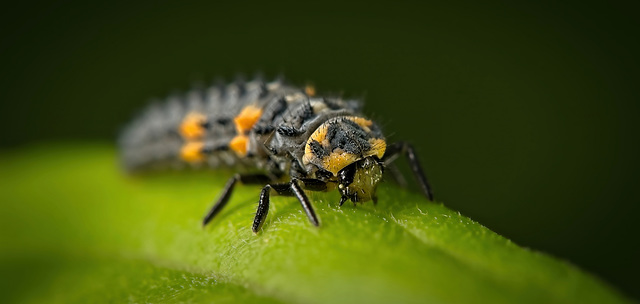
Die Larve des Siebenpunkt-Marienkäfers (Coccinella septempunctata) :)) The larva of the seven-spot ladybird (Coccinella septempunctata) :)) La larve de la coccinelle à sept points (Coccinella septempunctata) :))
Die Larve hat einen langgestreckten, leicht raupenartiger Körper mit drei gut sichtbaren Beinpaaren im vorderen Bereich,seine Farbe ist dunkelgrau bis blaugrün mit auffälligen, gelb-orangefarbenen Flecken an den Seiten. Der Körper ist faltig und mit kleinen, borstigen Warzen versehen.Er wächst von ca. 1,5 mm nach dem Schlupf auf etwa 7 bis 10 mm vor der Verpuppung heran.Bereits kurz nach dem Schlupf beginnt die Larve mit der Jagd. Eine einzige Larve frisst während ihrer Entwicklungszeit von etwa 2 bis 3 Wochen bis zu 400 bis 500 Blattläuse.
Pip1-4:Nahaufnahmen der Larve
The larva has an elongated, slightly caterpillar-like body with three clearly visible pairs of legs at the front. Its color ranges from dark gray to blue-green with striking yellow-orange spots on its sides. The body is wrinkled and covered with small, bristly warts. It grows from approximately 1.5 mm after hatching to about 7 to 10 mm before pupation. The larva begins hunting shortly after hatching. A single larva consumes up to 400 to 500 aphids during its development period of about 2 to 3 weeks.
Pip1-4: Close-ups of the larva
La larve possède un corps allongé, légèrement semblable à celui d'une chenille, avec trois paires de pattes bien visibles à l'avant. Sa couleur varie du gris foncé au bleu-vert, avec des taches jaune-orangé éclatantes sur les flancs. Son corps est ridé et recouvert de petites verrues hérissées. Elle mesure environ 1,5 mm à l'éclosion et atteint 7 à 10 mm avant la nymphose. La larve commence à chasser peu après l'éclosion. Une seule larve consomme jusqu'à 400 à 500 pucerons durant sa période de développement, qui dure environ 2 à 3 semaines.
Pip1-4 : Gros plans de la larve
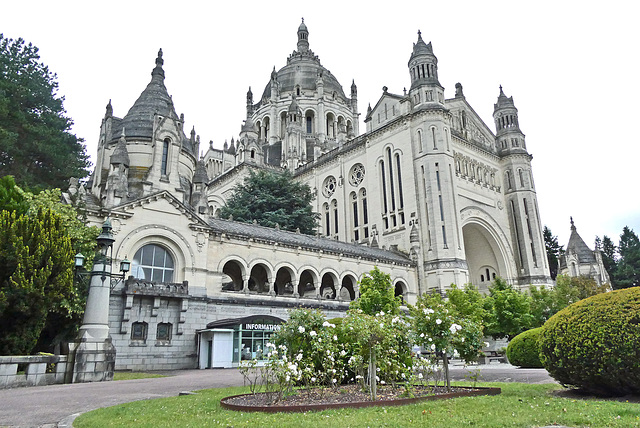
France - Basilique Sainte-Thérèse-de-Lisieux
The Basilique Sainte-Thérèse-de-Lisieux (Basilica of Sainte-Thérèse of Lisieux) was founded in Romanesque-Byzantine style in memory of Sainte Thérèsede l’Enfant Jésus. Construction of the church began in 1929 and it was consecrated in 1954.
The story of the Basilica of Sainte-Thérèse begins with the life of Thérèse of Lisieux, a young Carmelite nun who was canonised in 1925. Her popularity grew enormously and the need for a place of pilgrimage became apparent. In response, construction of the basilica began under the direction of the Bishop of Bayeux and Lisieux and architect Louis Marie Cordonnier.
The design of the basilica is a mix of neo-Byzantine and Romanesque styles, inspired by the Basilica of the Sacred Heart in Paris. The building is constructed of reinforced concrete and a local type of granite. The Basilica of Sainte-Thérèse has impressive dimensions: 104 metres long, 45 metres wide and a dome reaching a height of 97 metres. With an area of 4,500 m², it is the largest church built in France in the 20th century. The basilica can accommodate 4.000 worshippers.
The construction of the Basilica of Sainte-Thérèse-de-Lisieux faced many challenges, including financial constraints and the outbreak of the Second World War, but it was finally consecrated in 1954. Today, with more than 700,000 visitors, it has become the second most important place of pilgrimage in France.
Jump to top
RSS feed- Latest favorites - Subscribe to the favorite docs of Esther
- ipernity © 2007-2026
- Help & Contact
|
Club news
|
About ipernity
|
History |
ipernity Club & Prices |
Guide of good conduct
Donate | Group guidelines | Privacy policy | Terms of use | Statutes | In memoria -
Facebook
X
