

Free form
Natural caves
Checkered White butterfly
Not an easy landing
Majestic Saguaro
Rev. Johannes Elison and Maria Bockenolle (1634)
At the Art Gallery
Paint me orange
American snout butterfly
A pop of red
Mourning doves
Monkey puzzle tree (Araucaria araucana)
Prickly fingers
Hummingbird and aloe flower
The variety of desert life
Aloe flower with bees
Crested saguaro head
Crested saguaro
Saguaro landscape
Desert colors
Warts and all
Who needs a cellphone?
Flan with dulce de leche and chocolate
Ribs and spines
That's why it's called a prickly pear cactus
Saguaro stalks
Nature's glorious patterns
It's all a blur
Boojum tree trunk
Boojum Tree
Yucca plants
Prickly Pear Cacti
Desert flora
Barrel Cactus after flowering
Mama with babies
Two glass sculptures by Dale Chihuly
Roadrunner
Barrel cacti
Serious spines
High-Key Elephant
Crowded Necropolis
Eva Peron's Grave
Angel of mercy
Dome of the dead
An avenue in the necropolis
See also...
See more...
Keywords
Authorizations, license
-
Visible by: Everyone -
All rights reserved
-
292 visits
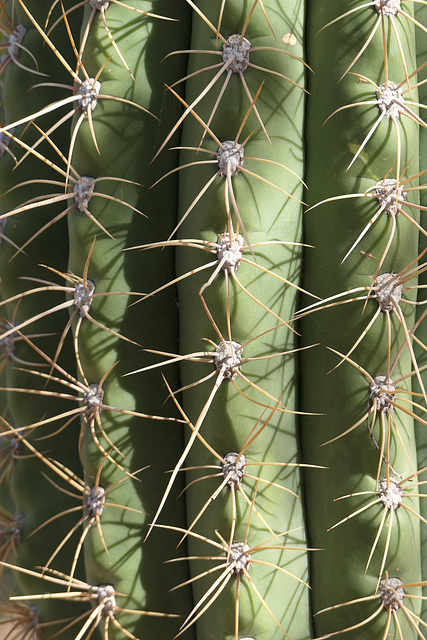
Rhythmic patterns

Desert Botanical Garden
Phoenix, Arizona
"Cacti are adapted to live in very dry environments, including the Atacama Desert, one of the driest places on Earth. Because of this, cacti show many adaptations to conserve water. For example, almost all cacti are succulents, meaning they have thickened, fleshy parts adapted to store water. Unlike many other succulents, the stem is the only part of most cacti where this vital process takes place. Most species of cacti have lost true leaves, retaining only spines, which are highly modified leaves. As well as defending against herbivores, spines help prevent water loss by reducing air flow close to the cactus and providing some shade. In the absence of true leaves, cacti's enlarged stems carry out photosynthesis.
Cactus spines are produced from specialized structures called areoles, a kind of highly reduced branch. Areoles are an identifying feature of cacti. As well as spines, areoles give rise to flowers, which are usually tubular and multipetaled. Many cacti have short growing seasons and long dormancies and are able to react quickly to any rainfall, helped by an extensive but relatively shallow root system that quickly absorbs any water reaching the ground surface. Cactus stems are often ribbed or fluted with a number of ribs which corresponds to a number in the Fibonacci numbers (2, 3, 5, 8, 13, 21, 34 etc.). This allows them to expand and contract easily for quick water absorption after rain, followed by retention over long drought periods."
en.wikipedia.org/wiki/Cactus
Sunday Challenge: "Show an image where rhythm is a clear theme.
Rhythm arises when elements repeat: a row of trees, waves on the water, the veins of a leaf. Sometimes rhythm is strict and measurable, sometimes playful and unpredictable."
AP1123863
Andrea Riberti, Roger (Grisly), Annemarie, sea-herdorf and 19 other people have particularly liked this photo
- Keyboard shortcuts:
Jump to top
RSS feed- Latest comments - Subscribe to the comment feeds of this photo
- ipernity © 2007-2026
- Help & Contact
|
Club news
|
About ipernity
|
History |
ipernity Club & Prices |
Guide of good conduct
Donate | Group guidelines | Privacy policy | Terms of use | Statutes | In memoria -
Facebook
X

Admired in: www.ipernity.com/group/tolerance
Wünsche noch einen schönen Sonntag,liebe Grüße Güni :))
Your info underneath your photo is complete and utmost instructive for most people, you did really great, better than I would have. Congratulations.
ombre et lumière
les aiguilles en bouquet étoilé, alignées en diagonales,
tout est impeccable dans ton choix et dans ta prise
j'aime beaucoup
Great iinformation too!
Freundliche Grüße und einen angenehmen Abend
Erich
(Great to be back:)
Sign-in to write a comment.