

That's why it's called a prickly pear cactus
mosquée à khiva
Mercedes 240 D.
Sanur Bali
Library Ceiling, Melk Abbey
Clock with Old and New Art, Melk Abbey
Montagsbank?
tête à tête
3 Amigos
Termas de Polloquere
Un coup de coeur visuel en plongée
Das Rot bleibt
Taxi sur la place du 9 avril
Deux chaises Coca-cola et une Dame au chapeau
Facade with Saint Statue, Melk Abbey (H.A.N.W.E.)
Pizza y Coca-cola
Offbeat building / Architecture étourdissante
Un orgue religieux d'une ampleur remarquable / Ein…
Mauerrest im antiken Rom
Camouflage
Dreamy Newfoundland / Paradis de Terre-Neuve
Baranagar, India
Der Weg zur Black Lodge (HFF)
Chorin: Before I Knew the Shadows
Saint Statue, Melk Abbey
Telescope and Library, Melk Abbey
Niederfinow, 2015 – oder: Wie das Wasser die Zeit…
Vélo hybride à énergie solaire / Solar-powered hyb…
Mercadito Chenchito
Hartland Point Lighthouse
Cape Buffalo
Window at Melk
Warthog Group
Lucky dogs & Coca-cola
Nature's glorious patterns
Ships in Harbor of Walvis Bay
Velas Negras | OFF for HFF | :-)
NIGHT WALK
Tenerife Observatory
Deux publicités discrètes de Coca-cola sur la droi…
Boutique modeste à la marocaine
Cappadoce (Turquie). Juillet 1980. (Diapositive nu…
„Alles ist Traum. Das Universum ist nicht die Schi…
Reisende zwischen zwei Nächten
Charlotte Bay

See also...
Keywords
Authorizations, license
-
Visible by: Everyone -
All rights reserved
-
112 visits
Saguaro stalks
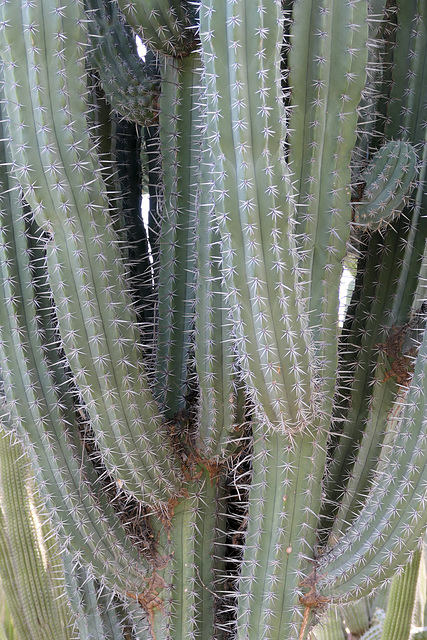

Desert Botanical Garden
Phoenix, Arizona
"Cacti are adapted to live in very dry environments, including the Atacama Desert, one of the driest places on Earth. Because of this, cacti show many adaptations to conserve water. For example, almost all cacti are succulents, meaning they have thickened, fleshy parts adapted to store water. Unlike many other succulents, the stem is the only part of most cacti where this vital process takes place. Most species of cacti have lost true leaves, retaining only spines, which are highly modified leaves. As well as defending against herbivores, spines help prevent water loss by reducing air flow close to the cactus and providing some shade. In the absence of true leaves, cacti's enlarged stems carry out photosynthesis.
Cactus spines are produced from specialized structures called areoles, a kind of highly reduced branch. Areoles are an identifying feature of cacti. As well as spines, areoles give rise to flowers, which are usually tubular and multipetaled. Many cacti have short growing seasons and long dormancies and are able to react quickly to any rainfall, helped by an extensive but relatively shallow root system that quickly absorbs any water reaching the ground surface. Cactus stems are often ribbed or fluted with a number of ribs which corresponds to a number in the Fibonacci numbers (2, 3, 5, 8, 13, 21, 34 etc.). This allows them to expand and contract easily for quick water absorption after rain, followed by retention over long drought periods."
en.wikipedia.org/wiki/Cactus
AP1123859
Phoenix, Arizona
"Cacti are adapted to live in very dry environments, including the Atacama Desert, one of the driest places on Earth. Because of this, cacti show many adaptations to conserve water. For example, almost all cacti are succulents, meaning they have thickened, fleshy parts adapted to store water. Unlike many other succulents, the stem is the only part of most cacti where this vital process takes place. Most species of cacti have lost true leaves, retaining only spines, which are highly modified leaves. As well as defending against herbivores, spines help prevent water loss by reducing air flow close to the cactus and providing some shade. In the absence of true leaves, cacti's enlarged stems carry out photosynthesis.
Cactus spines are produced from specialized structures called areoles, a kind of highly reduced branch. Areoles are an identifying feature of cacti. As well as spines, areoles give rise to flowers, which are usually tubular and multipetaled. Many cacti have short growing seasons and long dormancies and are able to react quickly to any rainfall, helped by an extensive but relatively shallow root system that quickly absorbs any water reaching the ground surface. Cactus stems are often ribbed or fluted with a number of ribs which corresponds to a number in the Fibonacci numbers (2, 3, 5, 8, 13, 21, 34 etc.). This allows them to expand and contract easily for quick water absorption after rain, followed by retention over long drought periods."
en.wikipedia.org/wiki/Cactus
AP1123859
Nouchetdu38, trester88, Günter Klaus, William Sutherland have particularly liked this photo
- Keyboard shortcuts:
Jump to top
RSS feed- Latest comments - Subscribe to the comment feeds of this photo
- ipernity © 2007-2026
- Help & Contact
|
Club news
|
About ipernity
|
History |
ipernity Club & Prices |
Guide of good conduct
Donate | Group guidelines | Privacy policy | Terms of use | Statutes | In memoria -
Facebook
X

Admired in: www.ipernity.com/group/tolerance
Wünsche noch einen schönen Sonntag,liebe Grüße Güni :))
Sign-in to write a comment.