

The MacDonnell Range
Looks like and Elephant Head and Trunk
Looks like Easter Island
East MacDonnells
Ghost Gums
New England Fence
Thigh high in snow
Serene snow (Explored)
Windshield wipers at the ready
Avalance - suburban style
Only another 25 feet to the street
Plowing the streets
Hunkered in
Iced over
Snow removal New England Style
Impassable
You only told me to shovel the driveway
Jessie Gap (Explored)
The road goes on
The Caterpillar
Rock painting (Explored)
Young Raven
Staredown (Explored)
Weathered
Corroborree Rock
Bottlebrush
Leaving the Alice
Crested Pigeon
Galah
Pearly Whites
Bearded Dragon
Dusty Goanna
The mighty Todd River
Goanna
Goose feathers
Cape Barren Goose
New Zealand fur seals
Bad Hair day
Short billed echidna
Taking a pounding
Golden waves
Windswept coast
View from Cape du Couedic
Zig Zag
Cape du Couedic Lighthouse
Location
Lat, Lng:
You can copy the above to your favourite mapping app.
Address: unknown
You can copy the above to your favourite mapping app.
Address: unknown
Keywords
Authorizations, license
-
Visible by: Everyone -
All rights reserved
-
311 visits
Corroboree in the light
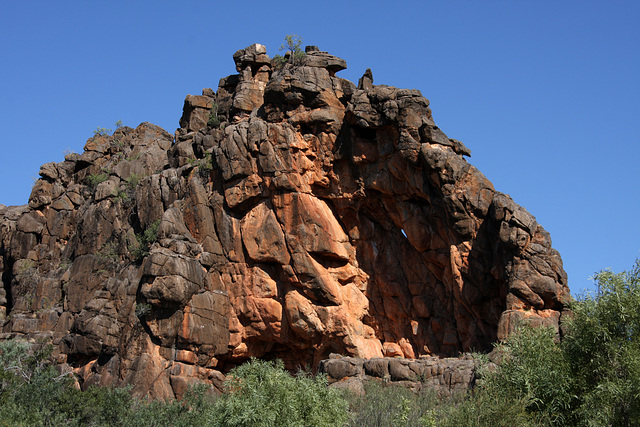

Corroboree Rock is a large formation made out of dolomite that is located approximately an hour's drive east of Alice Springs, Australia. It is part of the East MacDonnell Ranges. It is of great importance to the local aborigine people.
"Just off the Ross Highway, some kilometres northeast of the Emily and Jessie Gaps, is a weathered, rippled rock called Corroboree. It began to be formed some 800 million years ago when a shallow, salty sea laid down a fine silt. Algae grew over this silt and shaped itself into mounds that solidified into rock over millions of years.
The movement of the earth caused the folding of strata (layers) of rock into the vertical plane, causing the original horizontal layers to stick straight up out of the earth in the form of a ridge. Wind, rain and sun gradually wore down the ridge, with only Corroboree, a particularly hard section of rock, remaining today.
The three predominant colours in the rock are black, orange, and white. The black colour comes from the oxidation of iron particles within the stone, and the orange and yellow are the result of tropical weather conditions."
www.expedition360.com/australia_lessons_geography/2001/09...
AIMG_66235
"Just off the Ross Highway, some kilometres northeast of the Emily and Jessie Gaps, is a weathered, rippled rock called Corroboree. It began to be formed some 800 million years ago when a shallow, salty sea laid down a fine silt. Algae grew over this silt and shaped itself into mounds that solidified into rock over millions of years.
The movement of the earth caused the folding of strata (layers) of rock into the vertical plane, causing the original horizontal layers to stick straight up out of the earth in the form of a ridge. Wind, rain and sun gradually wore down the ridge, with only Corroboree, a particularly hard section of rock, remaining today.
The three predominant colours in the rock are black, orange, and white. The black colour comes from the oxidation of iron particles within the stone, and the orange and yellow are the result of tropical weather conditions."
www.expedition360.com/australia_lessons_geography/2001/09...
AIMG_66235
- Keyboard shortcuts:
Jump to top
RSS feed- Latest comments - Subscribe to the comment feeds of this photo
- ipernity © 2007-2026
- Help & Contact
|
Club news
|
About ipernity
|
History |
ipernity Club & Prices |
Guide of good conduct
Donate | Group guidelines | Privacy policy | Terms of use | Statutes | In memoria -
Facebook
X

Sign-in to write a comment.