

Red Car
Along The Track.
Honey Enjoying Her Day
contesse francesi :)
Tui In Blossom
Beside The Trunk.
In Full Blume.
Fungi
Tokoroa Track Club
New Season's Leaves
Dans mon jardin
Spring Treetop.
Magnolia Blossoming.
Standing Tall.
Lovely Pansy Faces
Corrigated Iron Car, Advert.
A Green World
Lovely Leaves.
Rainbow Sky.
Dans mon jardin d'hiver
Just Growing Wild.
Es geht eine Träne auf Reisen - A tear goes on its…
Red Berries
Totgesagte leben länger - The dead live longer -…
Blossoming.
Apples and Avocados
Magnolia Blossom
Casting My Shadow.
Cactus Plant
Pretty weeds.
Moon Rising.
Pilztränen - Mushroom tears
Blossoming.
Lilac Time.
amori ... brillanti :)
Pink Bluebells.
Azalea Bush Blooming..
rose of Sharon
Dragontailbutterfly ,Lamproptera curius_Vietnam
Matchsticks
Herbst im Ahornwäldchen - Autumn in the maple grov…
Thrush.
Ruhig gleitet der Schwan durch den schmalen Kanal
Tui In the blossom
Blossom

Location
Lat, Lng:
You can copy the above to your favourite mapping app.
Address: unknown
You can copy the above to your favourite mapping app.
Address: unknown
See also...
Keywords
Authorizations, license
-
Visible by: Everyone -
All rights reserved
-
535 visits
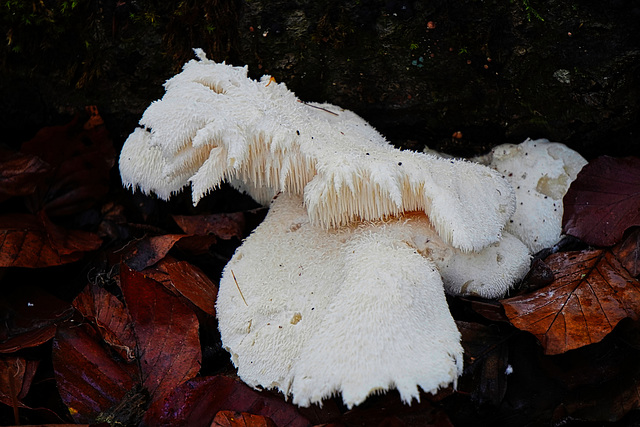
Heute entdeckt - Discovered today

Bitte vergrößern -Please enlarge
Heute bei einer Wanderung entdeckt: den bislang noch nie gesehenen Pilz Dorniger Stachelbart (Hericium cirrhatum), der aus einem umgestürzten Baumstamm herauswuchs. Die Oberfläche ist mit kleinen bogenförmigen "Haken" überzogen, auf der Unterseite des Hutes befinden sich zahlreiche weiße "Stacheln". Der Dornige Stachelbart wächst saprophytisch in Laubbäumen und erzeugt hier die gefürchtete Weißfäule. Da er sehr selten ist, sollte er geschont werden (also auch nicht gegessen werden, was möglich ist). Er wird in der Roten Liste Deutschlands und Großbritanniens als gefährdet eingestuft. Das Exemplar im Bild hatte einen Durchmesser von ca. 15 cm. Der Dornige Stachelbart (Hericium cirrhatum) ist übrigens mit dem Igelstachelbart (Hericium erinaceum) verwandt, den ich früher zeigte (www.ipernity.com/doc/cammino/51002756).
de.wikipedia.org/wiki/Dorniger_Stachelbart
Discovered today during a hike: the never-before-seen tiered tooth fungus or spine face (Hericium cirrhatum) growing out of a fallen tree trunk. The surface is covered with small arching "hooks", on the underside of the cap there are numerous white "spines" The thorny spikenard grows saprophytically in deciduous trees and produces the white rot here. As it is very rare, it should be protected (i.e. not eaten, which is possible). It is classified as endangered in Germany and the UK Red Data List. The specimen in the photo had a diameter of about 15 cm.
By the way, Hericium cirrhatum is related to the lion's mane mushroom (Hericium erinaceum), which I showed earlier (see www.ipernity.com/doc/cammino/51002756).
en.wikipedia.org/wiki/Hericium_cirrhatum
Translate into English
Heute bei einer Wanderung entdeckt: den bislang noch nie gesehenen Pilz Dorniger Stachelbart (Hericium cirrhatum), der aus einem umgestürzten Baumstamm herauswuchs. Die Oberfläche ist mit kleinen bogenförmigen "Haken" überzogen, auf der Unterseite des Hutes befinden sich zahlreiche weiße "Stacheln". Der Dornige Stachelbart wächst saprophytisch in Laubbäumen und erzeugt hier die gefürchtete Weißfäule. Da er sehr selten ist, sollte er geschont werden (also auch nicht gegessen werden, was möglich ist). Er wird in der Roten Liste Deutschlands und Großbritanniens als gefährdet eingestuft. Das Exemplar im Bild hatte einen Durchmesser von ca. 15 cm. Der Dornige Stachelbart (Hericium cirrhatum) ist übrigens mit dem Igelstachelbart (Hericium erinaceum) verwandt, den ich früher zeigte (www.ipernity.com/doc/cammino/51002756).
de.wikipedia.org/wiki/Dorniger_Stachelbart
Discovered today during a hike: the never-before-seen tiered tooth fungus or spine face (Hericium cirrhatum) growing out of a fallen tree trunk. The surface is covered with small arching "hooks", on the underside of the cap there are numerous white "spines" The thorny spikenard grows saprophytically in deciduous trees and produces the white rot here. As it is very rare, it should be protected (i.e. not eaten, which is possible). It is classified as endangered in Germany and the UK Red Data List. The specimen in the photo had a diameter of about 15 cm.
By the way, Hericium cirrhatum is related to the lion's mane mushroom (Hericium erinaceum), which I showed earlier (see www.ipernity.com/doc/cammino/51002756).
en.wikipedia.org/wiki/Hericium_cirrhatum
Nouchetdu38, grobi358, Erhard Bernstein, Heidiho and 39 other people have particularly liked this photo
- Keyboard shortcuts:
Jump to top
RSS feed- Latest comments - Subscribe to the comment feeds of this photo
- ipernity © 2007-2026
- Help & Contact
|
Club news
|
About ipernity
|
History |
ipernity Club & Prices |
Guide of good conduct
Donate | Group guidelines | Privacy policy | Terms of use | Statutes | In memoria -
Facebook
X

Wünsche noch einen schönen Abend,ganz liebe Grüße Güni :))
Ein toller Fund...
Admired in: www.ipernity.com/group/tolerance
Well spotted and captured.
Superbly shown, Reinhold!!
Sign-in to write a comment.