

Hummel und Distelblüte
Ewe Needing A Rest.
Alaska, The Tufted Puffin in Seward SeaLife Center
9J8A4571
Murmel - der Wächter
Der Einzelgänger
Alaska, The Tufted Puffin in Seward SeaLife Center
Der Einzelgänger
La "belle" cigogne
Entre cigogne, spatule et héron pic boeuf
Die Hundefreundinnen Kenzie, Lena und Lola auf ein…
Recurvirostra avosetta, Alfaiate, Castro Marim
Before the rain
Mein Überraschungsfund - My surprise find
Garrulus glandarius (Eurasian jay)
Garrulus glandarius (Eurasian jay)
Turmfalke
Stork
Spatules
Recurvirostra avosetta, Alfaiate, Castro Marim
A mouthful (Explored)
Female red-winged blackbird
Recurvirostra avosetta, Alfaiate, Castro Marim
dialogue with half of the russian double-headed ea…
I want to eat all the fish and frogs from the pon…
Deux jeunes cormorans (grand) avec un parent
Petite famille, grand nid
Avocette de la Baie de Somme
Stork wings outstretched
Alaska, The Tufted Puffin in Seward SeaLife Center
Gefiederpflege
Opulence.
Ulmen-Harlekin
Glareola pratincola, Perdiz-do-Mar, Castro Marim
Spoilt for Choice
Alaska, Harbor Seal in Seward SeaLife Center
Faulbaumbläuling ♀
Hummingbird. 5175128.
Tsavo West National Park
Tsavo West National Park
Silver Studded Blue and Small Wasp
80 DSC 0468 1
Tsavo West National Park
Jackdaw
Pheasant

1/160 • f/4.0 • 90.0 mm • ISO 5000 •
SONY ILCE-6400
FE 90mm F2.8 Macro G OSS
EXIF - See more detailsSee also...
Keywords
Authorizations, license
-
Visible by: Everyone -
All rights reserved
-
678 visits
Die Blumenkönigin des Waldes - The flower queen of the woods
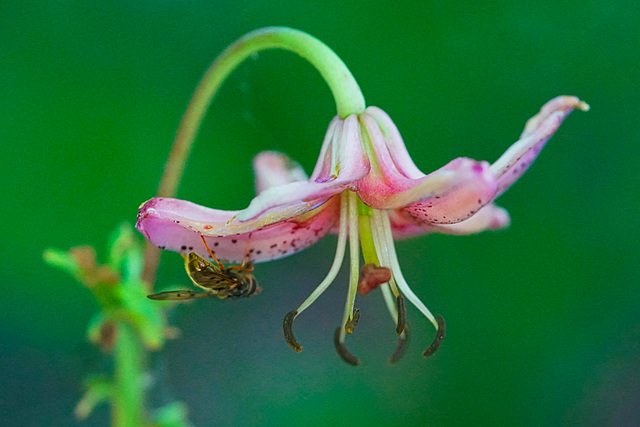

In vielen unterfränkischen Laubmischwäldern kommt vereinzelt der Türkenbund (Lilium martagon) vor. An der Spitze der etwa 50 cm großen Pflanze erscheint im Lauf des Monats Juni die Blütenrispe mit ca. 5 cm großen Einzelblüten, die Schwebfliegen wie magisch anziehen und die dann für die Bestäubung verantwortlich sind. Die Blütenknospen des Türkenbundes werden von Rehen gerne abgefressen und auch das Insekt Lilienhähnchen (bekannt aus dem Garten) schädigt die Pflanze erheblich, so dass viele Türkenbundpflanzen nicht zur Blüte kommen. Der Türkenbund ist in Deutschland im Bestand nicht gefährdet, dennoch ist er nach Bundesartenschutzverordnung geschützt.
Das Foto entstand in einem unterfränkischen Laubmischwald (Kalkboden) als Handaufnahme ohne Blitz. Für mich ist die Blüte der Türkenbund-Lilie die schönste aller Waldpflanzen wegen ihrer eleganten Blütenform und der feinen Pastellfarben.
de.wikipedia.org/wiki/T%C3%BCrkenbund
The Turk's cap lily (Lilium martagon) occurs sporadically in many mixed deciduous forests in Lower Franconia. At the top of the plant, which is about 50 cm tall, the flower panicle appears in the course of June with individual flowers about 5 cm in size, which magically attract hoverflies and which are then responsible for pollination. The flower buds of the Turk's cap are frequently eaten by deer, and the insect red lily beetle (known from the garden) also causes considerable damage to the plant, so that many Turk's cap plants do not come into flower.
The photo was taken in a mixed deciduous forest in Lower Franconia (limestone soil) by hand without flash. For me, the flower of the Turk's-cap lily is the most beautiful of all forest plants because of its elegant flower shape and the fine pastel colours.
Translate into English
Das Foto entstand in einem unterfränkischen Laubmischwald (Kalkboden) als Handaufnahme ohne Blitz. Für mich ist die Blüte der Türkenbund-Lilie die schönste aller Waldpflanzen wegen ihrer eleganten Blütenform und der feinen Pastellfarben.
de.wikipedia.org/wiki/T%C3%BCrkenbund
The Turk's cap lily (Lilium martagon) occurs sporadically in many mixed deciduous forests in Lower Franconia. At the top of the plant, which is about 50 cm tall, the flower panicle appears in the course of June with individual flowers about 5 cm in size, which magically attract hoverflies and which are then responsible for pollination. The flower buds of the Turk's cap are frequently eaten by deer, and the insect red lily beetle (known from the garden) also causes considerable damage to the plant, so that many Turk's cap plants do not come into flower.
The photo was taken in a mixed deciduous forest in Lower Franconia (limestone soil) by hand without flash. For me, the flower of the Turk's-cap lily is the most beautiful of all forest plants because of its elegant flower shape and the fine pastel colours.
Berny, Ruebenkraut, Traktor 49, Erika Akire and 44 other people have particularly liked this photo
- Keyboard shortcuts:
Jump to top
RSS feed- Latest comments - Subscribe to the comment feeds of this photo
- ipernity © 2007-2026
- Help & Contact
|
Club news
|
About ipernity
|
History |
ipernity Club & Prices |
Guide of good conduct
Donate | Group guidelines | Privacy policy | Terms of use | Statutes | In memoria -
Facebook
X

Wünsche noch einen schönen Nachmittag,ganz liebe Grüße Güni :))
cammino club has replied to Fred Fouarge clubMerci pour le groupe :
Nature's miracles
All Flowers Group
.
www.ipernity.com/group/194694
Sign-in to write a comment.